Will Starmer's plan for defence help UK hit Nato's spending target?

 BBC
BBCThe government has published the much-delayed Defence Investment Plan (DIP) and Prime Minister Sir Keir Starmer has said the additional spending represents a "huge historic shift for our nation".
BBC Verify has been looking at how much extra the government is committing to spend on defence in the coming years - and whether it puts the UK on track to hit its promised commitments.
How much does the UK currently spend on defence?
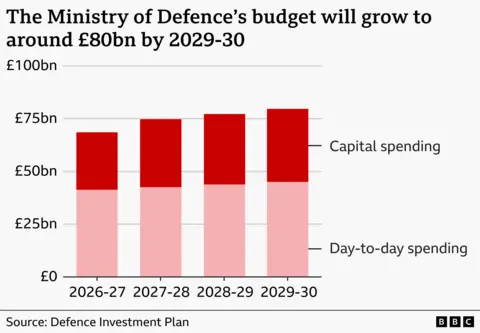
The Ministry of Defence's overall budget for 2026-27 is £68.3bn, according to the Defence Investment Plan.
However there is a measure known as Nato-qualifying defence spending which is wider than the MoD's budget, because it includes state spending on things like military pensions.
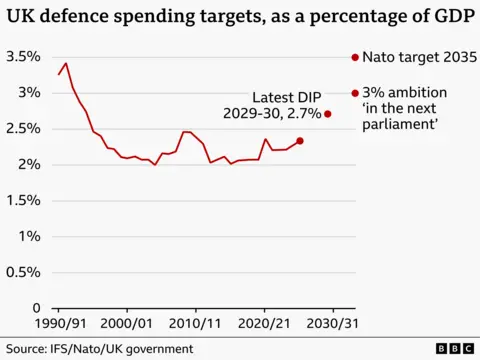
According to this measure the UK's spending was estimated by the military alliance to be £70bn in 2025, equivalent to 2.4% of the UK's GDP in that year.
What has the government committed to spend?
In February 2025 Sir Keir committed to raising Nato-qualifying defence spending to 2.5% of GDP by 2027.
The prime minister also announced that the activities of the UK's security and intelligence agencies would - by 2027 - be classified as Nato-qualifying defence spending. As a result spending would hit 2.6% of GDP by 2027.
The prime minister also stated a "clear ambition" to increase spending to 3% of GDP "in the next parliament".
At a Nato summit in the Hague in June 2025 the UK and other members committed to spend 5% of GDP on defence and security with 3.5% going to Nato-qualifying "core defence" by 2035.
The alliance's members agreed that the rest of the 5% (1.5% of GDP) could be made up of spending to "protect critical infrastructure, defend networks, ensure civil preparedness and resilience, innovate, and strengthen the defence industrial base".
Sir Keir said on Tuesday that the measures in the DIP "takes us to 4.2% under that commitment".
How much extra does the Defence Investment Plan commit to?
When he resigned on 11 June, former Defence Secretary John Healey said that the DIP he had been presented with only committed to take Nato-qualifying defence spending to 2.68% by 2030.
He said this was insufficient "to defend the country at this time of rising threats" and the government should be committing 3% of GDP to defence by 2030 rather than in the next parliament.
The actual DIP says that "based on latest projections" UK defence spending will rise to 2.7% of GDP by 2027-28.
It does not provide a year-by-year estimate for later years but states that the money spent on defence "by the end of the decade will be 2.7% of GDP".
That suggests that the proportion of GDP spent on defence is not planned to change between 2027 and 2030.
That 2.7% figure suggests an increase on the original DIP of around 0.02% of GDP, which the government has found since Healey resigned - that's equivalent in today's money to £600m extra in 2030.
Healey posted on X after the DIP was published on Tuesday that a "target date" was needed to achieve the 3% target and a "clear plan" for how the UK gets to Nato's 3.5% of GDP by 2035.
Will this be enough to hit the government's targets?
Sir Keir Starmer has insisted that as a result of this Defence Investment Plan the UK is on a "trajectory" to achieve the ambition of spending 3% of GDP in the next parliament.
And the DIP states that the separate commitment to Nato of 3.5% of GDP by 2035 "will be met".
However, it is hard to see how reaching 2.7% of GDP by 2030 would put the UK on a trajectory to meet that target.
Future spending reviews could potentially change that picture if they commit more money for the MoD's budget and other defence activity in future years.
What about the other figures being used?
The prime minister has frequently claimed the government is spending £270bn on defence over this parliament which he says is "the biggest sustained increase in defence spending since the 1980s".
This number represents the total cash spending figure for the MoD budget set out in the 2025 Spending Review, covering the four years to 2028-29.
Sir Keir said today that the DIP increases this by "a further £15bn".
So this £15bn figure is an increase in defence spending over four years relative to previous plans.
Reports suggest that the original DIP would have increased spending by £13.5bn over four years.
That suggests that, over four years, the government has found an additional £1.5bn for defence since Healey resigned from Sir Keir's cabinet.
Rachel Reeves said in a statement that of the £15bn, £10.3bn had been identified now, and "a further £4.7bn over four years will be confirmed at Budget 2026".
It has also been widely reported there was a £28bn "shortfall" in the UK's defence budget.
The figure was originally reported by the Times in January.
The paper said the Chief of the Defence Staff, Air Chief Marshal Sir Richard Knighton, had warned Sir Keir at a meeting late last year that the MoD faced a £28bn shortfall over the next four years.
The MoD has said that £28bn number did not come from them and it has not been officially confirmed.
It might represent an internal MoD estimate of the gap between its available budget funding over the next four years and the cost of existing commitments.

