Dig fails to prove world's oldest platform claim

 Friends of the S&DR
Volunteers excavating what is claimed to be the world's oldest railway station platform have admitted they have found "no silver bullet" to prove the boast.
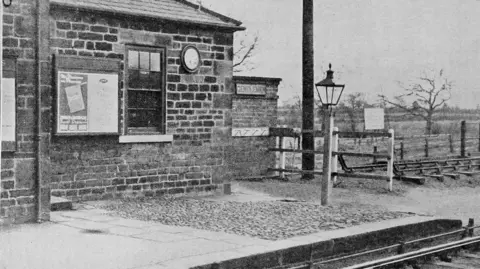
Heighington Station, which dates to back to 1827 and was part of the first passenger railway in the world to use steam trains, was bought by the charity Friends of the Stockton and Darlington Railway (FOSD) last year.
Archaeologists and volunteers have been digging around the station for the past two weeks and volunteer Bethany Cochrane said she had only found "rubble and rubbish" so far but the experience had been valuable.
FOSD chair Niall Hammond said Heighington was in effect the "world's first attempt" at a railway station.
Buildings near railway lines, which were then called inns, had been built before but Heighington was put up directly parallel to the line along with a platform for passengers, Hammond said.

The team found evidence near the line of drops where coal would be deposited from trains, Hammond said, but had been unable to find signs of a nearby building used to store limestone despite maps from the time suggesting its presence.
"That was a bit of a disappointment," he said.
But the team had potentially uncovered one of the station's original steps to the platform during the dig.

Tees Archaeology's Dr Emma Watson, who is leading the dig, said she had put young people in charge of several of the site's trenches to help boost their CVs.
This meant the youngsters would be responsible for all the paperwork involved and the discoveries made.
Cochrane, who recently graduated from Newcastle University with a degree in archaeology, said the responsibility had been "nerve-wracking".
"Archaeology is destruction," she said. "So you need to record every step as you go because then it's gone forever."
Meanwhile Oliver Dunn, 18, from Hartlepool, said he was still "learning the ropes" of being in charge of a trench and would soon be moving to York to study historical archaeology.
"It's a really good experience to get," he said.
Hammond said the team's next steps were to draw up restoration plans for the station and then try to find funding to pay for the works.
Further archaeological digs are also planned.
Follow BBC Tees on X,Facebook, Nextdoor and Instagram and listen to Radio Tees on BBC Sounds.
