Farmer's stone lifting hunt 'honouring the past'

 Calum Stott
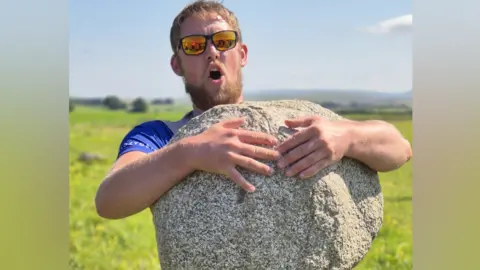
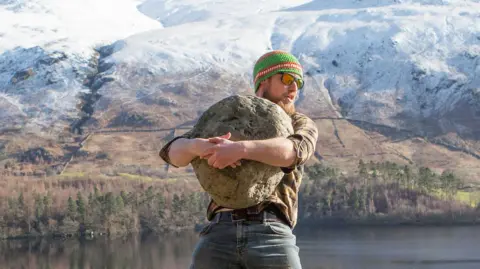
A farmer who found what he believes are five ancient lifting stones has said hunting for them "honours his Cumbrian heritage".
Calum Stott worked with archaeologists and fellow enthusiasts to uncover stones assumed to be used in the traditional practice of stone lifting, with some found in Stone Raise in Cumbria and Denston in Suffolk.
Archaeologist Carley Noga said the practice was a feat of strength in working class people which happened in community spaces, such as churchyards, in late-medieval times.
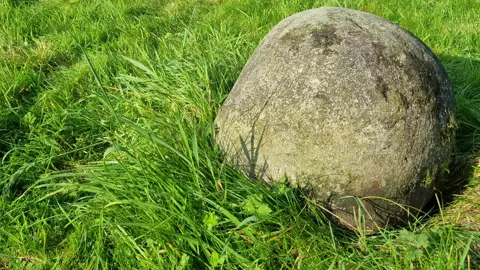
Noga said the five stones were "most probably used in lifting" based on Stott's research involving local knowledge, folklore and how they had a very distinctive size and shape.
"There's so little written about stone lifting but what we know is that it usually happened in churchyards," said Stott, who lives near Tebay.
Many people would come to the parish on a Sunday and young men would challenge each other, he said.
"Some of the stones are written about in the late 1700s to late 1800s, where it is mentioned as a dying tradition."
Noga said because the activity was mostly partaken by working class people, logs would rarely make it into archival records.
 Calum Stott
"They were also known as manhood stones, because they tested strength and marked a transition into adulthood," Noga said.
Stott said it was the "mystery, folklore and research" of it that fascinated him, which included trawling archives and speaking to fellow farmers and women's institutes.
"We found out about one stone near Bristol through a medical journal published in 1900, which reported a man had badly injured himself," Stott said.
The 35-year-old said what could be a "humble unassuming stone" could once have been "the focal point of a whole community... bringing people together, testing strength".
 Calum Stott
The farmer said he had been inspired by fellow lifter David Keohan, who has "spent the past five years unearthing a lost culture in Ireland that was previously unknown".
Stott said he was "instantly hooked" and started researching stones in Cumbria and the Borders.
"My family have always lived here in Cumbria, going back generations," Stott said, adding it was a "great way to honour the past" by "possibly lifting the same stone as his ancestors".
 Calum Stott
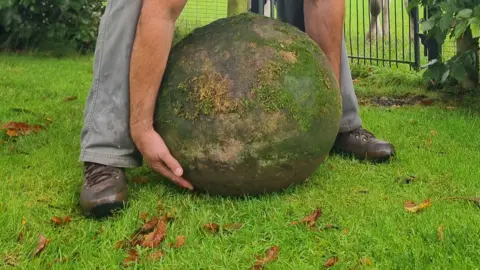
Through the help of a farmer and reading books, Stott also found a stone in Cumbria, which weighed 114kg (17st) and was supposedly used in competitions.
"We understand that the MP for Carlisle Richard Barwise, who died in 1648, was a stone lifter," he said.
"Legend has it he was a huge man, feared by many, who carried this stone in one hand and carried his wife in the other."
Stott said he has identified other stones in Mainstone in Shropshire, Denston in Suffolk, Ellisland in Dumfries and Lonton in County Durham.
Noga, who works at CFA archaeology, said there were key clues such as stones being found in places that had community spaces such as churchyards and pubs for hundreds of years.
Others were placed into "interesting spots that feel deliberate" or sometimes have their weight carved into them, Noga said.
Stott asked people wanting to lift stones to do it supervised with someone of experience and to respect the communities in which they sit.
