Showing my hernia makes me less self-conscious

 BBC
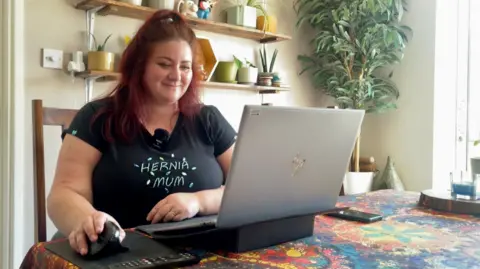
BBCA woman who has a large hernia in her abdomen has said showing it on social media has made her feel "less self-conscious".
Amy Bamford, from Chesterfield in Derbyshire, had five operations for lipoedema - an abnormal build-up of fat in legs and sometimes arms - in June 2022 and during her final surgery, she had a stroke and developed sepsis.
She underwent a further eight abdominal surgeries to remove the infection, but, months later, she noticed a lump developing in her stomach, which was later confirmed to be a hernia.
Amy turned to Facebook and Instagram to seek advice and says she has now developed a network of support for herself and others with hernias, all while boosting her confidence.
"Anybody is susceptible to getting a hernia," she said. "A lot of people are affected physically with the mobility, pain, discomfort, but also mentally.
"It's hard to ignore something that's on your stomach. It impacts how clothes fit you and it's just a big change for your life."
Amy chose to have her lipoedema surgeries in Germany after picking a doctor who was an expert in the condition and had studied it for many years.
After her lipoedema surgeries, Amy spent a further two months in hospital while she recovered from sepsis.
She was pleased by the hospital's response to the complications, but she noticed the lump developing on her stomach about three months later.
The 36-year-old said doctors in the UK confirmed it was a hernia and told her "it's nothing to worry about".
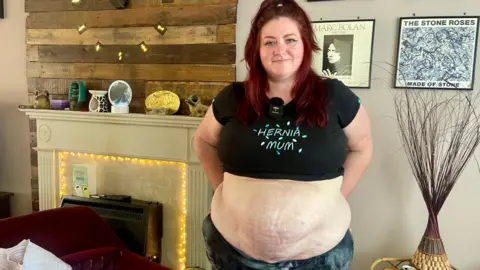
However, by about a year later, Amy said she had developed a "massive" incisional hernia, which, according to the NHS, happens due to a weakness or gap in muscles or "supporting structures of the abdominal wall" in the area where a surgical incision has previously been made.
"It's painful," she said. "When I eat or drink, I can feel everything moving through. There's no protection.
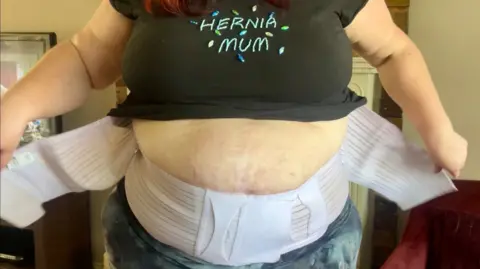
"It's also very heavy, so I have to wear a binder 24 hours a day. It's shifted my centre of gravity, so walking can be difficult and it impacts my hips."
The binder, which wraps twice around Amy's stomach, gives her extra protection and helps ease discomfort.
Amy said: "It's not like a soft, fatty belly that can move. It's just in the way and heavy."
Amy said she had contacted numerous surgeons about her hernia - NHS doctors, private providers and those based abroad - but it was felt removing it would be too risky, given the number of procedures she has already had in that area of her body.
"Ultimately, we decided we're going to stop pursuing it, because if they could do it, it'd be quite a dangerous, open abdominal surgery," she added.
"They'd have to try put everything together, maybe using mesh, I might not react well to mesh, I might get another infection.
"When the doctor was listing everything that could go wrong, we thought 'it's probably safer to stay as we are'."
According to the NHS, hernias can be managed with a binder where surgery is not a safe option.
It was during Amy's search for surgeons that she used social media to seek advice.
"But the main reason I do it now is because there's so many people that have got a hernia, that are kind of ashamed of it," she said.
"They don't know how to look after the hernia, protect it, potentially stop it from getting bigger - so we all meet online and share our advice."
There is another reason why Amy shares her experience online.
She said: "I know it looks weird, but I think it's important for other people to see somebody with a body difference that they've got themselves, because it makes them feel less self-conscious about it."
Listen to BBC Radio Derby on Sounds and follow BBC Derby on Facebook, on X, or on Instagram. Send your story ideas to eastmidsnews@bbc.co.uk or via WhatsApp on 0808 100 2210.
