Mystery find on Galloway beach aids Spanish shark study

 Solway Firth Partnership
A discovery made on a remote Scottish shore is helping marine scientists in southern Europe understand more about an endangered species of deep water shark.
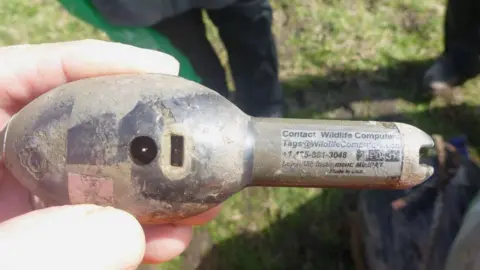
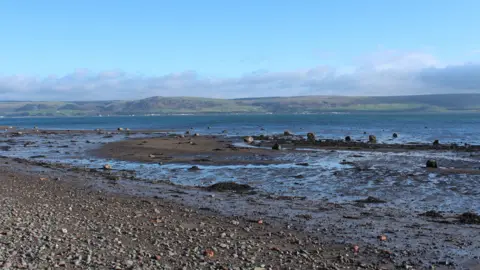
Volunteers taking part in a beach clean on the Rhins of Galloway - the south-west tip of Scotland - found a strange, grey object shaped like a small torpedo with an antenna at one end.
It was later identified as a wildlife tracking tag which had been attached to a leafscale gulper shark about 800 miles (1,300km) to the south - off the coast of Spain - several years earlier.
The equipment has now been returned to researchers who hope to access the data captured to gain a greater insight into the species.
The find was made by members of a local beach cleaning group, ONUS South West Scotland, who used contact details inscribed on the device to trace its origin.
It subsequently emerged that the tag had been manufactured by US company, Wildlife Computers, and was owned by the Spanish Institute of Oceanography (IEO).
Nic Coombey, a project officer for the local conservation charity, Solway Firth Partnership, was part of the litter-picking team.
He said: "It always amazes me how much weird and wonderful debris washes up on our shores.
"Although every item has a story to tell, it's rare to find something that we can trace the journey it has taken. "
 Mike Bolam
The leafscale gulper shark has been described as a little known species that lives in the cold waters of the deep ocean in near darkness.
Marine scientists from the IEO were using satellite tracking technology to further their understanding of its biology and ecology.
The shark at the centre of the study was tagged in Spanish waters in October 2021.
It was migrating north towards the Irish Sea when the tag detached prematurely 130 days later.
 Billy McCrorie
The equipment, which has been returned to the Spanish research team, was a MiniPAT pop-up archival transmitting tag - also known as a PSAT.
It is used to track the movements and behaviour of fish and other marine animals.
The tag collects information on water depth and temperature and light levels and can be programmed to release itself on a preset date.
Once it surfaces, a summary of the data is transmitted back to base via satellite.
If the tag is subsequently recovered the full archive held in its memory can be downloaded.
Christina Rodriguez Cabello, who is part of the research team, said the information from the Galloway beach find could turn out to be useful to their studies.
"Based on the data collected and transmitted, we can estimate the shark's route," she said.
From that, they can find out how far it travelled and the routes it took which can, in turn, improve management and conservation efforts.
