Could giant tuna fishing be set for a comeback?

 Scarborough Maritime Heritage Centre
"For a UK fish they are the most exciting and spectacular you can get by a country mile, no question."
Catching an Atlantic bluefin tuna is often a career highlight for an angler.
Last weekend a commercial vessel's crew caught and landed a 338kg fish off the coast of Whitby, becoming the first to do so in the North Sea for an estimated 60 years.
The following day, they did it again, with the story generating national and international headlines.
After decades away, the species - dubbed the "Rolls Royce of the sea" - is thought to have returned to the Yorkshire coast in recent years.
There are hopes its re-emergence could lead to a renaissance for "tunny" fishing, as it is still known in Scarborough and Whitby.
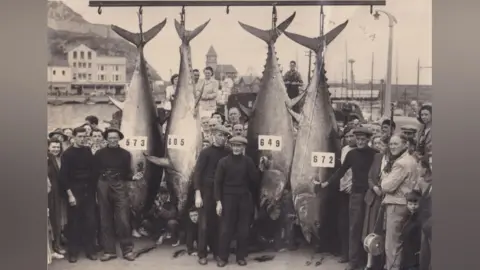
In the 1930s the rich and famous flocked to Scarborough for the chance to catch the prized tunny for sport.
The bluefin tuna, a migratory species, originally arrived in North Sea waters in search of herring to feed on when stocks of the latter were healthy.
Their presence was soon spotted by local fishermen and "word spread", according to Mark Vesey, chair of the Scarborough Maritime Heritage Centre.
"It became big game hunting for some very wealthy gentlemen," says Vesey.
"All these people were well-to-do. Some of them went off hunting fish in the Bahamas or big game in Africa. That was their sport, their hobby.
"It was really about catching it as a sport and having it weighed and being pictured standing next to it."
The catches were incredible and many were recorded by the Scarborough Tunny Club.
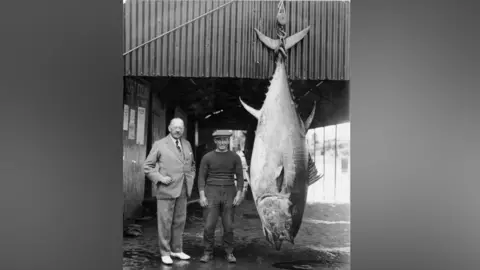
In 1933 Lorenzo Mitchell-Henry, an Irish angler, caught an 386kg (851lb) tunny off the coast of Whitby, which remains a British record for the biggest landed.
 Whitby Museum
"These things are just solid, pure muscle," explains Rupert Drury, who has been fishing for more than half a century.
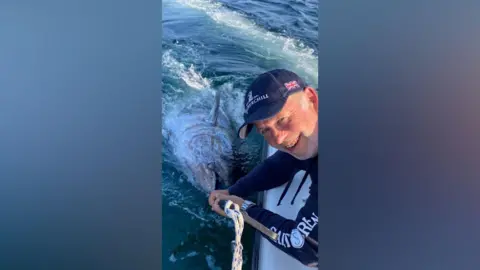
Drury, 60, caught a tunny off the coast of Whitby in 2024, describing the feat as "the pinnacle of my fishing career and all-time best catches".
"You need the adequate strength of gear and adequate strength of character and stamina to be able to pull them in, they are heavyweight things," says the 60-year-old
Drury recalls needing an hour-and-a-half, as well as the support of his crewmate Andy Watson, the pull the fish in.
"The challenge is you are fishing for something that's hard to find, hard to hook, and is incredibly strong," he says.
"It's a physical thing as much as anything, that's why it's called sport fishing."
 Rupert Drury
Unsurprisingly, the anglers who visited Scarborough were proud of their catches and keen to show off their achievements.
The British Tunny Club was established there in 1933 and would play host to members of high society after a day spent fishing.
"The would all meet there and smoke their pipes and display their photos with these great big tunny fish," says Vesey.
"Often the only thing they kept was the tail fin, they would have that stuffed and kept on the wall.
"As far as we know the fish didn't get eaten, sometimes they would give them to farmers to use as fertiliser. The strong flavour of the tunny fish wasn't as popular at the time."
Today, a good quality bluefin tuna is worth thousands and will end up in some of the most exclusive restaurants.
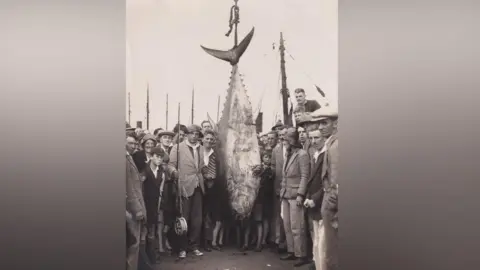
Rather than rushing to place the fish on ice and preserve its quality for eating, they would instead be hung up on the pier for locals and visitors to marvel at.
Today, a statue of a bluefin tuna on a fishing line stands on the town's seafront as a nod to the association with tunny fishing.
"Between the wars it did bring in a lot of money, it was a time when fishing was doing quite well here," says Vesey.
"It was a thing of the moment."
 Scarborough Maritime Heritage Centre
Indeed, the lure of big game fishing attracted famous faces of the time to the Yorkshire coast, according to Whitby Museum's natural history curator Elaine Hoyle.
"It would have put both towns on the map as far as big game fishing was concerned.
"Due to the existence of the Tunny Club in Scarborough, the kind of people who were going there had connections to the town through actor Charles Laughton.
"His relative, Tom, was quite big in the club. These were aristocrats, politicians [and] royalty."
But, as herring stocks began to decline, so too did the number of bluefin tuna.
"By the 1950s there were hardly any catches and the interest was lost as well," says Vesey.
The British Tunny Club is now a fish and chip shop, although memorabilia still adorns its walls.
'A lot to learn'
In recent years climate change has resulted in a warming of the UK's seas and major changes in marine ecosystems.
According to scientists, this provides a potential explanation for the return of bluefin tuna, which have become commonplace in waters off the south west of England.
Those measured in the North Sea are considerably larger and may be genetically distinct, researchers from the University of Exeter believe.
They have begun tagging them to track their movements, with the data used to help manage fishing quota restrictions in the Atlantic and ensure the survival of the species.
Recent catch records in the North Sea would suggest the species is in plentiful supply, with anglers confident of more given the peak season for their migration tends to run well into September.
Strict fishing quotas will also help preserve stock levels here, according to Dr Lucy Hawkes, who is leading the University of Exeter research.
Currently, only a small number of licence holders are allowed to fish for bluefin in order to protect their recovering numbers.
"For a UK fish they are the most exciting and spectacular you can get by, no question," says Drury.
"There's still a lot to learn about the species, particularly in this location. It's definitely exciting."
Listen to highlights from North Yorkshire on BBC Sounds, catch up with the latest episode of Look North.
