Genghis Khan's legacy explored in exhibition

 Royal Armouries
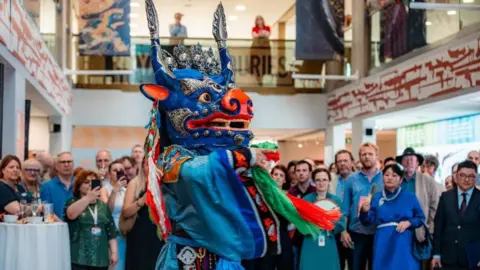
The life and legacy of Mongolian warlord Genghis Khan is being explored in an exhibition in Leeds.
"Genghis Khan: How the Mongols Changed the World" opened at the Royal Armouries on 26 June and runs until November.
It brings 248 rare Mongolian artefacts to the UK for the first time, dating from the 1st to the 14th centuries - and many of the pieces have never left Mongolia before.
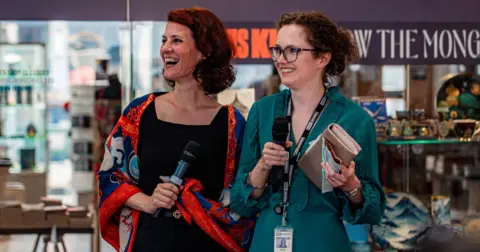
Curator Dr Marie Favereau said: "The Mongolians created new maps, science was very developed, they loved astronomy, they loved art."
She added: "Paintings were important, ceramics. So the idea is to recreate this world that you can now touch."
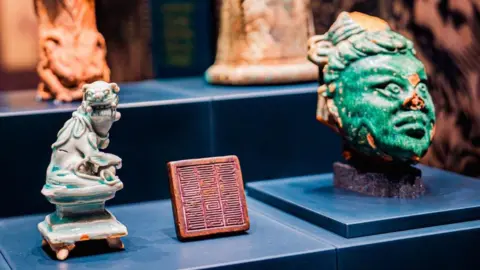
Ongoing archaeology efforts in Mongolia have recently unearthed objects from the 13th and 14th centuries.
These include coins, ceramics, fine textiles and felts, which highlight a rich and varied material culture beyond warfare and mobility.
The French historian added: "For the first time, we have objects coming directly from Mongolia and not from other museums, because they are starting to recreate their own history with objects they found in archaeological excavations."
 Royal Armouries/Nomad Exhibitions
Favereau said one of the most exceptional objects in the exhibition is a deel, which is a robe made from silk.
"It's what men and women actually used to wear to ride horses, to live their life as herders."
She said they needed beautiful clothes because they were a nomadic elite.
"It is really exceptional to, you know, to feel the person almost inside the tunic."
According to the museum, the exhibition offers an "unparalleled insight" into one of history's most influential empires and lessons still relevant to today.
 Royal Armouries
These range from climate change to pandemics, cartography and science.
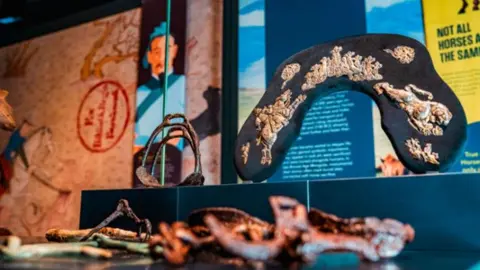
Highlights include ancient saddles, ceramics, inscribed coins and the largest spearhead found in Mongolia.
The exhibition also features the stories of those living under Mongol rule, including Genghis Khan's daughter, Alakai Beki, revealing the significant and surprising power wielded by women in the Mongol Empire.
It reveals how a nomadic people created a network of exchange and production on a previously unseen scale, connecting regions from China to the Middle East, Africa and Europe - ultimately transforming the course of global history.
 Royal Armouries
Director General and Master of the Royal Armouries, Nat Edwards, said: "Cutting across ethnic, cultural and religious distinctions, Genghis Khan forged a new political and military force, the like of which had never before been seen.
"In a moment of vision and commitment, history changed and the balance of power began to shift.
He said: "Today, the epic story of the Mongol Empire, brought into life through these amazing treasures, feels like something to which we should all pay attention and it's an honour to bring this exhibition to the Royal Armouries."
The exhibition is produced by Nomad Exhibitions in association with Nantes History Museum and in partnership with the Chinggis Khaan National Museum.
Listen to highlights from West Yorkshire on BBC Sounds, catch up with the latest episode of Look North.
