The prisoners whose listening saves lives in jail

 Getty Images
In 2015, David decided he wanted to go back to prison. Aged 46, he was homeless, his family relationships had shattered, and he'd hit rock bottom.
First arrested when he was 10, expelled from school at 14, and given his first custodial sentence when he was 15, David had been in and out of jail his whole life.
"I knew I couldn't carry on living the life I was leading. I thought the only thing I can do is go back to prison and sort myself out, and swore after that I'd never go back to prison again."
Working out he needed a five-year sentence, which would give him two and a half years inside, he committed an armed robbery and said he got caught on purpose.
"I was a criminal, but I wasn't a bad person. I just couldn't cope in society. On the outside, I just felt like I was in this bubble of chaos all the time, and I needed to remove myself from that."
Jay - not his real name - was the opposite. He had never been in trouble before when, aged 34, he was convicted of fraud and handed a 30 month prison sentence.
"It was like landing on Mars, it felt like arriving in an alien environment. I just shut down, I spiralled completely.
"I refused to come out my cell, I wouldn't eat, I wouldn't engage with anyone, I wasn't maintaining contact with my family, I just stayed on the top bunk alone with my thoughts."
'Listeners saved my life'
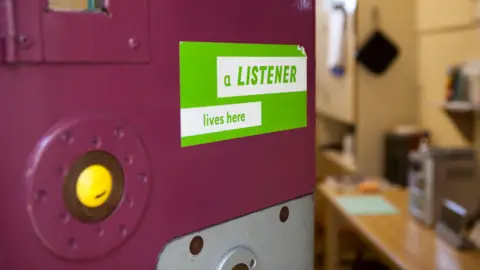
Across London's eight prisons there are currently 115 Listener volunteers - prisoners trained by the Samaritans to provide emotional, and often life-saving support.
The Samaritans' Listener Scheme is funded by the government and operates within prisons nationwide.
Jay said they "probably saved" him.
"Without their help, I'm not sure what would have happened to me. You hear about people in prison taking their own lives. I'd like to think I wouldn't have gone down that route, but I was in a really, really bad way."
Jay later signed up to be a Listener himself, becoming one of a team of ten in HMP Isis in south-east London, trusted to have free movement around the prison, working around the clock to help those in crisis.
'I was so angry'
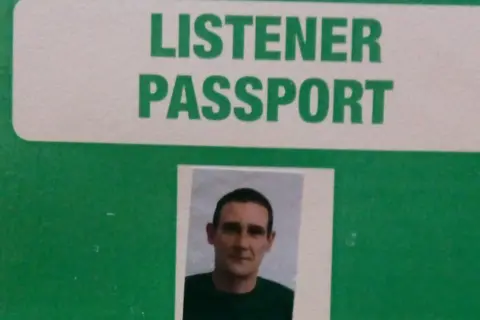
David appeared to thrive in prison. While serving a 30 month sentence in 2005, he trained to become a Listener.
"I started becoming a better person in prison through the roles I was doing like the Listeners. I started looking at things from a different perspective. It deepened my understanding and it also deepened my empathy for people around me."
The prevalence of suicide within prison took its toll on David.
HMP Norwich reported three suicides in the space of six weeks in 2008. David had been working with two of the men who died.
"I was mainly angry, I wanted there to be a public inquiry. I gave evidence at their inquests. It weighed on me massively."
This coincided with David losing his reception job on the wing, resulting in him being confined to his cell for 23 hours a day.
"It all piled on top of me and I made an attempt on my own life. If it wasn't for my neighbour, who was coincidentally also a Listener, I don't think I'd be here today."
 David Breakspear
Jay, as a Listener, was exposed to some of his fellow prisoners' darkest moments.
"Many people who were really genuinely struggling, people like me on their first time in prison, and other seasoned inmates who had been in and out."
Jay's final week in prison coincided with the announcement of the Covid lockdown.
The four listeners working across the 680-prisoner site were the only people allowed to leave their cells.
"I didn't get any sleep, we were going from one prisoner to another to another, working around the clock. People were so anxious. It was really awful.
"Nobody was allowed out of their cell for three whole days, they wouldn't let you shower, no one could get any fresh air. No-one could use the phone to contact their family."
Last year, 79 people died by suicide in prison custody in England and Wales.
It's a fall from the 90 self-inflicted deaths recorded in 2024, but Jodie Anderson from Inquest - a charity which supports families bereaved by a death in prison - warned against optimism.
"The rate of suicide in prison is still alarmingly high, of course a reduction is good, but it's no consolation to any of the bereaved families of the people that died."
Anderson described the Listener scheme as a "low cost substitute for professional psychological care".
"What can a Listener do, but listen? If I'm saying to you I'm actively suicidal, not only is that incredibly triggering and traumatising for prisoners, it's unacceptable that prisoners are being used to plug the gap in mental health services."
But John Simpson, from the Samaritans, was adamant Listeners were not there to replace professional help, but to supplement it.
"There are very few people in an incredibly overstretched prison environment who have the time to sit down for an hour, listening to somebody talk about their emotional struggles. Listeners have that time."
Now on the outside, Jay works for a charity which supports inmates and their families.
He said that, as prisoners themselves, Listeners are able to reach people nobody else can.
"A lot of people don't feel comfortable speaking to mental health professionals because they think there will be a marker against them. Or they see them as part of the establishment. Some people in prison have a real issue with authority."
He says although mental health care in prison desperately needs funding, it is constantly at the sharp end of cost-cutting measures.
"Prisons and the criminal justice system are where you can make cuts - people on the street don't really care about the guy inside unless they have personal experience."
Defending the current system, a Ministry of Justice spokesperson said prisons had "robust systems" in place to support prisoners at risk of harm, with trained staff and healthcare professionals playing a central role.
They added they were proud to partner with the Listener scheme.
 David Breakspear
David's work as a Listener in prison gave him purpose, a better understanding of himself, and a sense of validation.
"I realised what I needed to do was leave the person I was in society in prison, and bring the person I was in prison out with me."
He was released in 2017 and slowly built an impressive professional CV.
He's spoken about prison reform in the Houses of Parliament, mentors teenagers with ADHD on the brink of criminality, and is a Lived Experience Influencer with the National Suicide Prevention Alliance.
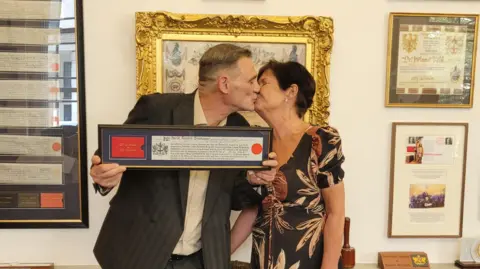
Last year, David was given the Freedom of the City of London Award for his suicide prevention work in the capital.
"For me, it's an incredible achievement. Thankfully, you're not allowed to take photos while the ceremony is taking place, because I started sobbing."
Celebrating his sister's 70th birthday last month, for the first time David felt like his family were proud of him.
"I had things to talk about - it wasn't about my latest burglary or relationship breakdown, it was about my awards and my Master's in applied forensic psychology.
"I wanted a better life, but there's no way on this planet that I could have dreamed it would be like this."
Listen to the best of BBC Radio London on Sounds and follow BBC London on Facebook, X and Instagram. Send your story ideas to hello.bbclondon@bbc.co.uk
