East Midlands Railway cancellations - is it really just the hot weather?

 Getty Images
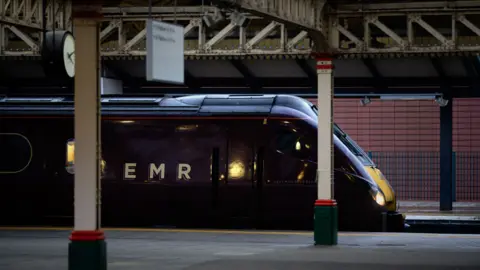
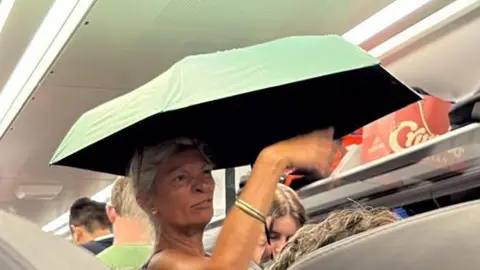
Numerous trains have been cancelled and services disrupted over the past two weeks amid soaring temperatures across the country.
East Midlands Railway (EMR) was among several operators that announced major timetable changes due to the expected hot weather.
Despite a drop in temperatures this week, the rail disruption for passengers in the region has continued, with timetable changes affecting trains to and from London.
According to experts, the heat would not have been the only factor EMR would have considered, citing other issues like an ongoing shortage of stock and "teething problems" with new trains.
So what is going on?
How have services been affected?
EMR, operated by Transport UK, announced last week that timetable changes would be implemented across some services from 8 July.
The operator also cancelled some services the day before, telling customers several trains required repairs due to "heat-related issues".
For the rest of the week, EMR reduced services with regional services between Nottingham and Worksop, and between Nottingham and Leicester, suspended from 12:00 BST and passengers advised not to travel from midday onwards.
Intercity services - which operate to and from London St Pancras, providing services to areas including Leicester, Nottingham, Lincoln, Derby and Sheffield - were also cancelled throughout the day.
In addition, the operator warned services could be "removed" at short notice and some could run at lower speeds.
EMR had said regional timetables would return on Tuesday but added it would continue to operate a reduced Intercity timetable until Friday "due to the ongoing impact of hot weather".
What has East Midlands Railway said?
 Guida Simoes/Getty Images
EMR said its temporarily amended timetable was "designed to protect the wider railway".
"Periods of high temperatures create significant operational challenges across the UK, affecting both infrastructure and train operations," said a spokesperson.
"Our priority is always the safety of our customers and colleagues, which is why we introduce temporary timetable changes where necessary to help keep the railway operating as safely and reliably as possible.
"The reduction helps us maintain greater resilience across the wider network and allows us to respond more effectively if circumstances change during the day.
"We recognise these reductions are frustrating and apologise for the inconvenience. The decisions we take reflect the conditions on our part of the network and may differ from those made elsewhere, as different operators run different routes, infrastructure and train fleets.
"We would like to thank our customers for their continued patience and understanding. Customers should check their journey before travelling, as services may be subject to short notice alteration."
How does hot weather impact rail infrastructure?
 Nigel Harris/Getty Images
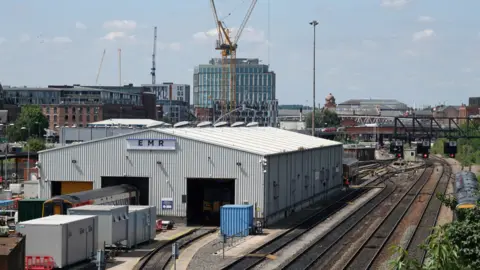
Tony Miles, a railways expert and journalist, said in the hot weather, railway track was at risk of "expanding and buckling".
He said: "The problem with the super hot nights is that the track doesn't cool down back to its base temperature again overnight.
"So you're picking up the next day and already it's a really warm track, and this really long period of high temperature means that the tracks are retaining quite a lot of heat into the following days."
Miles added when rail infrastructure was impacted by the weather, Network Rail - which manages most of the railway network in Britain - could tell operators that services have to run at reduced speeds.
The BBC asked Network Rail if it had instructed EMR to amend services due to the heat, but the company did not confirm.
A spokesperson for Network Rail said: "To protect the safety of passengers, colleagues and the railway, temporary measures such as revised timetables may need to be introduced.
"We understand that this can result in longer journey times and changes to services, and we would like to thank passengers for their patience."
Were other operators affected by the hot weather?
Miles said rail services across the country had been affected by the heatwave.
Operators Transport for Wales, Northern Rail and Great Western Railway all announced changes to timetables, with weather-related disruption continuing this week.
"It's a very complicated jigsaw, but the long continuous period [of hot weather] is certainly having an impact on the infrastructure and it is happening all over the country," Miles said.
He added he believed EMR was publicising changes to timetables more than other operators and was also a "victim" of having a number of routes that were "very, very rural routes" with older infrastructure, which led to additional challenges.
Is it just the heat affecting EMR services?
 Supplied
According to the passenger advocacy group Railfuture, no.
Steve Jones, the secretary for the East Midlands branch, said Railfuture was seeing "quite a lot of cancellations" even before the hot spell.
"There are a whole range of reasons for that, boiling down primarily to train reliability," he said.
According to Jones, while there was "no doubt" the hot weather exacerbated problems with trains, services were already struggling.
"The principal reason for cancellation of trains on the Intercity route is simply a shortage of rolling stock. They haven't got enough rolling stock," he said.
Jones said the new Aurora trains should have been in service by now, and said while some were running, others were still being delivered.
Additionally, some of the older trains had "already been transferred away", he said, adding: "Some of them have already gone, but we haven't got enough of the new ones to replace them.
"Hence the shortage of trains, also exacerbated by the older trains, because there are fewer of them - they're being worked hard by EMR. The new trains are proving, or have been proving unreliable in service.
"They have been breaking down mid-journey and there have been faults to do with things like toilets and doors and maybe other things as well."
He added "teething problems" were inevitable.
A spokesperson for Hitachi, the supplier and manufacturer of the Aurora trains, said: "The Class 810 fleet has been in passenger service with East Midlands Railway since December 2025 and more than a third of the fleet has now been delivered.
"Hitachi Rail continues to work closely with all industry partners during the entry-into-service phase of the Class 810 fleet, implementing improvements and supporting the transition from the existing fleet to new Aurora trains."
They added the firm was investing in additional testing at its Long Marston Rail Innovation Centre to improve fleet introduction.
A Department for Transport spokesperson said: "Delays from the manufacturer have affected the rollout of new trains on this route, creating unacceptable disruption for some passengers.
"We've asked East Midlands Railway to do everything possible to minimise the impact while this is resolved to give passengers a more reliable service.
"Under Great British Railways we're bringing together track and train, running the network as one joined-up system to ensure these kinds of decisions are better planned across the network."
How does all the disruption affect passengers?
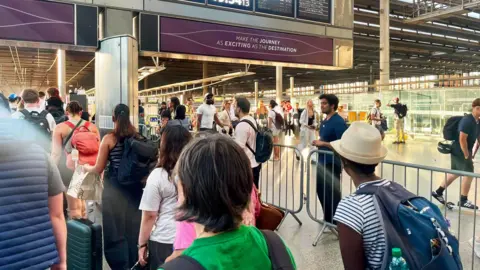
For passengers, the impact of cancelled services can be "severe", Jones said.
While for some people the timetable changes can be a "nuisance", he said, for others they could be "critical", affecting medical appointments, jobs and other things.
Jones added: "There's no doubt that certain train fares, especially things like annual season tickets, are very expensive.
"It costs an awful lot of money, and people quite rightly expect to have a decent service in return for that."
Cancelling services from midday during the heatwave rendered the train services "pretty much useless" to some people, particularly commuters, during the most recent heatwave, Jones said.
He added thinning out services but keeping them running would be more helpful to passengers, while cancelling an entire services from midday "seemed a bit of an extreme step".
Is there still disruption from the Bedford crash?
 EPA
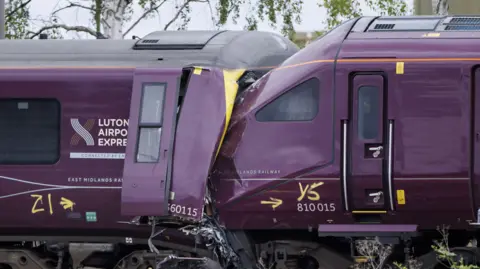
EPAJones said it was important to bear in mind the ongoing impact of the recent fatal train crash in Bedford.
EMR mainline driver Shaun Burton, 60, died and 162 people were injured when a London-bound service crashed into the back of another on 19 June.
"The shock of that will, of course, will be enormous for all the people involved," Jones said.
An investigation into the collision by the Rail Accident Investigation Branch (RAIB) is ongoing.
In an interim report, the RAIB said it found the stationary train had come to a stop "unexpectedly" because of a fault with its automatic warning system (AWS) equipment, prior to the collision.
Jones said: "That will have caused an awful lot of problems for EMR, not least that it's taken two trains out of service for a time, and of course, the driver was tragically killed.
"EMR will be very busy dealing with the aftermath of that."
However, he added "a bit more transparency" around a recovery plan and the issues the operator was facing would be helpful for passengers.
"We need the train service.
"It's vitally important to the region, to the economy and the region.
"And, you know, of course there are problems, stuff happens. A bit more transparency, I think, wouldn't go amiss," he said.
Listen to BBC Radio Nottingham on Sounds and follow BBC Nottingham on Facebook, on X, or on Instagram. Send your story ideas to eastmidsnews@bbc.co.uk or via WhatsApp on 0808 100 2210.
