'We cried together': Trump's deportation drive forces tough decisions for couples

 Submitted by Janie Pérez
Janie Pérez found it strange that her husband called her just a few minutes after leaving the house on his way to work.
When she picked up the phone, she learned why.
"I think ICE is here," her husband, Alejandro Pérez, said, referring to agents from the US Immigration and Customs Enforcement agency.
"We started praying," Janie recalls, while in the background she heard the immigration agents arresting him.
At that moment, Janie - whose maiden name is Hughes - understood her life would change forever. But she did not imagine she would end up living in Mexico with her husband and their two young daughters.
The American woman, who does not speak Spanish, admits it's been difficult to start from scratch in an unfamiliar country. She does not regret the move, however. "There is nothing more important than being together."
These are the kinds of decisions being faced by families of mixed immigration status (one US citizen spouse and the other undocumented spouse), following an increase in detentions and deportations of illegal immigrants in the US since President Donald Trump began his second term in January 2025.
Official estimates suggest 1.1 million US citizens are married to an undocumented person.
- Read this story in Spanish - "El sueño mexicano": las mujeres estadounidenses que se mudan a México para vivir con sus maridos deportados
Despite the marital bond, undocumented foreign nationals have difficulties in obtaining permanent residence – or a green card – through marriage, because once they have entered the country unlawfully, they may be barred from obtaining legal status.
Since returning to office, Trump has made good on his campaign promise to crack down on illegal immigration, which he has described as an "invasion".
But for couples like Alejandro and Janie Pérez, the choice between separation and leaving America is fraught.
'I had tears of happiness when I saw him again'
Speaking to BBC Mundo from the Mexican state of Querétaro, Janie recalls that fateful morning last October when her husband was taken away from her and their two young daughters, Luna and Lexie.
"I fell to the ground on my knees crying uncontrollably," says the 29-year-old.
As he was undocumented, both of them knew that the most likely scenario was deportation to Mexico. And that is what happened.
The idea of separating her family, Janie says, was "simply inconceivable", even if she had to leave behind her life in Missouri and start a new life in a country completely unknown to her.
Religion has been a fundamental part of their relationship since they met in 2019, when they worked at the same café, he as a cook and she as a waitress.
"He was also a man of faith and that was something very important to me," Janie says.
 Submitted by Janie Pérez
When they eventually decided to get married, they consulted a lawyer to try to get him legal status, but their efforts were unsuccessful.
Although they knew he could be arrested, they tried to go on with their lives as normally as possible.
Until everything collapsed when he was detained by ICE agents.
From then on, Janie says, it was clear that her husband's next stop would be Mexico.
While they were waiting for the judge's decision, Janie went to see her husband at the detention centre.
"As we couldn't touch each other, we put our hands facing each other separated by a pane of glass," she says. "And we cried together."
She also had the opportunity to see him from a distance at each of the court hearings, shackled at the feet and hands, with chains around his waist.
"It was heart-wrenching to see him like that," she says.
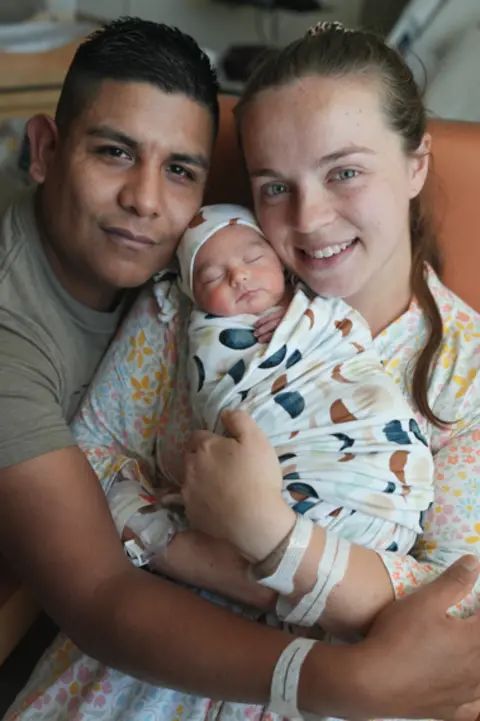 Submitted by Janie Pérez
Alejandro was born in the Mexican State of Michoacán and entered the United States without a visa for the first time with his father, when he was just seven years old.
They soon returned to Mexico, but a few years later, Alejandro decided to try his luck in the US again.
He says he returned to the US unlawfully because he was afraid of being forcibly recruited by criminal organisations in that region - a common fate for other young men around his age.
In total, he lived around 16 years as an undocumented migrant in the US.
The Department of Homeland Security (DHS) says its priority is to remove "the worst of the worst illegal aliens with criminal records".
But many of those deported who entered the US without authorisation have clean records, the department's own data shows. Recent DHS data says that under 38% of deportees have been charged or convicted of a crime.
"Although he crossed without authorisation, I think he made a morally correct decision when he travelled to the US," his wife argues.
"He was seeking opportunities and a life away from criminal organisations. All these years he has devoted himself to working and he has no criminal record. That makes me think that many people want this to be a country only for white people. I am white and that does not make me a better person."
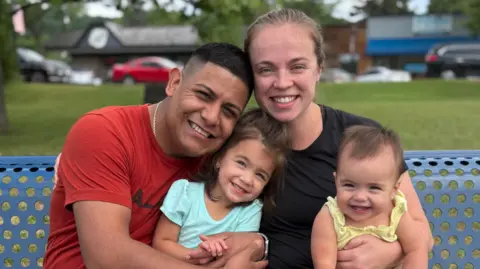 Submitted by Janie Pérez
After his arrest by ICE agents, he spent about five months in a detention centre, before being deported to Mexico on 11 March.
A few days later, Janie moved to Mexico with her two daughters.
"I had tears of happiness when I saw him again at the airport," she says.
Alejandro says that when he saw his three-year-old daughter, Luna, come up to hug him in the airport, he felt profound emotion. "It can't be explained in words."
But that happiness has been accompanied by hard moments and difficulties to adapt to a new life in a country that, at times, feels alien to him. Alejandro says he wakes up in the middle of the night, looks around and asks himself: Is all this really happening?
"So far I feel like all this is a dream, but I believe in God and I know he did this for a purpose."
Volunteering to leave
 Submitted by Raegan Klein
Although it's still early days for Alejandro and Janie, another couple of mixed US immigration status says that returning to Mexico has proved challenging.
Raegan Klein and Alfredo Linares chose to move voluntarily to the other side of the border to avoid the risk of deportation.
"If something happened to him, I would never forgive myself," says Raegan, who now lives in Puerto Vallarta, Mexico.
Alfredo, who entered the United States without authorisation at the age of 17 and remained in the country for more than two decades, built a career that led him to become a chef at a fine-dining restaurant.
He and his wife had just opened their own Japanese-style barbecue business when immigration deportations began ramping up.
Raegan feared that ICE agents would detain her husband and convinced him to move voluntarily to Mexico.
"I was the instigator," she says.
For Alfredo, leaving the US - a country that had become his home - was very difficult.
"Today is my last day here in the United States. After 20 years, it's time to leave," he said in a social media post through tears.
They say their first year living in Mexico has been very challenging.
Although Alfredo is Mexican, he feels like a foreigner in the country he left behind when he was a teenager.
 Submitted by Raegan Klein
Many times they have regretted the decision they made because they have not managed to generate a permanent source of income, although Raegan still remains convinced that leaving was necessary.
Alfredo says that despite working as an independent chef, offering dinners for small groups, it is not enough. And Raegan, who does not speak Spanish, has had problems finding any remote work.
Despite the difficulties, they have a very clear goal: to open a restaurant in Puerto Vallarta, a popular tourist destination for many Americans and Europeans.
What they lack, however, is the initial investment.
Securing financing is the start of what could be called "the Mexican dream" for this couple, because the other one, "the American dream", is already behind them.
