The indoor climbing wall where legends honed their craft

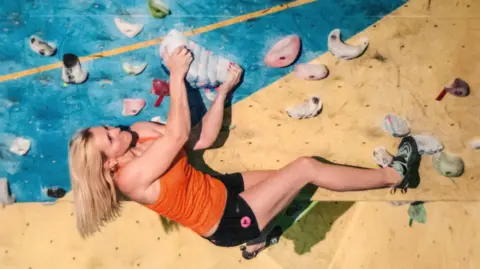 Kendal Wall
You should only tackle perilous routes like the north wall of Gogarth sea cliff in North Wales when you are over 74, says rock climber Rob Matheson.
This, the 75-year-old jokes, is because, by then, "you've had a good life, so it doesn't matter what happens".
Matheson first got to grips with the sport in 1957 and has since put up a long list of some of the Lake District's hardest first ascents, meaning he was the first to identify, create and climb those routes up rock faces.
His experience is strikingly different from the majority of beginner climbers today, who use indoor walls to learn the basics. And yet, at an indoor wall in Kendal in Cumbria, you can find masters and amateurs alike - and everything in between.
Indoor centres offer regulated safety equipment, soft matting and coloured plastic grips to hold on to, attached across the walls. Some big, some small, different shapes and some harder to reach than others, they are a route-choosing puzzle that caters for all abilities.
Kendal Wall, perched on the edge of the Lake District, opened 30 years ago and has nurtured new climbers and enabled the more experienced to train for some of the hardest routes in the UK.
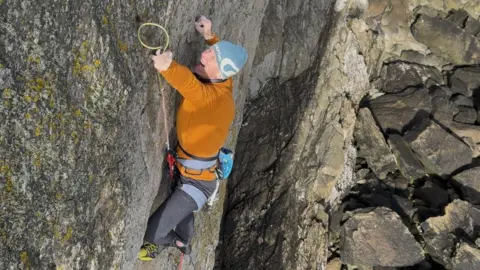 Rob Matheson
At the time, Stella Adams, and her husband Jonny, both 79, would host fellow climbers travelling up to the Lakes at their home in Kendal.
"Climbing walls were few and far between back then," she said.
"To have a facility like that coming to Kendal was very exciting because our nearest one before that was Preston or Altrincham."
Adams was one of the wall's first route-setters, meaning she devised the layout of linked climbing holds.
"It was good fun - it's up to the setter to make the routes flow properly and enjoyable," she said.
"We stopped route-setting in our mid-60s but we're still climbing of course."
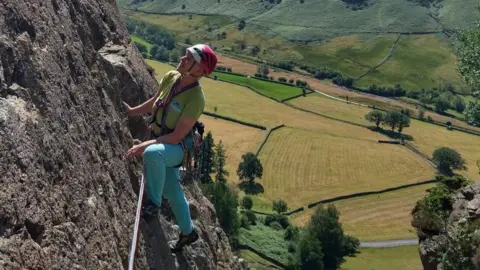 Stella Adams
Cumbrian adventure climber Leo Houlding said he helped build the wall "straight out of school aged 16".
Some "climbing legends" mucked in with the construction of it too.
"My dad was on the job too - it was really exciting working with them on the building site," the 45-year-old said.
Since moving to the village of Staveley, his two children have learned to climb at the wall and have gone on, with him, to scale El Capitan in Yosemite National Park, California.
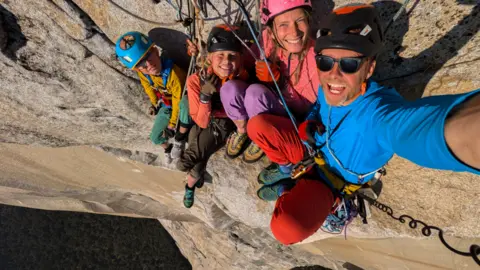 Leo Houlding
One of the wall's founders, Jeremy Wilson, said his involvement in its making was "entirely serendipitous".
He said he stumbled on the idea of setting one up after bumping into two friends at a wedding, where he heard about this former creamery building which had become available but "needed a lot of finance".
However the project almost "ended in early disaster" when he tried out its newest wall - the highest in England at that time - and fell.
"I was being belayed by one of Britain's top mountaineers at the time, the late Brendan Murphy, who I trusted intimately but we were using a 45m rope," he said.
He was being lowered when the end of the rope "ran right through the belay plate and I fell the last 15ft (4m), landing smack on my bottom".
"I thought I had broken my back and couldn't walk properly for weeks".
 Kendal Wall
Adams said the climbing wall scene in the 1990s was "very small", consisting of regular local climbers and clubs.
Since Kendal Wall opened, she had seen more young women "getting out there and supporting each other".
"It has been phenomenal to see our community grow," she said.
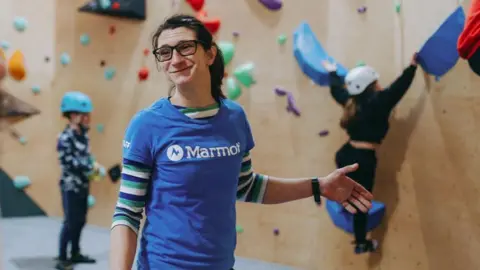
It is a sentiment echoed by Mel Adam, who runs women's technique workshops at the venue.
"Walls were a bit male-dominated" when she first started climbing several years ago, she said.
"From what I've seen, many beginner women climbers have a lot of self doubt," the 41-year-old said.
"They feel out of their depth so it's about throwing them a float and giving them a way to be independent."
Adam said numbers just "keep on growing" with mothers returning to climbing, entry-level beginners and those looking for new climbing partners.
 Kendal Wall
Matheson said he too had seen a big shift in more women coming to climbing walls in recent years.
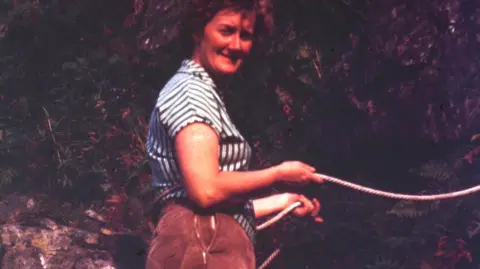
"When I was climbing with my parents in the 1960s, my mum Rena was pretty much the only female on the crag," he said.
How the walls are used has also changed, he said, with so many "young 'uns leaping about and putting us to shame".
Climbers now used walls "instead of training at the gym or socialising at the pub" whereas, in the early days, walls in Ingleton and Kendal were mostly used for training on bad weather days.
"It was also a place to make plans for the high cliffs of the Lakes," he said.
 Rob Matheson
Professional climber Neil Gresham said, growing up, he found some of the wall's cohort were an inspiration to him.
"I used to read about these legends in magazines and it's a marvel to be able to see them at the wall," he said.
Gresham too has been responsible for laying out some of the hardest routes in UK climbing, one being the first ascent of a climb called Lexicon at Pavey Ark in the Lake District in 2021.
Under the British grading system, the route is E11 7a - the E standing for "extremely severe", the "11" suggesting a very high level of difficulty and potential for fatality, and "7a" referring to technical complexity.
But the 54-year-old's career keeps connecting back to the wall, he said, and his time living in the town and working as a climbing coach had been "a huge part of his life".
"I had a renaissance period here by doing some of my best routes and I used Kendal Wall as my training base for them," he said.
"You can see 12-year-old kids climbing with 70-year-old adults.
"There are no boundaries in climbing."
 Ben Mitchell
As the wall enters its 30th year, Wilson said older venues could "struggle financially such that they cannot refresh their centres and keep them clean and shiny".
He pointed to an "overbuild of indoor walls" as climbing has become more mainstream.
But, he said, Kendal's offering to the community was something more than just a place to climb. It was a hub linking veteran Lake District climbing legends to each other and to a new generation.
 Kendal Wall