Londoners reflect on Brexit 10 years on from referendum

 Getty Images
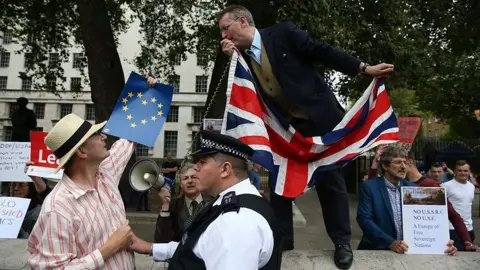
London is a city that did not follow the national trend a decade ago when the UK voted to leave the European Union.
But even in majority-Remain London where 59.9% of Londoners voted to stay in the EU, there was divided opinion, with five of London's 33 local authority areas backing the Leave campaign.
A decade on, I have been back to the two London boroughs which respectively had the highest Remain and Leave votes - Lambeth and Havering - to get a sense of how some people there are feeling now.
'Tumultuous times'
Ten years ago 78.6% of voters in Lambeth in south London voted to remain in the EU.
At Brixton market on Electric Avenue, I met Tony Jones from Brixton who did not vote in 2016.
He told me that "everything" had got worse for traders on the market since Brexit.
"Britain depends on food coming from outside, now everything's gone up," he said.
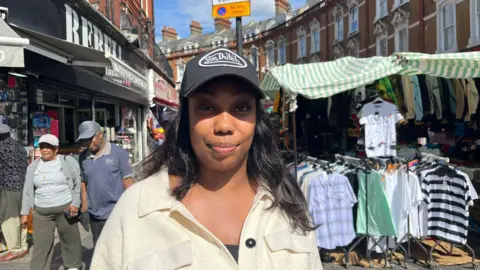
His view was echoed by another local, Vilma Oketta, who was a teenager when Brexit happened.
She said: "Food is expensive but we just get on with it. I'm sure things will go back to normal at some point, I'm hoping."
But she said she was not sure if that was down to Brexit or not, because a lot had happened in the past decade, like the Covid pandemic and international conflicts.
Jacob Chabeaux, who lives in Camberwell, voted to remain in the EU.
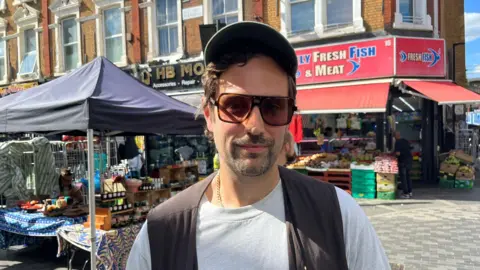
He said he never thought Brexit would happen in the first place, but said it was now "hard to pinpoint if the changes in society [were] directly related to the fallout from Brexit".
He added: "We live in tumultuous times."
Brexit 'curtailed London's potential'
New analysis from the Greater London Authority this week suggests that Brexit has "curtailed London's potential" to create jobs, boost productivity and raise living standards, but it also states that the outcomes we have seen since 2016 "can't be solely attributed to Brexit".
Sir Sadiq Khan - who became London's mayor just weeks before the EU referendum happened, and campaigned for the Remain vote - is now calling on the next Labour leader to make a manifesto pledge to rejoin the EU.
He has not changed his mind on where he thinks blame lies.
"The Brexiteers claimed those of us campaigning to remain were responsible for Project Fear," he said.
"In fact the consequences 10 years on are worse than we feared. Research shows the size of London's economy is £30bn smaller than it otherwise would be. The average Londoner is £3,400 less well off. We've seen less investment, less trade as a consequence of Brexit."
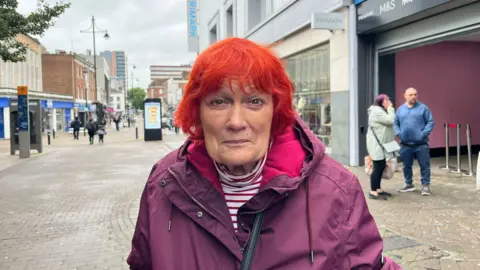
Havering in east London was one of the five London boroughs, along with Barking and Dagenham, Bexley, Sutton and Hillingdon that voted to exit the EU back in 2016.
Of those, Havering had the highest leave vote with 69.7% of local people there voting to be out of the EU.
In Romford town centre I asked shoppers whether leaving the EU had made a difference.
Mina Blaauw, who lives in Upminster and voted for Brexit, told me she was disappointed with how politicians had approached its delivery.
She said it had not made "enough difference" as people had not "done it properly".
She added: "They never intended to do it properly - and they haven't."
Mina told me she had hoped 10 years ago that leaving the EU would lead to "less delay with public services... we might have less rules to follow, there wouldn't be so many regulations.. [but] all those things didn't happen".
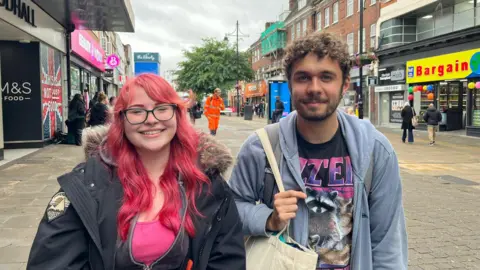
Rhys Underwood was nine years old when the EU referendum was held. He told me he did not think the outcome was "the best move" for the economy.
He said: "Obviously there was Covid and all that, but even taking that out of the equation, I think inflation, the rates of stuff in shops... it shot up quite a bit because of Brexit."
According to Bank of England data, UK economy has taken a 6% hit from the effects of Brexit.
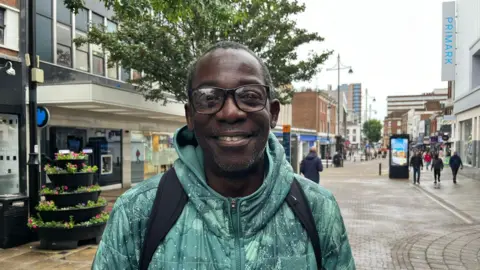
Adrian Orlando-Nurse, who supported leaving the EU, told me he still thinks Brexit was "a good idea" but said change had not come quickly enough on issues like immigration.
"You still see people still complaining about immigration stuff," he said. "I think there is a problem. There is a serious immigration problem."
He added: "They have not really delivered what they promised."
Latest figures from the Office for National Statistics (ONS) show that UK net migration has dropped to the lowest level, outside of the Covid pandemic, since 2012.
'City hasn't collapsed'
Andrew Rosindell was in Havering on the day the referendum votes were counted.
The Romford MP, who defected to Reform UK from the Conservatives earlier this year, told me he still thinks Brexit was the right choice.
"It's incredible to think that in a country like United Kingdom, which has based its entire history on global trade, gave away its ability to make its own trade arrangements with the rest of the world," he said.
"We had to rely on Brussels to do it on our behalf so Havering and London is a global trading centre and that's why all the predictions that the remainers came up with 10 years ago were all wrong. Look at the City of London, that hasn't collapsed."
A decade on, and counting, there continues to be no let up in the arguments on both sides.
Listen to the best of BBC Radio London on Sounds and follow BBC London on Facebook, X and Instagram. Send your story ideas to hello.bbclondon@bbc.co.uk
