A summer of queues and chaos for UK-bound flights

 BBC
BBCWe may have thought the days of airport stress were winding down with the introduction of e-passport scanning and no more liquid bags, but this was certainly not the case for a lot of Londoners and Brits alike this summer.
I was one of those on Tuesday. Despite giving myself what I thought was a generous two-hour cushion before my flight to Stansted, I missed it. Or, as I prefer to put it, it missed me.
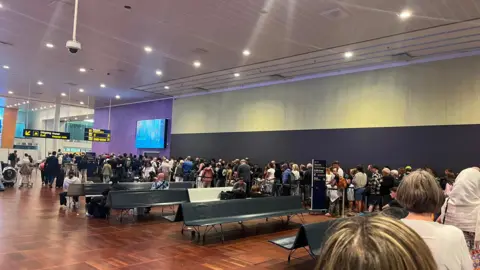
There was a single passport control queue that afternoon staffed by three officers after a water leak closed another set of booths. The queue was at least 300 people strong when I joined it at 15:45 CET ahead of my Ryanair flight, scheduled for 17:55 local time.
Fully operational since April, the EU has introduced a system replacing manual passport stamping for non-EU nationals, the Entry/Exit System (EES). It requires biometric registration of fingerprints, passport data and a facial image on first entry.
UK passport holders are third-country nationals under EU law and cannot use the automated e-gates so every British traveller must pass through a staffed lane. But the idea is that you should only have to do this once in three years.
The new system has caused passport queues around Europe to swell, particularly affecting departing passengers trying to catch flights.
But some airports have been managing better than others for compounding reasons, such as the size of the airport and destinations of the flights.
Unbeknownst to me, Copenhagen has already been singled out by the Foreign Office in May as one of the least efficient according to a May statement in other press.
I realised the queue wasn't just long, it was impassable. Others abandoned it entirely, realising it made no difference.
It reduced only by airport staff who periodically shouted the last call for flights to Edinburgh, Birmingham, Manchester and London and escorted passengers to the front. Even airline staff on occasion had to come down and fish out their passengers themselves.
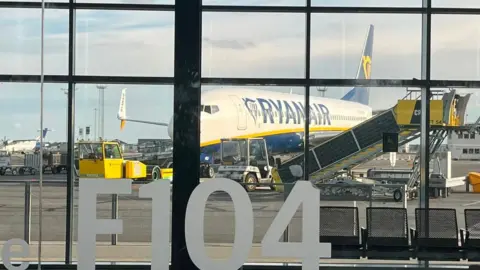
Eventually, Stansted was called with about 30 minutes until take off, and we were gathered up and taken to the front.
When I was through the queue and arrived at the gate, it was around 15 minutes after the scheduled take off. I found about 50 people shouting and head in hands huddled around a staff member insisting that the gate had closed and we could no longer board.
I realised I optimistically assumed that they would hold the flight, because they must know about the passport situation. Ryanair said there was nothing they could do for us, because it was not their fault.
Ryanair later told the BBC that passengers on the flight were "offered Ryanair's missed departure fee to travel on to the next available flight".
Almost every other flight to London was booked that evening, with a couple of seats going for more than £500. I spoke to one couple who had to get home that evening, and had to cough up knowing they may likely not be reimbursed.
We stared at the plane, still grounded, as we saw our luggage being lifted back off the plane again. More people arrived, trickling through the passport controls, met with the same dismay. I wondered how many people must actually be on the flight. Not more than half, at an estimate.
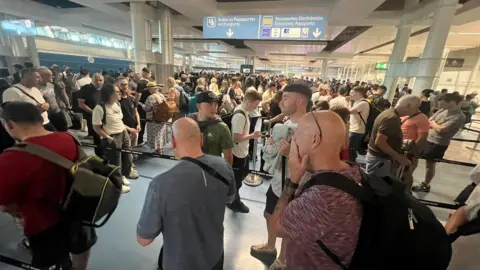
As I was venting to friends, one of them, Lauren Rowlands, had just flown back with British Airways (BA) from Porto to London that same day. She said about 400 people were queuing for non-Schengen passport control, with only two officers checking passports.
"There were rumours BA would hold our plane for people if lots missed final call - but they didn't, we took off not even half full. And before I had to put my cabin bag in the hold because the flight was sold out!
"So many people missed their flights, and there was no system to get people through if their flight was on final call.
"They were mostly Brits in the airport, because they had a Manchester flight and two London flights at the same time. The airport said the e-gates were out of service for Brits but don't think we can use them anyway. "
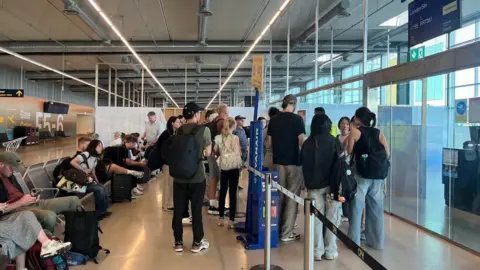
Emily, who regularly travels to Milan for work, got in touch with me saying that her trips back to London this summer had been blighted by passport controls, with one missed flight and two delayed flights at Milan Malpensa.
Emily, who did not wish to give her surname, said: "Flying back from Milan was a total nightmare. I flew in June, so I guess after the new checks.
"There was no organisation and I missed my flight and it was horrendous trying to get home. I paid another €350 to get home the same day, which I have not been reimbursed for.
She said she has since become anxious about travelling and has repeatedly seen passengers miss UK-bound flights because of long queues.
"I know that of course the extra passport processing is not aimed at Brits but I wonder if we are suffering disproportionately because we travel so much to Europe in the summertime. Every queue I've been in is filled with Brits."
Since the rollout of the EES passport scanning, which began gradually in December, an emergency mechanism has been introduced that has allowed member states to partially suspend EES if the queues get too bad, and this expires on 6 September.
After this, every border post must take biometrics from every eligible traveller, however long the queue is.
Portuguese airports, including Lisbon, Faro and Porto, have reportedly been using the suspension flexibility during this summer.
Nine countries wrote to Home Affairs Commissioner Magnus Brunner on 7 July asking for it to be kept beyond that date, and the airline and airport bodies have asked for it to run until the end of October.
When I asked the European Commission about this, they referred me to a briefing on Thursday where Politico journalist Tommaso Lecca asked about the extension.
 submitted
Spokesman Marcus Lammert said: "When it comes to the time after the summer, we are in close and constructive contact with those few member states who have challenges at a certain moment or had certain challenges before the summer, and we will be in touch with everyone to see how to take it forward."
He said it was an "effective and well working system", with millions of entries processed and about 50,000 refusals that might otherwise have gone undetected.
"I think it's a good example of how the EU is strengthening its border systems, its external border systems, also when it comes to the new digital border systems," he added.
The Commission's argument is that queues should ease over time as regular visitors are registered in the system for up to three years.
In theory, that should reduce the number of passengers requiring full biometric checks, although implementation is left to individual member states and airports.
Emily was a regular traveller who was supposedly already registered. As far as I could tell, and those who I have spoken to at the time of writing, in all the mentioned airports the queues were generally organised by Schengen and non-Schengen travellers, rather than by registration status.
As for me, I had actually been travelling in Sweden and chose to fly back from Copenhagen for "convenience". I was very lucky to find a cheap and seamless flight back from Swedish city Malmo the next day, a short train over a bridge from Denmark.
Copenhagen Airport insisted to the BBC the delays on Tuesday were an exception where the water leak was to blame, not the EES processing.
A spokesperson said: "What you experienced at Copenhagen Airport on Tuesday was an extraordinary situation at passport control.
"An unfortunate water leak occurred in a server room connected to the passport control, which is one of the airport's two passport control facilities.
"As a result, all passengers had to pass through passport control in Pier C for the remainder of the day. This extraordinary situation was not related to the EES system.
"When half of the available passport control capacity is taken out of operation, longer waiting times are unfortunately unavoidable. We sincerely apologise for the inconvenience this caused our passengers."
They said passengers were informed about the additional waiting times through public address announcements, and additional customer service staff were deployed to "provide guidance and assist passengers whose flights were close to departure".
The spokesperson said whether to delay a departure in order to wait for passengers is a decision for each individual airline.
Vinci Airports, which manages Porto Airport, and Milan's Malpensa Airport have both been approached for comment.
Listen to the best of BBC Radio London on Sounds and follow BBC London on Facebook, X and Instagram. Send your story ideas to hello.bbclondon@bbc.co.uk
