How my brother went from liberal Hollywood actor to manosphere 'messiah'

 YouTube
Warning: This story contains offensive language
Ten years ago Luis Castilleja was a free-wheeling creative, seeking his fortune as an actor in Hollywood, and enjoying the liberal Los Angeles lifestyle. Now he is better known as El Temach, Latin America's biggest manosphere influencer, whose misogynistic and hyper-masculine content has gained him more than 11 million social media followers.
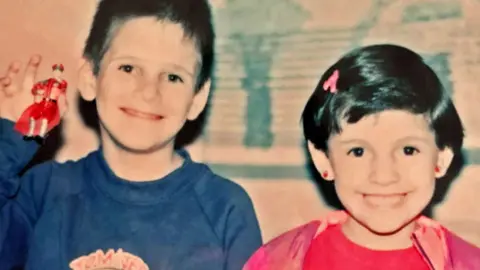
His sister Alex says his transformation is shocking and they no longer speak.
"I don't like saying El Temach because for me he's a completely different person. So I'm sister with the human that he was," she says.
Alex, a design engineer from Mexico, says her brother's metamorphosis shows how even the most unlikely people can be tempted into making manosphere content, once they realise the money and fame to be made.

The impact of Western influencers such as Andrew Tate has been well documented. But a BBC World Service investigation has scrutinised the content and followings of 15 other influencers - based in South and East Asia, Latin America and Africa - and found that, on average, their followings have tripled in the past three years. These regions have seen relatively recent gains in gender equality, and experts say this environment is fuelling men's hunger for manosphere content.
As well as El Temach, our investigation also focused on Andrew Kibe - a household name in Kenya who promotes male self-empowerment and misogyny on social media. Both have repeatedly attacked single mothers, and regularly accuse women of being "gold diggers" who manipulate men.
Both influencers, we found, are earning large sums of money from their platforms.
El Temach and Kibe both strongly deny their content is misogynistic, with Kibe - in an interview with the BBC - even disputing the existence of the concept.
We wanted to see the impact this content has on consumers. Two Gen Z followers - one in Kenya and one in Mexico - gave the BBC uncensored access to several years of their social media activity, allowing us to see thousands of their posts, views, likes, comments and shares.
The data reveals their personal journeys into the manosphere.
Mexican Julián first started using Instagram aged 16, liking and commenting on content about cars, fitness and self-development. His history shows that he first liked a video from El Temach a few months later, after it appeared in his recommended feeds.
Now 19, he has so far liked more than 3,000 videos from dozens of manosphere creators. Julián told the BBC he felt "feminism has made men's problems invisible".
That sentiment is a key tenet of El Temach's messaging - but he did not always hold these views, according to his sister Alex.
He grew up wanting to be a performer, she says, and after studying theatre in Mexico City, moved to LA to pursue his dream of becoming an actor.
But he returned home a couple of years later, she says, after a break-up and failure to book regular work. These setbacks motivated him to help other young men navigate difficult experiences, she says, and he began in 2020 to post content focused on male self-development.
"I think at the beginning it was very noble how he wanted to help other men to feel worthy and valuable, and that's how he started," Alex says.
But this quickly "twisted" into something else. "He got this Messiah complex, like he's the one that has to fix [men's issues]," she tells us.
And she says he soon began to blame women for the difficulties his male followers were navigating. She is not sure how far her brother actually believes the misogyny he espouses - and how much is just for social media likes and views.
"He believes some things - and others, he's just experimenting what works best with the algorithm."
 Alex Castilleja
Her brother admitted he was simply copying Andrew Tate, says Alex. "Tate was super big at that time, [and] since he saw it worked he just started pushing [his argument] further and further."
She says her brother's content soon became mirrored in his behaviour towards her.
"Anything I would express… was taken like a feminist belief… an affront to his persona."
The BBC asked El Temach to take part in our documentary. He initially agreed to speak to us, inviting us to film his world tour which began in the US, but just days before we were due to fly out, he went live on YouTube telling his followers he had no intention of participating.
"BBC and Miss Jacqui from the BBC, we don't need your permission to be men. Make your documentary, don't involve me or my bros. [Expletive] the BBC."
We nevertheless went to his show in Las Vegas, which was a mixture of self-improvement advice and sexist rhetoric, including advising his fans to avoid "sluts" because they will never change, and that single mothers are "not a good catch" because their status reflects poor life decisions and character flaws.
Afterwards, we tried to confront him about these statements, but his security blocked our way.
El Temach's earnings from content, including these shows, is sizeable. According to our analysis, from April 2025-26 El Temach made an estimated $1.5m (£1.1m) from social media views alone. He also made $200,000-300,000 (£149,000-£223,211) from YouTube "Super Chats" - in which fans pay to boost the prominence of their comments during livestreams, often asking for relationship advice - as well as $800 (£595) per person for small-group workshops. This is in addition to the money he made from merchandise and his regular stage shows.
His team told us they consider it "highly irresponsible to publish the estimated income of El Temach".
Kibe also monetises his popularity, selling merchandise and even a crypto coin. He told the BBC: "If anybody is really my fan, the only thing I tell them is make sure you send me M-Pesa [money via a Kenyan app]."
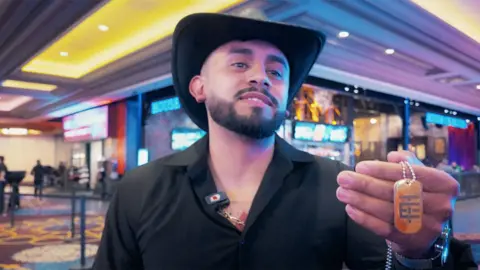
One group of men we spoke to outside El Temach's Las Vegas show told us what they liked about his content - that he encourages discipline, inspires them to find self-confidence, and acknowledges their problems.
"He focuses a lot on men as having been dismissed by society, and [the narrative that] women have, you know, been the stars of the show," says Dr Ali Siles, gender and masculinities researcher at the National Autonomous University of Mexico.
"He has this message of: 'You do matter, believe in yourself.'"
And this is what fan Julián says he likes about the influencer too. "The teaching that impacted me the most was about feeling confident."
Kenyan university student Ryan, who follows the videos of Andrew Kibe, says as a young man raised by a single mother, he views the influencer as a surrogate father figure.
Using analytical tools developed by the University of Queensland, we found Ryan had watched videos on TikTok from Kibe - whose hashtag has attracted more than 500 million views - after searching for terms such as "success", "self-improvement" and "masculinity tips with no father".
But Siles says manosphere content tends to come "at the expense of" women and other gender identities.
"It's very harmful to women's rights and development, because it's also trying to put them back in places a lot of them have been trying to get out of, with limited choices, with very stereotypical roles."
Julián's social media history shows how such messaging, in his case from El Temach, soon becomes mirrored by followers.
When Julián broke up with a girlfriend in late 2023, his interactions with manosphere content spiked and he began referring to women as "sluts" in his online comments, and praising subservience. "If you're a feminine and submissive woman, then perfect," he wrote in one post.
Julián says he regrets the tone of his past Instagram comments, but stands by their content.
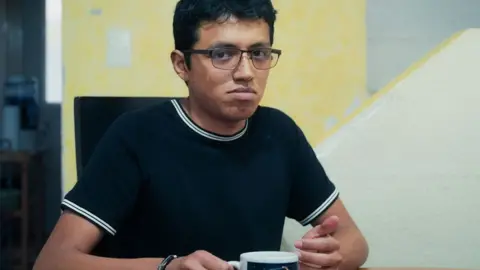
Many of Julián's generation believe that feminism has come at the cost of men's rights, according to a recent global survey of 23,000 men and women by King's College London. More than half of Gen Z men - some 57% - agreed with the statement: "We have gone so far in promoting women's equality that we are discriminating against men."
It's a belief that manosphere influencers are tapping into. According to these influencers, "women are the problem," says Awino Okech, at The School of Oriental and African Studies (SOAS) in London.
Their belief, says the professor of feminist and security studies, is "it's this gender equality thing that is leading to boys underperforming… It's gender equality that is leading to mental problems for men and boys."
These misleading narratives can have a real-world impact, we found.
Fernanda, a doctor from Mexico City, says her ex-partner, also a doctor, used El Temach's messaging to justify his controlling behaviour.
On what was to become the day they split up, she says he locked her in a room and forced her to watch videos made by El Temach for four hours.
"He kept saying: 'See? I'm not doing anything wrong… You're the one who's wrong.'"
She told us the situation that day escalated to the point where he threatened to kill her.
"His eyes were empty, he was acting purely on impulse. In that moment, I was really very afraid of what might happen to me."
Though she does not blame El Temach directly for her experience, Fernanda does believe this type of content has an effect on relationships in the real world.
"I think [my former partner] was already a sexist who was hiding it. But El Temach influenced him to no longer feel bad about it."
Alex, El Temach's sister, thinks her brother is in denial about the negative impact of his content.
"I think he knows what he's doing on some level. I think that he sees and realises that if he ever owns up to what he did, it'll destroy him."
She feels he has drifted from the path he was destined to follow, "into this weird dystopic hell and he's just this... violence robot".
"It's very sad."
The BBC asked El Temach to respond to our allegations that he promotes misogynistic content. His team responded to say they "categorically rejected the allegations and that they were unfounded and taken out of context".
Kibe, when challenged on his misogynistic content, denied this term applied to him and said: "No man hates a woman. We love you - we are like gods to you, worship us."
