The parents fighting the closure of the smallest secondary in Scotland

 BBC
BBCAt the end of a winding road among the hills and trees and turbines of south-west Scotland an educational battle is raging.
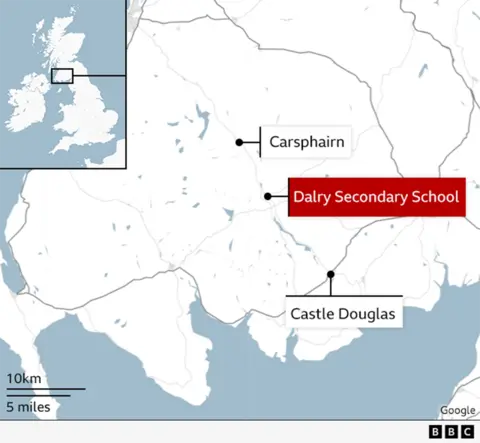
Dumfries and Galloway Council (DGC) agreed this week to begin the statutory process required to close Scotland's smallest secondary in the village of Dalry - forecast to have just eight pupils in the next school year.
It concluded that the fall in pupil numbers, limited peer interaction, curriculum challenges and running costs meant that was the "most appropriate response".
However, the handful of parents left with children at the school feel very differently and are ready to fight the proposal every step of the way.
Dalry Secondary provides education for S1 to S4 pupils before they transfer to Castle Douglas High School about 16 miles (25km) away for S5 and S6.
Wednesday was the final day before the summer holidays for its 13 remaining pupils - a number projected to fall even further.
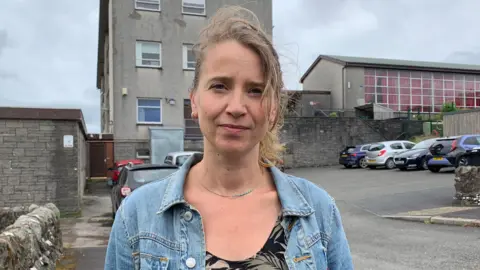
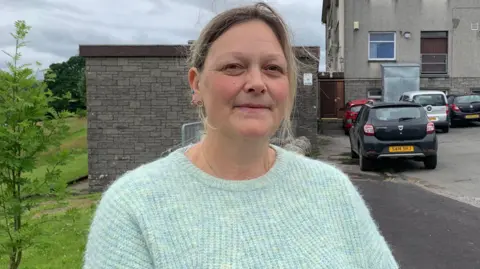
It came just 24 hours after the council's decision to proceed towards closure which parent Sharon Currie - who has children Millie and Nairn currently at the school with Oakley due to start in August - has vowed to fight until the end.
"I will be here to the last day," she said. "They will not be pushed out.
"It makes me feel really sad and upset.
"The school's part of the community - I went through the school myself - it's just going to be a huge loss."
She said she hoped that the closure process could "look at other options" to keep "some kind of learning" in the area.
Sarah Ade - whose son Finn has just gone into second year and will come back after the holidays - said she felt the council had undermined the school for some time before moving to close it.
"It feels, at this point, kind of inevitable, very disappointing, but we've been fighting this battle for over two decades now," she said.
"There's been managed decline on the part of the council for that length of time.
"Our communities and parents have been flagging up issues which should have been addressed all through that period."
She said it was not just about the educational impact, there were wider implications for the community which had been seen with primary school closures elsewhere.
"A rural area is different," she insisted. "So we feel that we need to be treated that way, we need to have something made that's thinking outside the box.
"We need our councillors and our education officials to be seeing that and to not just say closure is the only option, but to say let's find out how we can make rural education work for you."
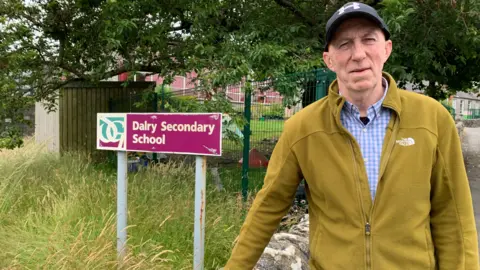
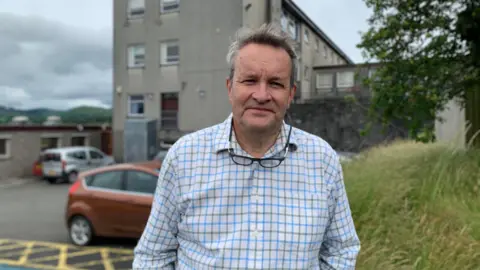
Jan Burrows moved to the area in 2018, and two of his children have already gone through the school with the third, Joshua, in S2.
He criticised the consulation carried out before the proposal to close and the fact that no impact assessment had been done.
"I think only the parliamentary level can probably help us now," he admitted.
"If they think about rural depopulation - which is a big issue on the agenda - closing a school like this certainly could contribute to rural depopulation.
"People may not move to this area if they have children of secondary school ages, some people may move out, so there's a lot of consequences."
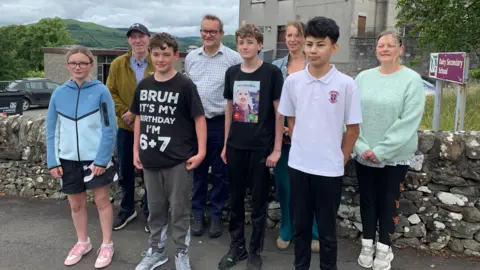
They have found allies in the local community too.
Jeremy Sainsbury is the chairman of the Kells and New Galloway Community Council but also director of renewable energy firm Natural Power, a major business in the area.
"As an employer, I will find it much more difficult - and am finding it much more difficult since the problems we've had with the secondary over a number of years - to actually get good quality employees to move here," he said.
"And I'm sure the council won't like it very much if 80 of my employees leave here because I can't get the quality of employee that I need to continue the office here."
He said his big disappointment was that he felt the entire process had been "driven by the building, not by what is good for the children".
That is an argument which the council refutes and has highlighted the educational and social issues associated with running a school for such a small number of pupils.
Several steps lie in store before they can close the doors for good in Dalry.
And the local authority's school estate specialist, Louise Rae, told councillors this week that public opinion would play an important part in determining what happened next.
"There is still an opportunity for all stakeholders to be heard through the process," she said.
She said that could be via public meetings, surveys or contacting the council directly.
"There will be an opportunity for everyone's voice still to be heard," she said.
Parents in Dalry will be among those with the strongest views but their fate is likely to be watched with interest by other small secondary schools across Scotland.
What steps are needed to close a rural school in Scotland?
 Getty Images
The Schools (Consultation) (Scotland) Act 2010 spells out what needs to be done in order to close a site.
In the case of rural school like Dalry the local authority has to identify its reasons for the move and decide whether or not closure is the most appropriate response.
Phase two sees the education authority consult on a proposal – for a minimum of six weeks, including at least 30 school days.
A paper is then taken to Education Scotland which must prepare a report on the educational impact within a maximum of three weeks.
The next phase - which has no specific timescale - sees the local authority publish a consulation report.
Then, a minimum of three weeks later, it should make its final decision and, if that is for closure, inform the Scottish government within six working days.
Ministers then have up to eight weeks to decide whether or not to "call in" the move for further scrutiny.
If they do, it heads to a School Closure Review Panel which has a maximum of 17 weeks to give its verdict.
In the event that it refuses consent no fresh attempt to close the school can be made within five years - unless there is a "significant change" in its circumstances.
