Safety framework for public events 'insufficient'

 Reuters
An inspection of policing and public safety at large events has concluded that guidance to manage risks at gatherings like festivals and concerts is "inconsistent" and increasingly unable to guarantee public safety.
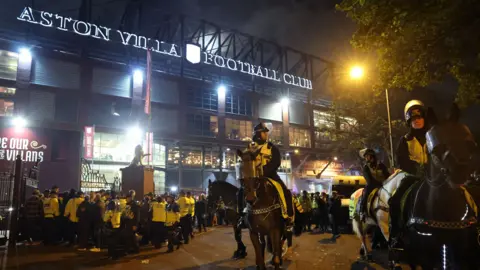
The HM Inspectorate of Constabulary and Fire & Rescue Services report was commissioned after controversy involving Aston Villa's European fixture against Israeli side Maccabi Tel Aviv in November.
Birmingham Safety Advisory Group recommended no away supporters should attend the match because of public safety concerns - prompting an international outcry.
Chief Inspector of Constabulary Michelle Skeer urged government to review wider arrangements for keeping the public safe at events.
She said she had been particularly struck by evidence heard regarding non-sporting occasions suggesting it was a "question of when, not if, public safety at an event will go wrong".
"We were struck by the number of interviewees who told us that a disaster at a major event in the UK, such as those seen recently in other countries, was inevitable," she said.
Inspectors reviewed 856 documents, assessed 28 events and interviewed 113 police officers, staff and representatives from other organisations.
 HMICFRS
One of the key findings was an "inconsistent" approach taken by police forces and SAGs across the country regarding events, not helped by SAGs' non-statutory status and having "no basis in law".
While most councils had SAGs, some did not.
SAGs are multi-agency bodies, typically made up of representatives from the local authority and members of the emergency services in the area.
The HM Inspectorate of Constabulary and Fire & Rescue Services (HMICFRS) report said there was a lack of clarity about the roles and responsibilities organisations take in keeping the public safe.
The report also said police commanders' training did not prepare them adequately to work with SAGs.
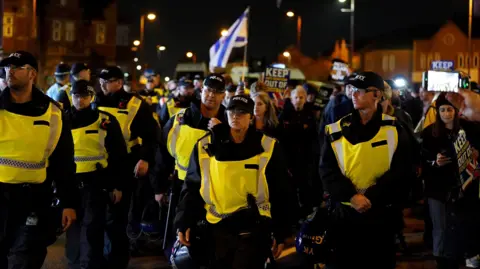
In an interim report for the Home Secretary in January, HMICFRS said "shortcomings in the command structure" were apparent in West Midlands Police's decision not to declare a critical incident surrounding Villa's Europa League fixture against Maccabi Tel Aviv.
Declaring a critical incident should have brought about a more rigorous approach, it added.
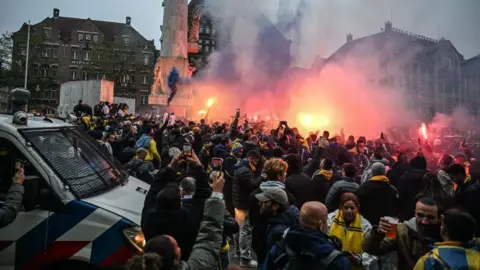
In assessing police evidence to the Birmingham SAG in the advice to ban Maccabi fans, the HMICFRS interim report concluded West Midlands Police commanders had overstated the role of Maccabi fans in previous match disorder in Amsterdam in November 2024.
 PA Media
It echoed evidence by Lord Mann, who suggested the force had "greatly exaggerated" the problems faced by Dutch officers.
HMICFRS said a letter from West Midlands Police's Gold commander to the chair of the SAG on 10 October referred to Maccabi Tel Aviv fans at the Ajax fixture "setting fire to Palestinian flags".
However, after an interview with Dutch police then Chief Inspector of Constabulary Sir Andy Cooke said his team understood that there had been only one report of a person attempting to set fire to a single Palestinian flag.
In documents released earlier this year, the force admitted overstating the evidence to the SAG, adding that it "did not engage early enough with the local Jewish community".
Crucially, Sir Andy's January update said there was no evidence of antisemitism in the force's decision-making, but that it was guilty of "confirmation bias" regarding "the anticipated behaviour of Maccabi Tel Aviv fans and the potential disorder their presence might cause".
Sir Andy also took aim at wider "inaccuracies" within a written report from police to the chair of the Birmingham SAG on 24 October, including a reference to a Maccabi match against West Ham that never took place and was instead an AI "hallucination" after a member of staff carried out a search using Microsoft Copilot.
Other inaccuracies or issues overstated relating to the Ajax match included the number of Dutch officers that West Midlands Police said were deployed, attacks by Maccabi Tel Aviv fans on Muslim taxi drivers or their tearing down of Palestinian flags, and suggestions that members of the public had been thrown into the river.
 Getty Images
The former chief constable of West Midlands Police is currently facing a misconduct investigation alongside three serving officers and a member of staff regarding the force's planning and preparation for the match at Villa Park.
HMICFRS' interim report reflected that the Villa fixture's significance was "further heightened by the 2 October terrorist attack on Manchester's Heaton Park Hebrew Congregation.
It said that while West Midlands Police's approach "focused on reducing the risk of short-term disorder and long-term damage to local community relations" due to the presence of Maccabi Tel Aviv fans, it "lacked the necessary foresight to recognise the long-term, global consequences".
The force told the BBC it had noted "the findings of this review into the national SAG process" published on Friday.
Despite HMICFRS criticism of the force, Skeer said sporting events were at least covered by stronger regulations than other types of public events.
'Lack of legislation'
Lord Taylor recommended establishing SAGs in his report following the 1989 Hillsborough disaster, primarily to consider public safety at football stadiums.
However, Skeer said that threats and risks to public safety had "changed dramatically over the last 20 years".
"Music concerts, fairs, airshows and celebrations have all been the setting for serious injury and deaths, she said.
"Sadly, occasions that bring together large crowds of people have also been a target for those causing harm and fear through acts of terrorism."
Skeer said it was in relation to the arrangements for these events "that we found the framework to be insufficient".
"We are concerned that the lack of legislation and statutory guidance for non-sporting events is leading to widespread inconsistencies in the police's public safety operations," Skeer said.
"They, and the public, deserve clarity so that police forces can work with local authorities and event organisers to protect the public.
"That is why we are calling for the government to carry out a review of public safety arrangements at events and the wider issues our inspection raises.
"This review, alongside the wider recommendations we make, will help make vital improvements to event safety."
In all, the report made 37 recommendations, including the development of a national risk matrix for events, to include a threshold for escalation to a regional or national level.
It also proposed revised guidance for those involved in SAGs, and appropriate training for SAG chairs.
The report similarly called on the UK Resilience Academy to introduce a national oversight and monitoring function for SAGs.
It also suggested a requirement on the College of Policing to refresh the training on public safety command courses to encourage commanders to recognise, declare and manage critical and major incidents associated with events.
Follow BBC Birmingham on BBC Sounds, Facebook, X and Instagram.
