'Our great-uncle's WW1 death reunited us 100 year later'

 BBC/Olivia Richwald
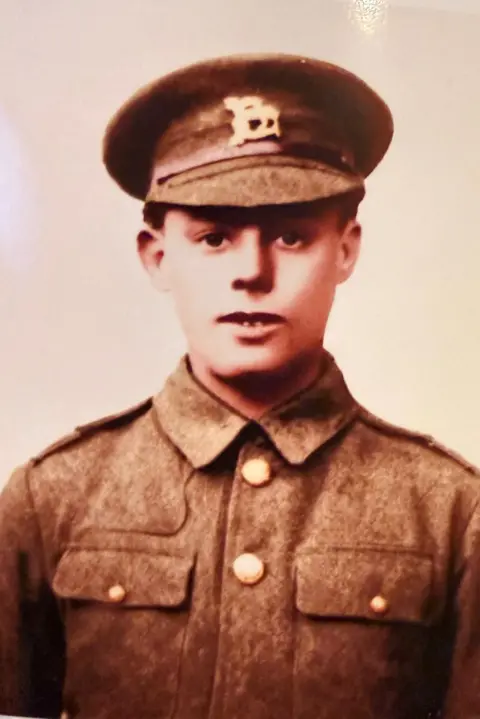
Thomas Whitaker was just 18 when he was killed in an explosion in a trench just a month before the end of World War One.
His body, and those of five other private soldiers, was not found until 2020 and only this week were their remains interred after being identified by "war detectives".
Yet his poignant military funeral has reunited the great-nephews and distant cousins of the young Bradford soldier more than a century on.
Thomas's descendants invited BBC Look North reporter Olivia Richwald to Belgium for the burial ceremony of the six men, who were manning a Lewis gun when they died in a likely shell blast in October 1918.
Their bodies were undiscovered for more than a century before they were found during construction work in Wervik, near the French border, six years ago.
Their funeral took place at Tyne Cot, near Ypres, the largest Commonwealth war cemetery in the world.
Thomas's younger brother, Walter, went on to have a family and the Whitaker line has continued, as Thomas was unmarried and had not had children when he was killed.
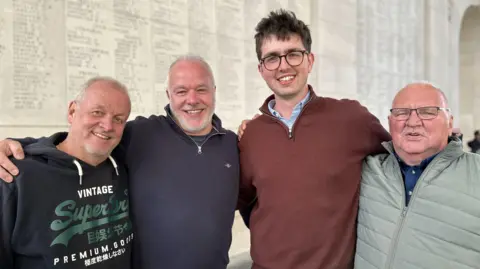
Yet Walter's grandson, Dave Whitaker, had never met his distant cousin Nigel - and they have now been reunited at their great-uncle's graveside.
Dave said: “It is fascinating, it is emotional, it is poignant and it is important.
“It is important we talk about it and reflect. Because Thomas died when he was 18, he was never able to have his own family, so it is not just the loss of Thomas, it is the loss of that family line.”
Remembering his grandfather Walter, Dave added: “He spoke very little about Thomas, his older brother, and you can understand why.
“They found it very difficult, people didn’t talk about loss in the same way back then.
“One of the stories he did tell me was about Armistice Day in 1918. Everyone was celebrating the end of the war, but they got the telegram that day to say Thomas was dead.”
 Whitaker family
The six men who were buried together are Pte Horace Cook, Pte Frederick Martin, Pte Courtney Hart, Pte Joseph Turnley, Pte Charles Russell and Pte Thomas Whitaker.
They were aged between 18 and 22. Families of four of them attended the burial ceremony.
Thomas's great-great-nephew, Joe Whitaker, is 22 and had already researched his ancestor before his body had even been found.
Joe said: “My grandfather describes him as a family hero.
“We have always known about Thomas but we have never had anything concrete. He has been a photo and stories and that’s it.
"Now we have a coffin, we have a grave and that is actually him. It's completely surreal that 100 years later we can have this."
 BBC/Olivia Richwald
When the six bodies were discovered, archaeologists and Ministry of Defence war detectives began a painstaking process to preserve anything which could identify the men.
It took almost five years before the team wrote to Nigel Whitaker, Thomas’s first cousin once removed.
Nigel and his family still live in Bradford, whereas the other Whitakers had relocated to Doncaster.
Nigel, who had never heard of Thomas, agreed to provide a DNA sample which matched the remains.
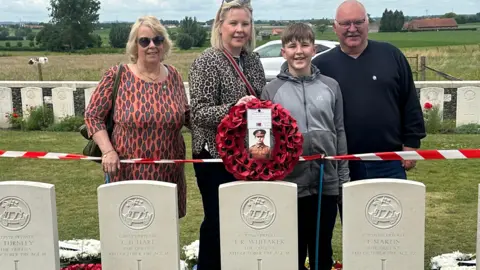
Three generations of Nigel’s family, including his daughter Lee-Anne and grandchildren Katie, 16, and Harry, 12, travelled to Belgium to say goodbye.
Nigel's own family has a long history of military service and he was in the Army for 25 years.
He said: “It is the culmination of this past year, from being told about him, doing the DNA test, getting a positive result, all the planning and we are here.
“It is emotional. I never knew Thomas but I do now.”
 BBC/Olivia Richwald
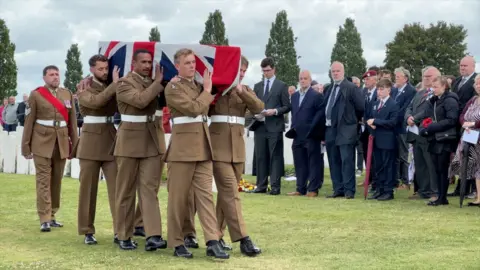
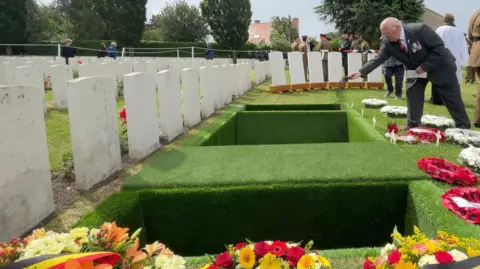
The funeral began silently as one of the coffins draped in a Union Jack was carried past white war graves by military pallbearers.
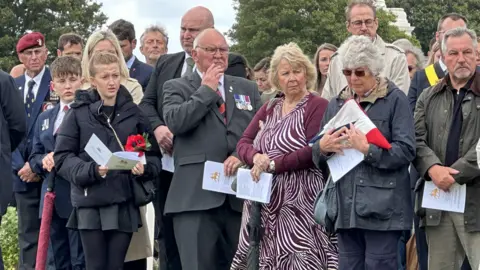
More than 100 people watched on, including family, military representatives, curious tourists and passers-by.
The coffin was placed with the other five and the flags were folded into triangles and presented to each family as a symbol of national gratitude.
Joe read a poem he wrote which imagines what Thomas felt far from his home in Bradford amid the noise and horror of World War One, before wreaths were laid and Nigel threw soil on his ancestor's coffin.
 BBC/Olivia Richwald
Sixteen-year-old Katie is just two years younger than her distant cousin Thomas was when he went to war.
She said: “It is such an honour. Thomas’s mum and his brother didn't get the have this honour, we do and that is what makes this emotional.
“We are not just doing this for us it is also for his friends and his family, he was only 18.”
Also at the ceremony was Alexia Clark, the war detective who discovered the men’s identities and traced their families.
The soldiers were from the Queen’s Royal West Surrey regiment and cap badges were found with their bodies.
Clark investigated and found a crew of six were still missing from that regiment in the right area.
Tracing living relatives was more difficult, but she eventually found Nigel, who is descended from one of Thomas’s uncles.
She said: “It is immensely satisfying. It is the best job in the world, when you see the impact that this has on the families I couldn’t wish for anything better.”
His closest living relative is Ian Whitaker, his 86-year-old nephew who lives in Doncaster, and who Clark was initially unable to find.
But by coincidence, Joe, who is Ian's grandson, had already contacted Clark's team after watching a BBC documentary about their work.
The Doncaster Whitakers and the Bradford Whitakers did not know each other, but were thrilled to be reunited through Thomas and spend the day together at his funeral.
Dave said: “It was one of those things you never expect and we have had a really nice day together with members of our family we have never spent time with."
Nigel said: “Before I got the letter for the DNA test we didn’t know that side of the family existed.
“They have known all about Thomas and we have known nothing of him. But what they have told us about him, I am just so proud of him.”
 BBC/Olivia Richwald
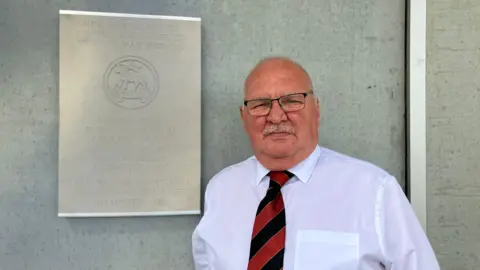
Each of the families was also presented with a memento recovered from the excavation site.
Joe and Dave have Thomas’s cap badge and Army veteran Nigel received his shoulder badge.
The word "Queen's" remains visible despite 102 years underground.
Nigel said: “Thomas left Bradford aged 13, so he must have been an independent chap.
“He went to Newmarket [the racing town in Suffolk] and became a groom. We think he was hoping to become a jockey, he was only just over 5ft.
“The only consolation I have as ex-military is that he wasn't alone. He has lain there with five of his mates until they were found six years ago.”
 Whitaker family
All of the Whitakers finished their day at the Menin Gate in Ypres.
The huge monument commemorates 55,000 British and Commonwealth soldiers with no known grave.
Dave said: “It brings it home how lucky we have been today to be able to bury our relative when there are all these names here who are lost in this area.”
For Lee-Anne, Nigel’s daughter, the experience was emotional and she said she was amazed at the kindness and generosity of the people she met in Belgium.
She said: “It hasn’t been a job for them, it has been their life.
“It has been a very humbling, emotional day seeing the young soldiers laying them to rest and being with my children and my dad.
“It's also been lovely to be reunited with the other family and see that all the Whitakers have the same nose!”
Listen to highlights from West Yorkshire on BBC Sounds, catch up with the latest episode of Look North.
