Adder rescued after being spotted on beach

 Friends of Portheras Cove
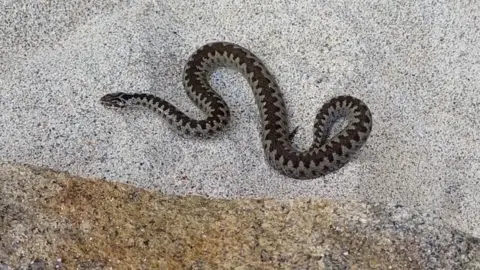
Dog walkers and families have been reminded to be aware of adders in the hot weather after one was rescued from a popular beach.
Friends of Portheras Cove said a large adult adder was found at their beach in Cornwall on Monday, noting it may have been "dropped by a bird or prey, or simply fallen off the clifftop".
In an update on Facebook, the group wrote: "Be aware that the warm weather means the adders are active all around the cliffs and coastal areas."
The group said a wildlife expert had been able to "relocate the adder to a remote, safe location" but urged people not to touch or let dogs near any adders they find.
Delia Webb, from the group, told Radio Cornwall it was unusual for the snake to be so exposed.
She said: "Adders like basking in the sun while they bring their body temperatures up to a higher temperature.
"But once they're at their temperature, they don't like the full sun. So being on a sandy cove, with no cover and no means of getting anything to eat, was not good for the adder."
Webb said adders did not want to attack humans or dogs but would if they felt threatened and said people should keep their distance.
"Look ahead, keep your dogs and your children behind you and make noise; they don't like noise," she added.
Adders are the UK's only venomous snakes and are protected in the UK under the Wildlife and Countryside Act 1981.
Shauna Walsh, PDSA vet nurse, recently said their bites were "uncommon", but should be treated as an emergency, where symptoms could develop "between a couple of minutes to an hour".
She said mild symptoms included pain and swelling around the bite, limping if bitten on a leg, with more serious symptoms including vomiting and diarrhoea, pale gums, and drooling.
"If you think your dog has been bitten, stay calm and keep them as still as possible to slow the spread of venom," Walsh said.
Follow BBC Cornwall on X, Facebook and Instagram. Send your story ideas to spotlight@bbc.co.uk.
