'We had to stop fighting nature after losing five homes'

 Martin Barber/BBC
As the recent extreme weather brings the impact of climate change to the fore, a Suffolk farming family who has lost acres of land to the sea explains how they shifted their business to adapt.
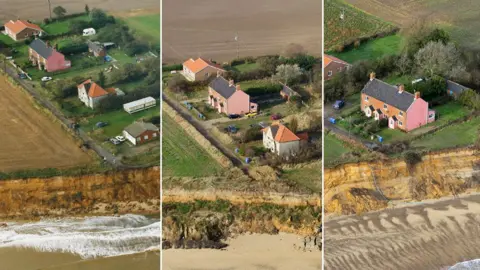
Since the 1920s, coastal erosion has reclaimed more than two-thirds of the estate and five homes in the family of Anne Jones.
The government says in many places, sea level rise caused by climate change is likely to increase erosion over time.
But rather than abandoning the serene coastline or trying to fight an unwinnable battle with the sea - and the law - the family has chosen a different path.
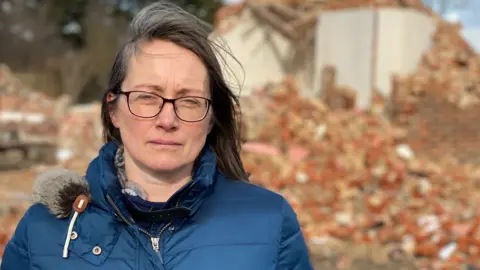
"It's a stunning place, it's beautiful," says Jones, standing on a remote spot at Easton Bavents, near Southwold.
Once a thriving village and England's most easterly point, its church disappeared into the sea in the 17th Century and much of the land surrounding it has been eroded.
Jones has spent her life watching the sea reshape her family's land.
A hundred years ago, her great-grandfather Herbert Boggis used his life savings to buy the 400-acre estate. Since then, the tide has swallowed up two-thirds of it.
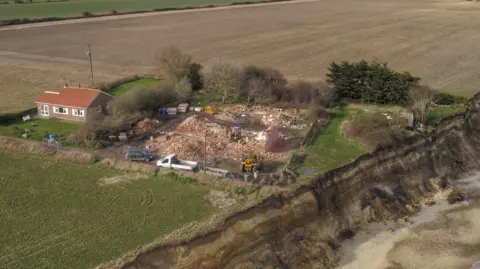
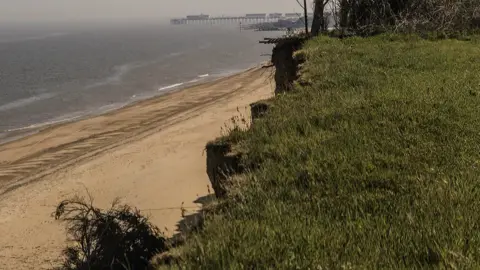
She speaks to BBC Suffolk in what was the back garden of a pink house. It ceased to exist in 2020. It was among a row of properties the Jones family had knocked down over the years, before they fell from the cliff and into the sea.
"It's very tough, for the people who live there and tough for us as owners to have to take them down and just accept that nature take its course and we have to adapt with it," she says.
"But we've recently decided to stop fighting nature and work with it.
"We need to adapt to climate change because we can't change it, we have to do something positive while the land is still here so people can enjoy it."
 Mike Page
 Martin Barber/BBC
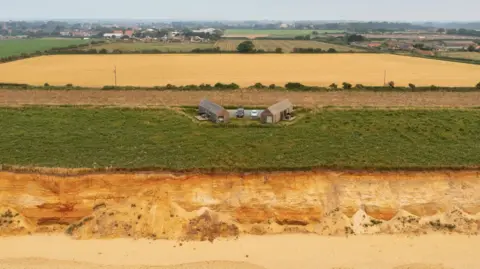
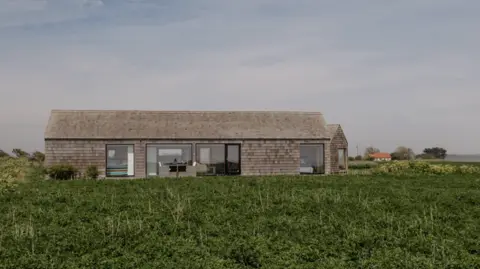
The family now rents holiday cabins which can be rolled further inland as nature gradually takes it course, under an agreement with the council.
"It's inevitable this coastline will erode and that can be reflected in planning, and that's been hard work but we feel good that we've managed to achieve that now," adds Jones.
The alternative option of protecting the sandy cliffs is neither financially viable or lawful.
 Anne Jones
Jones's mother's cousin, Peter Boggis, started building his own sea defences 20 years ago to protect the area, but was ordered to stop after losing a court battle.
A government-funded scheme, which was approved in 2012 to help them relocate, did not work out - and the landowners were left to fend for themselves.
She says she found the process frustrating and while they had previously "riled against it", they had taken a different tack.
"It has been very exhausting, it's been difficult and not without bumps in the road, but we are feeling very positive."
 Anne Jones
It is an ever-shifting landscape.
A clifftop cabin in view is one of several they own and it has been in situ since 2020, after the houses were demolished, but it may need to be moved for next summer.
Sea-view deckchairs are arranged on the land that could be in the waves come winter, and the trees dotted around the place will soon no longer be there.
Jones says the cabins are kept at least 10m (32ft) from the edge, with one on the clifftop likely to be moved behind a neighbouring house, owned by another family.
"You don't want to be dealing with anything in an emergency. We like to plan the moves well ahead of them happening," she explains.
"The [neighbour's] house - they have owned it for several generations as a holiday place, and it will be a very sad time for them when they have to do the inevitable.
"I suspect they might get next summer, but I shouldn't think it will be long before they have to plan the demolition of that one.
"It's very sad - it's people's memories and their lives."
 Anne Jones
Her husband, Phil, adds: "It's a little unpredictable - we have to suffer a few late evenings with the wind whistling around our home on the other side of Halesworth.
"It can be quite concerning what we might find in the morning.
"We make sure we are pro-active with planning and engineering and how we design things and keep things going."
Asked if he was at peace with the sea, he says: "It's easier to say 'yes' on a day when the sun is shining and the north-easterly wind isn't trying to freeze everything.
"We are where we are, and we really enjoy what we are doing and it's well worth it when people come and stay and 'get it'.
"They have an enjoyable time and feel at one with our special bit of nature up here."
Do you have a story suggestion for Suffolk? Contact us below.
Follow Suffolk news on BBC Sounds, Facebook, Instagram and X.
