Ambulance service at 90: 'Bombs filled freezers with fish'

 St John Ambulance and Rescue
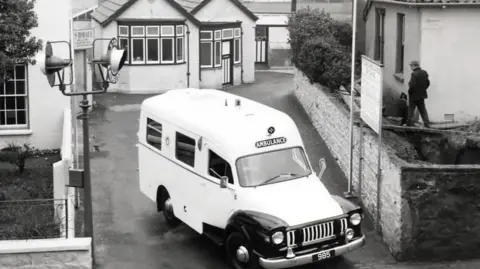
Free fish from controlled bomb blasts, artificial legs, and memorable rescues are just some of the stories that have been shared by former Ambulance and Rescue staff as a service marks its 90th anniversary.
St John Ambulance Transport Section, in Guernsey, was formed on 2 June 1936 by Reg Blanchford.
He had been involved in a serious motorbike accident six years previously, his injuries were made worse by a lack of proper transport to hospital.
It became his mission to create a service for injured islanders and it started with a second-hand ambulance.
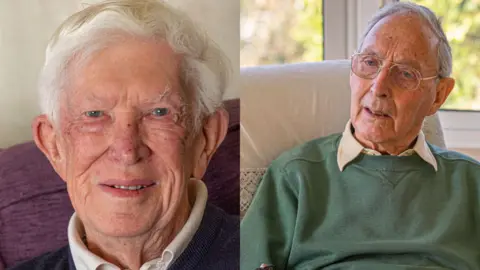
Neil Tucker, who was originally employed by Blanchford at the age of 23, worked his way through the ranks to become chief ambulance officer from 1990 until 2008.
He said of Blanchford: "He was a fair but very driven man, he knew what he wanted.
"His vision was quite unusual in that he wanted any patients who were injured and needed ambulance care to get it, wherever they were."
That saw the service develop diving, cliff rescue, and inshore boat teams.
Keith Fothergill joined all the various rescue teams when he started work with the ambulance service.
"I loved it" he recalled.
Fothergill remembered the dive team got friendly with the Royal Navy bomb disposal team who used to come to Guernsey on a regular basis.
"We used to go out with them in our inshore rescue boat mainly, and if there was a bomb to blow, they'd blow it and within minutes you'd see dead fish floating upside down on the water, so we all had big freezers at home with lots of pollock and such like in it," he laughed.
 St John Ambulance and Rescue
Over many years of service there are naturally some events that still standout.
Fothergill said: "The 17 January 1974 was when the ship, the Propserity came ashore in two bits at Perelle and the following day I was on duty with John Marshall and we were approached and told to put our wetsuits on."
A helicopter lowered them on to the wrecked ship.
"There was piles and piles of timber all over the place on this deck.
"Every time a wave hit the wreck the whole thing shuddered, some of the planks of wood were washed off as we were on there."
Managing to get access to the wheelhouse Fothergill said they found identification papers for the missing crew.
Eighteen people died in that wreck but "they were able to be identified by virtue of the fact that we'd found their passports".
'Broken legs and ball bearings'
John Marshall who was in the service at the same time was involved in one first aid incident that became something of logbook legend within St John.
At the time, there were two first aid rooms at the ambulance station where patients could be treated rather than going to A&E.
He remembered: "We were on nights and we had a couple of people come in and say this chappy had a broken leg."
It turned out it was a very old fashioned artificial leg and it had lost all the ball bearings in the knee joint.
"We thought we should be able to do something with this, sat him in the staff room to watch television while we went into the workshop."
They took the leg apart and after securing some ball bearings from an old wheelchair on site, were able to fix it.
But it all had to be entered in the first aid room logbook.
Marshall laughed as he remembered: "It said: Incident: fractured left leg. Treatment: lower leg removed, stripped, welded, re-threaded, re-assembled, new ball bearings, greased and refitted."
'Service evolution'
The evolution of Guernsey's health service eventually saw the rescue side of things come to an end.
Former Chief Officer Neil Tucker said: "Once it was realised that ambulance staff could be trained to perform things that previously only ever doctors had done, it was obvious to keep up that training and to evolve into a health service arm rather than an emergency rescue arm that we couldn't keep staff trained in all the aspects we needed to do."
Other organisations, like the RNLI, took over some of the services.
Blanchford died in 2002 but always kept a close eye on the service he created.
In his time as chief, Neil Tucker would get the occasional phone call.
"The first reaction I would have was 'oh dear what did I do yesterday that he's not happy with?'
"He was still very interested, even long after his retirement, it was still his service and he wanted it to be the best that Guernsey could possibly have."
Follow BBC Guernsey on X and Facebook and Instagram. Send your story ideas to channel.islands@bbc.co.uk.
