Is 'out of control' US tipping culture spreading overseas?

 AFP via Getty Images
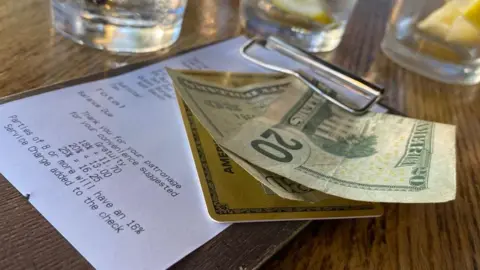
The debate about tipping culture in the US has reignited in recent years, with social media posts about waiting staff angry that they haven't been left enough money going viral. Is this increased pressure to tip, and to do so generously, now spreading around the world?
Lillian Price thinks that tipping in the US is "out of control". "It's too much," she says.
"You might just be grabbing something to go, and you are expected to tip," says the animal care worker who lives in Philadelphia.
Price, who says she tips 15% in table-service restaurants, adds: "If somewhere is providing a service, that's fine, but I don't see why you need to tip in other places, or worse still, that they expect one. It's for any little thing… when do we stop giving tips?"
Price's policy of tipping 15% in a restaurant might seem generous to many people, but in certain cities in the US it could very well result in a frosty response from a waiter or waitress. In places like New York, Boston, Los Angeles and Chicago 20% is now more often expected.
For Kate Santos, a waitress who works at Sanger Hall, a bar in Queens, New York, tips are an essential part of her income.
"Servers in New York make $11 (£8.18) an hour, so basically I make my salary off tips," she says. "If people don't tip, it's a bad day for me. In New York, there's an unspoken rule that you tip 20% minimum and if the tip is less, then people think it's terrible."
 Kate Santos
While tipping culture is ingrained in the US, 2,000 miles (3,220km) away in Iceland it was historically unheard of. But things have now changed, led by a big increase in American visitor numbers.
In 2010, 50,810 Americans went to Iceland, according to official Icelandic data. By last year this had soared to 660,114, and many simply wish to tip.
A spokeswoman for Efling Union, the second-largest union in Iceland, says this has led to a number of restaurants in the country asking customers if they want to add a gratuity when they pay. She adds that this is antagonising local people.
"Tipping is not customary in Iceland because there has long been a broad social consensus that employers are responsible for paying their staff decent wages.
"However, tourists from the United States expect tipping to be customary and often do so to some extent, as do tourists from elsewhere. In addition, some payment terminals are now programmed to prompt customers for tips."
The spokeswoman adds: "Generally speaking, Icelanders themselves tend to become irritated when this happens, as they do not consider it reasonable to pay an additional surcharge on top of already high prices when, for example, buying a drink at a bar."
It is a similar situation in Mexico City where I am currently based - local people blame American tourists for the growth in tipping culture.
In the UK there is a move towards higher service charges in restaurants, says food and drink consultant Lisa Harris.
"We're seeing a slight increase from 12.5% to 15%," she says. "The cost of living is going up in all areas, so it is no surprise there's tip inflation too."
Harris says this rise is generally being seen more in high-end restaurants, and she views it as a way to pay staff more without increasing wages.
"Since tips go straight to staff, it is quite likely that restaurants are using tips as a way to increase salaries without footing the bill," says Harris. "The UK hospitality industry is on its knees, with restaurant owners being squeezed by VAT, increased minimum wage, national insurance, and increased food and utility bills.
"Not to mention people eating out less. It really is no surprise that they're turning to tips as a way to balance the books."
Michael Lynn is the author of the book The Psychology of Tipping. A professor of consumer behaviour and marketing at Cornell University in New York State, he says that the rise in tipping globally is being driven by the digital payment machines that people have to tap with their bank card. These increasingly now prompt the customer to add a tip.
The number of UK cafes and restaurants that now digitally ask customers if they want to add a tip increased by 78% from 2022 to 2024, SumUp, a manufacturer of such card readers, tells the BBC.
 AFP via Getty Images
Back in the US, tips are vital for American waiting staff because of federal minimal wage laws dating back to 1938 that set a lower level for workers who receive tips. Today, while the federal minimum wage is $7.25 per hour, for employees who receive gratuities this drops to just $2.13 per hour.
So although states are free to legislate for restaurant workers to be paid more, tips are seen by the US government as a core - and expected - component of such employees' income.
Waiting staff across the US agree, and some are complaining if they think they have not been sufficiently tipped.
Last December, US magazine Newsweek reported on how a person took to social media site Thread to show that a waitress left a note on his bill telling him to "learn to tip. It's not my job to serve you FOR FREE".
The post has now been viewed by 4.5 million people.
In a separate posting on X in November a waitress, said to be from New York City, complained that a table of four who spent $3,000 only gave her $200 or 6.7%.
Tipping is such a hot topic in the US that in the 2024 presidential election both Donald Trump and Kamala Harris pledged to reduce the tax that waiting staff, and others reliant upon tips, had to pay.
As a result, in July of last year, Trump signed a new law that enables qualified staff to deduct up to $25,000 (£18,500), equivalent to the tips they received that year, from their annual federal income tax.
 Getty Images
Santos says she works hard for her tips. "As a server you provide the space, we make or break the atmosphere, we have lots of tasks to do, we keep everyone happy, refill drinks, it feels like a lot of effort and people don't recognise it."
But would she prefer for bars and restaurants in the US to increase salaries so as to reduce the need for tips?
"I like the system as it is," she says. "If it's snowing it would be helpful to have a steady wage as people don't want to come out, but then when summer comes around it balances it out."
She adds that occasionally she gets a huge tip. "I received a $100 tip on a $70 bill once. It's really nice and you never know when it might happen."
