What do teens think about the social media ban?

 Charlie Jones/BBC
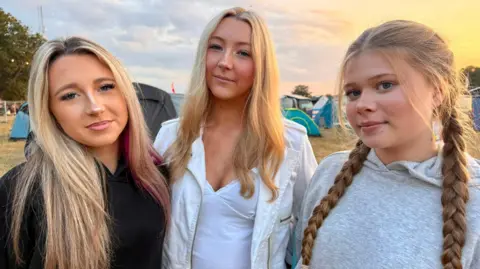
Seventeen-year-old Abi uses social media every day, arranging to meet up with friends on Snapchat and watching videos on TikTok.
When the student, from Colchester, heard under-16s could be banned from social media, she was relieved it would not affect her.
But older teens are now facing an overnight social media curfew, the government announced last week.
Speaking at Latitude Festival, near Southwold in Suffolk, Abi says the curfew feels "pointless" and says "it won't be respected".
She worries about her younger sister Caitlin and younger cousin Libby using social media, but feels she is grown up enough to make her own decisions.
"I know we're not adults yet, but it feels like we are being treated the same as a 12-year-old," she says.
Apps such as Instagram, TikTok and YouTube will be set to be unavailable by default to 16 and 17-year-olds between midnight and 06:00, according to the plans.
Teens will be able to opt out of it by changing their account settings.
The government also wants "addictive" features like auto-play and infinite scroll to be disabled, to help improve teenagers' focus, sleep quality and family life.
 Richard Haugh/BBC
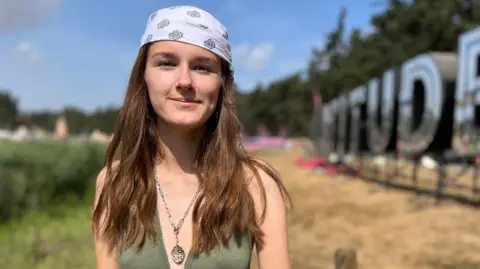
Rafi, from Suffolk, is 15 but will be 16 when the curfew comes in.
"I'm not that bothered by it because I'll be asleep, especially on school nights," she says.
"If it's between midnight and 6am it's pointless, because I won't be using social media.
"It would be more effective if it was earlier, and more useful."
She says there can be a pressure among young people to be ever-present and always online, but the big tech companies could also do more to help.
"I would argue it's the apps' responsibility on timings and when they should be stricter on rules and curfews, rather than the government's involvement," she says.
 Richard Haugh/BBC
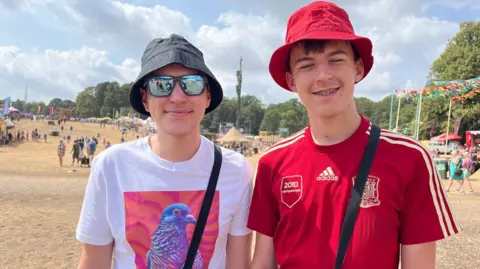
Pablo has travelled from London to be at Latitude.
The 15-year-old says he is not a heavy user of social media apps, but does have Snapchat.
"It's useful to have for communication," he says.
"I think it can have its benefits so it's not good to completely ban them - there are educational purposes, and for entertainment. Rather than watching TV you could watch on that.
"I think there should be restrictions, but not as harsh."
A recent pilot involving more than 300 teenagers and parents across the UK saw social media usage drop overnight due to the curfew.
The measures, which are one of the final acts of the government of Prime Minister Keir Starmer, will have to be legislated upon. It is widely believed that Andy Burnham will follow through with the plans.
"These measures will be crucial in helping young people get the sleep they need, focus on school and college, and spend more quality time with family and friends," the government said.
Australia's social media ban has been held back by VPNs, which disguise the location of internet users.
The government says it will not be taking any action to restrict them in the UK for now, saying they were useful for whistle-blowers, minority groups and family privacy.
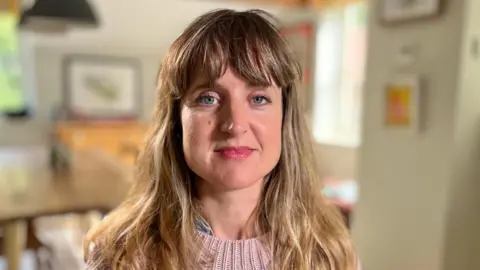
Mother-of-three Daisy Greenwell, 43, from Woodbridge, began the campaign group Smartphone Free Childhood in 2024.
What started as a small WhatsApp group quickly amassed thousands of parents from across the UK.
She has described the planned curfew as a "really good thing".
 Martin Giles/BBC
"A lot of this is about signals and changing social norms around what's healthy and not healthy," she says.
"It lets parents know that kids shouldn't be on these things overnight, and as we know a lot of kids want to spend less time on their phones as well.
"But of course they can switch it off, and any kids with problematic smartphone use, which is one in four, will do that straight away."
While welcoming the recent moves by the government, Greenwell says the root of the problem needs to be addressed.
"Engagement being the core driver of the way these businesses are run is not healthy for children or adults, so the ultimate end goal would be to get that fixed too.
"But let's start with getting this social media ban in place and working."
However, Dr Sarah Turner, a researcher based at UCL's Knowledge Lab who investigates how young people interact with emerging technologies, believes the measures are a step too far.
Speaking at Latitude Festival, where she was doing a talk on the social media ban, she said platforms like YouTube could be a lifeline to some teenagers.
"If you don't have parents who take you to places or a community where there is a space to hang out, then you will be disproportionately affected by this.
"There is undoubtedly harm online, but there needs to be more research. We've told teenagers to use these systems, they have socialised themselves into it, and now we're saying they can't use them.
"They use messaging within these platforms to connect with each other and it's the way they access news. They use these platforms in a different way, to the way people behind the policies do.
"Social media is not all bad. Parents need to have better discussions with their children."
Lorna Woods, professor of internet law at the University of Essex, similarly believes the curfew is an attempt to appease parents and campaign groups.
She welcomes the move in general, but hopes apps can be made safer while they are being designed in the future.
"The focus on features and functionalities rather than content is a positive step, albeit limited in scope," she says.
"A more coherent and arguably more future-proofed approach would be to require services to be safe by design - essentially product safety for digital products."
NSPCC chief executive Chris Sherwood says the proposals are a good first step but not enough on their own, without restrictions on gaming, AI and messaging services.
"Unless they're followed up with further, stronger measures they will be a sticking plaster that fails to address the addictive design features which are driving high screen time and undermining children's wellbeing," he says.
"We need to see action to address harm caused by AI chatbots, which are amplifying damaging content and trapping children and young people in echo chambers. Their safety must be an urgent priority for the new prime minister and his government."
Do you have a story suggestion for Suffolk? Contact us below.
Follow Suffolk news on BBC Sounds, Facebook, Instagram and X.
