How are farmers adapting to climate change?

 Jessica Tilley-Moore
As Britain sweltered this week under the force of its latest heatwave, farmers battled to protect their livestock and crops.
With red weather warnings across much of the Midlands, the pressure was on to keep animals and farmers cool.
It came as this week, the government laid out a new 25-year "roadmap" for farming, setting out how farmers could cope with climate change driven extremes, claiming to give farmers certainty "beyond the next harvest".
Last month, a report by the National Farmers Union (NFU) about the impact of climate change on the industry said farmers needed more help to adapt their businesses, as they faced extreme weather events which were expected to increase in frequency and intensity.
NFU deputy president Paul Tompkins said the report made clear "that farming has becoming increasingly challenging in the UK – changing weather patterns are already hitting yields, farm incomes and long-term business confidence".
'We've got to be flexible'
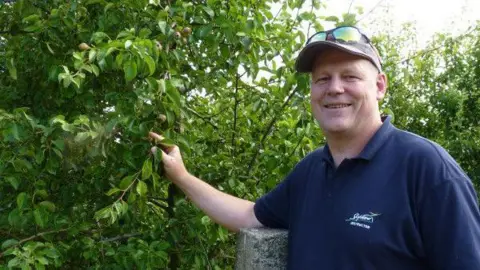
For Stephen Ware from Weobley in Herefordshire, the toll of climate-induced heatwaves is a heavy one.
"It's quite brutal, given the political and economic background as well," Ware said.
"The cost of failure is quite high, it's a perfect storm of issues."
Ware is a third generation fruit farmer at Throne Farm, named as such because King Charles I hid there and sampled its cider while on the run in 1645.
The farm has been growing apples since the early 1600s, when one of Ware's ancestors introduced bittersweet apples to Herefordshire from France.
Now, the farm grows an array of fruits, after the demand for cider apples collapsed, with Ware also farming poultry on the site.
"We've got to be flexible, you can't rely on the seasons anymore, you need a plan," he said.
 Stephen Ware
The heatwaves put a particular pressure on the chickens at the farm.
"It's huge impact depending on the age of the poultry at the time. Chickens are like a down duvet, you use chicken feathers to stuff your duvet to keep you warm," he said.
Ware has made a "major investment" to mitigate this, spending £75,000 on a misting system to keep the chickens cool, which he said reduced the temperatures in the sheds by five to six degrees celsius.
To protect his orchards, the farmers carry out mulching, to hold moisture in the soil, and manage the land using agroforestry - a practice that integrates trees and shrubs into farming systems.
"Agroforestry is a big way you can adapt, it's how a lot of farmers will have to move to adapt to climate change," the 58-year-old said.
"It helps with shelter, you don't have to use chemicals so much, there's a whole raft of benefits."
In order to futureproof the farm, 120kw of solar panels have been installed, and a review of crops that have been grown there historically aims to find out which of those are resilient in the heat.
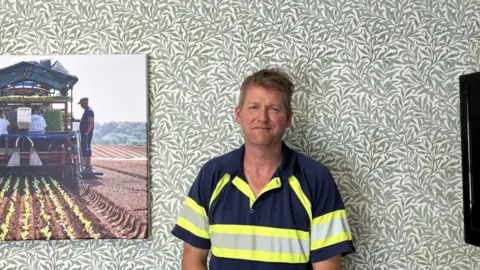
John Harper, from Harper Farming in Worcester, has had to review the crops grown on the site to ascertain which fare better in heatwaves.
While some of the crops can sustain "a couple of days of heat", it becomes more difficult during prolonged heatwaves.
"Some of the crops we grew 20 years ago we don't grow anymore, such as runner beans and marrows," he said.
"They tend to not perform as well in the hot temperatures and we need to look at crops more acclimatised to the heat.
"This year, we're trying butternut squash, which seems to work in the hot temperatures, and courgettes enjoy the heat."
Most of the crops on the farm are hand harvested, meaning the team are having to get up earlier so they can retreat when the heat becomes severe.
"The crops they're harvesting need to come in before the heat of the day, that's critical. We're doing it for the staff and the product," Harper said.
Water security is vital for futureproofing the farm, which is hoping to build a reservoir so there is less scarcity in the summer months.
"Water for us is absolutely critical. We're here to produce food for the nation," he added.
"We've either got to grow less, which is no good for anyone, or plan for the future."
 Jessica Tilley-Moore
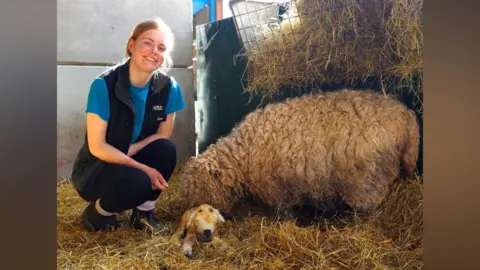
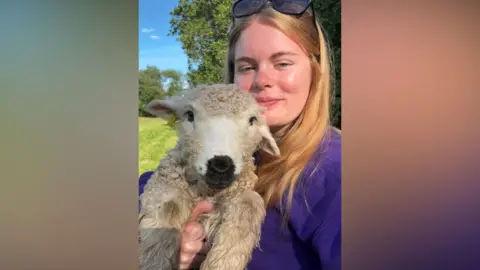
Jessica Tilley-Moore, 20, is the farm education leader at Lower Drayton Farm in Penkridge, and also manages her own flock of sheep in Brewood.
"I do worry about climate change. From last year the yields of crops were horrendous," she said.
"My bales of hay cost me the best part of £100 a bale."
Tilley-Moore dips into her own savings to feed her sheep, and said some people were forced to sell their flocks because they cannot afford to feed them.
Climate-induced flooding takes a huge toll, which she called "horrendously stressful", and causes health problems with the flock.
In regards to heatwaves, the sheep benefit from the land being a mixture of woodland, pasture and hedges, meaning they have plenty of shade.
However, there is still a strain for the 20-year-old in the heat.
"One of the sheep had flies laying on a scab, so I was chasing her in 33 degree heat," she said.
Looking to the future, Tilley-Moore thinks selective breeding is the best way to adapt to climate change.
"I have to look into breeding genetic lines adaptable to the heat, with fleeces that are a lot cooler," she said, adding that her sheep that were bulkier were suffering more in the heatwave.
"It is hard work, don't get me wrong, but I would never change it because I do it for the love of it," she added.
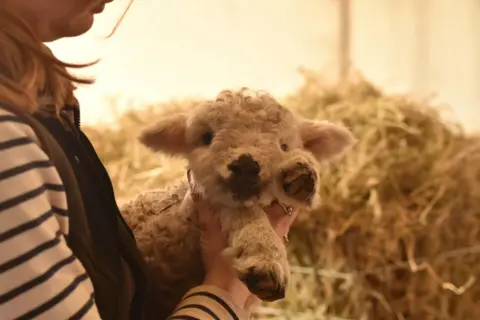 Jessica Tilley-Moore
While farmers are feeling the strain, Ware is optimistic about the future.
"I've got a young lad here on the farm going to college next year, who sees agriculture as a very positive future compared to a lot of jobs," he said.
"It's more AI-proof than other jobs. That's a positive element to the change, we're going to need bright people to help out."
Follow BBC Shropshire on BBC Sounds, Facebook, X and Instagram.
