Plans for £16m renewable energy research centre in Ayrshire scrapped

 East Ayrshire Council
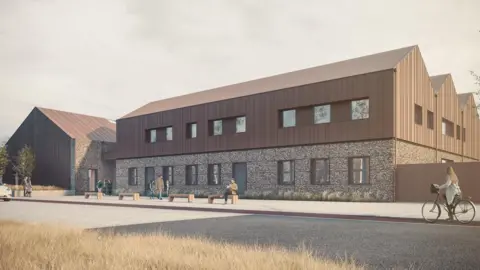
Plans to build a £16m renewable energy research centre in Ayrshire have been abandoned.
The proposed Community Renewable Energy (CoRE) Research and Innovation Centre at Knockroon, near Cumnock, was intended to become a regional hub for renewable energy innovation.
East Ayrshire Council have now overhauled the project, which was funded through the local authority's growth deal initiative.
It now aims to establish three vocational training hubs in Cumnock and Dalmellington while redirecting money towards other renewable energy projects in local communities.
Up to £5m of money budgeted for CoRE could be transferred to help meet rising costs at the Ayrshire Innovation Park at Moorfield, near Kilmarnock.
The centre of excellence was to include research and development facilities and two Passivhaus demonstrator homes - meaning they would meet energy efficient design standards and maintain an almost constant temperature.
The changes are detailed in a report to the Ayrshire Regional Economic Partnership Board, having originally been suggested in March.
CoRE is a £24.5m project, comprising £17m from the UK government and £7.5m from East Ayrshire Council. It is aimed at using the transition to renewable energy to create jobs, improve communities and tackle fuel poverty.
The project was split into three phases in 2024, covering demonstration projects, renewable energy infrastructure projects and the new Centre of Excellence.
Funds of £16m were allocated to the centre at Knockroon, but the report states the proposed Research and Innovation Centre "will not progress".
Officials say the pandemic, cost-of-living crisis, supply chain disruption and post-Brexit market pressures have increased construction costs and interest rates to the point where the original building plan has become financially unviable.
'Lack of locally skilled workers'
The rationale originally used for a standalone centre has also changed, as project partner the University of Strathclyde no longer requires space in a dedicated facility, following changes to working practices and delivery models.
Discussions with businesses, education providers and academics also identified a shortage of workers qualified for jobs in renewable energy and low-carbon industries.
The report says employers "consistently" identified the absence of a locally skilled workforce as one of the main constraints on business growth and inward investment.
As a result, the focus is switching from a research-led facility towards vocational training, STEM education (science, technology, engineering and mathematics) and helping local people gain qualifications for jobs in the low-carbon economy.
The proposed CoRE Vocational Skills and Training Academy would operate from three existing partner locations.
"CoRE in the Community" would be based at Cumnock Juniors Community Enterprise, while "CoRE in Industry" would operate from fire appliance manufacturer Emergency One's premises in Cumnock.
A third hub, "CoRE in Education", would be based at Skills & Learning 99 in Dalmellington.
The three hubs now require separate business cases before final investment decisions are made.
The council expects the multi-site approach to cost substantially less than the original research centre, but the report does not specify how much the replacement facilities are expected to cost.
Some of the money released would instead be used for further CoRE projects in communities and council buildings.
The council is also seeking permission to transfer up to £5m from CoRE to the Ayrshire Innovation Park in Kilmarnock.
The £5m represents a maximum possible amount rather than a confirmed final figure.
