Calls for clarity over schools smartphone ban

 Getty Images
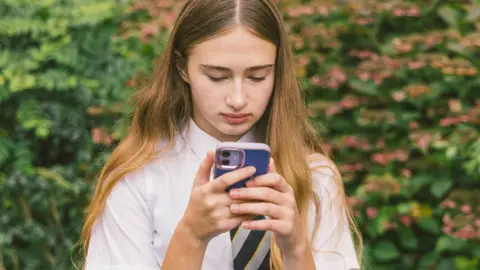
Headteachers and campaigners have called for clarity on how best to implement the government's proposed legal ban on smartphones in schools.
In an amendment to the Children's Wellbeing and Schools Bill, the government is proposing an existing law be altered so schools will have a legal duty to consider the guidance which says schools should be "mobile phone-free environments by default".
In the Commons on Wednesday afternoon, Minister for Early Education Olivia Bailey said "the package of measures that we have already put in place will ensure effective bans of phones in schools".
In response, the shadow education secretary Laura Trott welcomed the statutory ban but pressed for clarity on whether a "not seen, not heard" policy is allowed under these rules saying "these policies don't work."
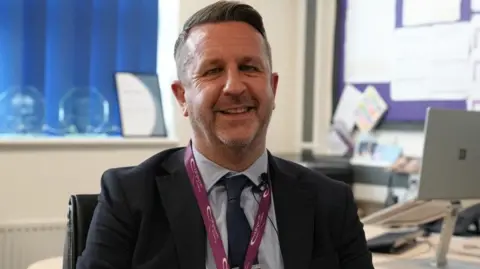
Rob McGinty, headteacher at Hollingworth Academy in Rochdale, Greater Manchester, said his school currently has a "no see, no hear policy" but he would be in favour of completely removing smartphones from schools.
"I think some pupils will still continue to bring phones into school, so as far as a ban is concerned I think we need more details around what that looks like in order to support schools and teachers better," he said.
 Hannah Karpel/BBC
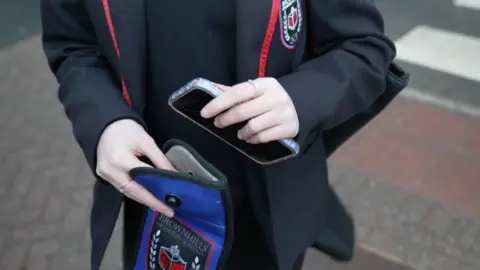
The school has started a consultation with pupils, staff and parents on the introduction of lockable pouches, which block the phone's signal so notifications are not transmitted to smart watches or wireless earbuds and headphones.
"No one's naive enough to think that mobile phones won't be going off in a blazer or trouser pocket, or even in school bags," McGinty said.
"They vibrate, they go off, then prompting a child to want to have a look and see what the alert is rather than focusing on the important thing - which is being in a lesson, focusing on what the teacher's saying and getting a really good education."
Parliamentary 'ping-pong'
Education Secretary Bridget Phillipson had written to schools earlier this year encouraging them to follow new guidance that schools be phone-free for the entire day.
But the Conservatives had pushed for an amendment to the Children's Wellbeing and Schools Bill, calling for an outright legal ban.
The government has said it will put that guidance on a statutory footing which means schools must pay attention to it, and argued it is different from what the Tories have been advocating for.
The Bill is currently stuck in parliamentary "ping-pong", where legislation moves between the Commons and Lords until agreement is reached on its final wording.
The government is now running out of time to get this key bit of legislation - which includes other measures such as a register of children not in school and a unique identifying number for children - over the line.
The Bill is expected to return to the House of Lords early next week, with potentially limited time for a final Commons vote before the end of this parliamentary session.
Charlotte Ashton, from school phone-free campaign group Generation Focus, agreed that head teachers need more direction on how to implement the ban.
Ashton said 80% of schools with smartphone bans have a "no see, no hear" policy, which she says is "simply ineffective".
"It doesn't work to allow children to keep possession of their smartphones, because they are the world's most powerful distraction devices, and they are using them under the desks and in the toilets and in places where teachers can't have eyes on them.
"Until we move explicitly to a ruling out of 'no see, no hear' for smartphones, we won't get the change that we need to protect our children during the school day."
Ashton said the "gold standard" would be for schools to only allow "brick" phones, which can be used to call or text but have very limited internet access, and are not a "distraction tool".
A significant logistical exercise
Pepe Di'Iasio, general secretary of the Association of School and College Leaders (ASCL) said school leaders are "best placed to decide on the most appropriate mobile phone policy for their setting".
He added that to go further than a "not seen, not heard" policy, where pupils are "separated from their phones throughout the day", would be "a significant logistical exercise for schools and one that could prove hugely costly".
"The government would therefore have to provide funding to enable schools to find a safe and secure storage that works for their setting."
Paul Whiteman, general secretary of the headteachers' union NAHT, said it supported the legal ban and that statutory guidance will give school leaders the clarity they need to implement the ban.
 Hannah Karpel/BBC
"Schools will only then need to decide how to implement and enforce a ban across their school community and the Government must provide any support they require to do so effectively," he said.
"Some schools will need time to communicate with parents and pupils on implementation of a complete ban where this is not already in place."
Skills minister Baroness Smith of Malvern told the Lords on Monday: "We've listened to concerns about how we support headteachers in delivering on this policy and we have listened to Parliament."
In a statement, Laura Trott shadow Education Secretary said: "I am delighted we have forced Labour to see sense and U-turn. This is fantastic news for headteachers, parents and pupils across the country.
"This is the right step for improving behaviour and raising attainment in our classrooms."
Liberal Democrat schools spokesperson Caroline Voaden said the government "must ensure all schools have the necessary support and funding to manage this transition".
In a statement, she added: "If schools decide to introduce pouches or lockers, the government should ensure they are resourced to do so."
Reform UK's Education Spokesman Suella Braverman MP said: "The current guidance simply does not go far enough. A clear, enforceable ban to protect children is the right thing to do, for standards, parents, teachers and for the future of our children."
A Green Party spokesperson said they are "deeply concerned about the potential harms caused to children and young people by smartphone usage and social media."
A statement went on to say a "thorough consultation process with parents, teachers, and young people themselves, is key to creating effective solutions to the problems associated with mobile phone use in schools."
 Hannah Karpel/BBC
Back at Hollingworth Academy, Year 10 student Elena says having a phone can be useful if a plan changes "if I need to tell my mum where I was going to be and I wouldn't be able to then she would be worried about me and then I would have no way of getting home."
Shaan says there are pros and cons to a ban. She agrees that not being able to quickly get hold of her parents would make her feel "stressed and have anxiety" but that she gets "distracted on my phone a lot as well".
"I feel like if I have a pouch, it will stop me going on my phone a lot and checking it."
Additional reporting by Branwen Jeffreys, education editor and Hannah Karpel
