Police make 43 arrests in first month of anti-social behaviour zone

 Police Scotland
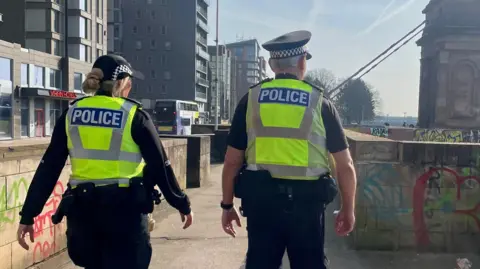
Police have arrested 43 people in the first month of a new dispersal zone to tackle crime and anti-social behaviour in Glasgow city centre.
Officers have used their powers 438 times since the zone was introduced on 20 March - on average 14 times a day - with the majority of warnings to adults over 16.
The zone allows police to ban groups of two or more people from the area for 24 hours if their behaviour is "impacting on the safety and well-being" of others.
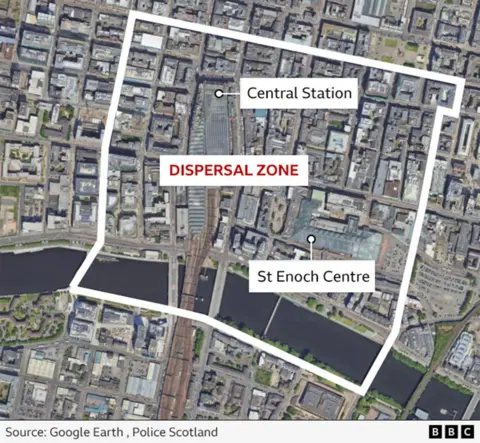
Police Scotland said those arrested had returned to the area - which covers Glasgow Central Station and St Enoch Square - in breach of dispersal warnings.
The force said 14 of the 43 arrests were also connected to other offences including breach of the peace, drugs possession, police assault, possession of an offensive weapon and two in connection with sexual assault.
Supt Jackie Dunbar said: "These powers provide officers with an additional tool to address anti-social behaviour and help keep people safe in the city centre and are used proportionately and only when necessary."
"The majority of those who have been issued with warnings have been adults, with very few instances involving those under the age of 16."
The dispersal zone is an area bounded by St Vincent Place, Glassford Street and West Campbell Street to the opposite bank of the River Clyde.
Police Scotland said it would continue to be monitored and kept under review.
Are dispersal zones an effective measure?
Dispersal zone powers are not new but were introduced in Scotland under the Antisocial Behaviour etc. (Scotland) Act 2004.
A review carried out three years later, found they had been used on 14 occasions in 11 separate areas including in Glasgow, Edinburgh, Aberdeen.
But they have also been used in smaller towns like Dumfries and Dingwall - and one was once imposed on an entire village, Mid Calder in West Lothian.
The aim was to end the "cat and mouse" problem for police officers who often found trouble makers had moved on by the time they arrived.
The new powers also gave officers a new way of dealing with behaviour that while being anti-social, was not serious enough to merit stronger enforcement action.
Failing to comply with a dispersal order became a criminal offence which could lead to arrest under the act.
Recently the dispersal powers have been used alongside new Firework Control Zones in parts of Edinburgh following repeated incidents around Bonfire Night.

Analysis: Is this a cosmetic exercise for tourists?

What's striking is just how much this power has been used - on average around 14 times a day.
So it's clearly being treated as a useful weapon against anti-social behaviour. How long then, will this temporary measure last? Police Scotland are simply saying it will be kept under review.
There's sensitivity about how this power is used, because it allows officers to scatter, not just caution.
It allows exclusion on the spot - with no court order required. And it means people can be banned temporarily from their own city centre.
Glasgow hosts the Commonwealth Games at the end of July.
Some will want this power to remain in force until then, as a way of helping the city centre look its best for the visitors.
But is this essentially a cosmetic exercise - rolling out the red carpet for tourists, by clearing the pavement?
It'll certainly move people along, but it's unclear if it will stop the problem - and make the city centre safe all year round.
