MSPs sworn in at Holyrood before electing new presiding officer
The SNP's Kenneth Gibson has been elected as Holyrood's new presiding officer.
The Ayrshire MSP, who will resign his party position to take up the impartial role, was chosen in a ballot of the whole parliament.
His election came after MSPs were officially sworn in for the new term.
Gibson saw off challenges from Liberal Democrat Liam McArthur, as well as SNP colleagues Claire Haughey and Stuart McMillan.
The SNP's Clare Adamson and Scottish Labour's Katy Clark were elected as deputy presiding officers.
The presiding officer - paid a £136,112 salary - chairs debates, selects speakers in the chamber and represents the parliament at home and abroad.
Gibson was elected in a secret ballot of MSPs. After McMillan and McArthur were eliminated in the early stages of the voting, Gibson saw off Haughey in a final round by 74 votes to 54.
McArthur, a well-respected MSP and former deputy presiding officer, had been widely tipped for the role.
Haughey, a former health committee convener, was seen as the SNP leadership's favoured pick.
Gibson, on the other hand, was known not to pull any punches in his role as convener of Holyrood's finance committee, including criticism of the SNP government.
He has vowed to liven up proceedings, saying during a hustings event that chamber business had become "dull".
After taking his place in the presiding officer's chair, Gibson said the parliament could "be so much more" but that he was looking forward to working with the whole chamber to make improvements.
Who is Kenny Gibson?
Gibson, who represents Cunninghame North, was first elected in 1999. Aside from a spell away from Holyrood between 2003 and 2007, he has been there ever since.
Although an SNP veteran, he has never been a minister.
Gibson is married to fellow SNP MSP Patricia Gibson, elected in Cunninghame South.
Born in Paisley, he served as a councillor in Glasgow before being elected to Holyrood.
Gibson was the first MSP to table plans for a public smoking ban in 1999, though the proposals were shelved when Gibson lost his seat, with a ban not passed until 2006.
His first task as presiding officer was to chair a vote to elect two deputies.
SNP colleague Clare Adamson and Labour‘s Katy Clark took the roles, which come with a £114,297 salary.
Next week, MSPs will choose a first minister. The SNP's John Swinney is the firm favourite to be reappointed in the role after his party won a comfortable election victory.
Gibson's election means the SNP group will be cut to 57 MSPs, with Reform and Labour on 17, the Greens on 15 and the Lib Dems on 10.
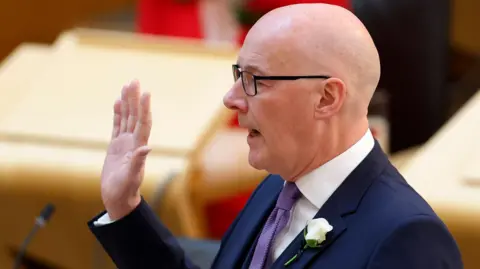
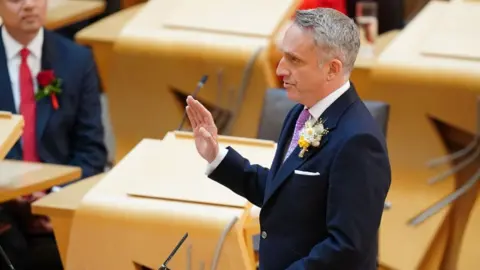
Earlier, MSPs were officially sworn into the Scottish Parliament.
All 129 parliamentarians - including 64 first-time MSPs - swore allegiance to the King, either by affirmation or oath during a ceremony in the chamber.

 Getty Images
 PA Media
Swinney took the opportunity to declare his "primary loyalty" to the "people of Scotland".
MSPs made statements in a variety of languages, including Scots, Gaelic, Hindi, Polish, Mandarin and French.
MSPs donned traditional floral decorations during the ceremony. SNP MSPs wore white roses - a nod to Hugh McDiarmid's 1931 poem The Little White Rose.
The Conservatives also wore a white rose - though it was not linked to the nationalist poet.
Labour MSPs wore red roses, Reform UK a Scottish heather, the Greens what appeared to be a fuchsia pink gerbera and the Liberal Democrats a mini-mixed bouquet.
Some parliamentarians also wore traditional dress reflecting their various backgrounds.
The SNP's Karen Adam, carer to her deaf father, made her statement in sign language.
Moray representative Laura Mitchell was among those to use a prop during the ceremony.
She held a stave of the Clavie - a piece of charred wood from the annual Burghead fire ritual - which is meant to bring good luck.
