Government urged not to 'abandon' coastal communities to the sea

 BBC
BBCThe government is being urged to ensure homes and businesses on the low-lying Lincolnshire coast are fully protected from flooding in the decades ahead.
The plea by council leaders follows the publication of a new strategy to defend the coastline from rising sea levels and climate change.
Some of the ideas being explored in the Lincs Coast 2100 document include allowing parts of Lincolnshire to flood and moving some communities inland to higher ground to avoid flood risk.
While the report does not identify specific areas, Councillor Craig Leyland, Conservative leader of East Lindsey District Council (ELDC), said it was important coastal communities were not "abandoned" by any new policies.
"We have established communities here with small businesses and big businesses investing every day of the year," he added. "Why would we abandon them? It works."
Faye Walton, who lives across the road from the sea front in the town of Mablethorpe, described the defences as "reassuring".
"We've had a few close calls over the years when we've had the [flood] warnings and we've been told to get out or go upstairs, so it's very important to keep these defences going," she said.
The Department for Environment, Food and Rural Affairs (Defra) said the government had invested more than £600m in protecting communities from sea and tidal flooding over the past two years.
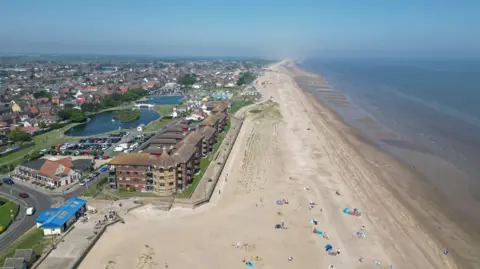
While the report states that urgent action is required to ensure Lincolnshire is "ready for and resilient to flooding and coastal change beyond 2100", it also warns coastal communities cannot rely on existing defences after 2040.
According to the Environment Agency (EA), defences along the Lincolnshire coast protect about 20,000 homes, 60,000 residents, 35,000 hectares (86,000 acres) of agricultural land and 29,000 caravans.
If the event of a breach, floods could spread up to nine miles (15km) inland and reach depths of up to 8ft (2.4m), according to the EA.
The agency has formed the Lincolnshire Coast 2100 partnership with Lincolnshire County Council and ELDC to consider options to reduce the risk.

According to the Lincs Coast 2100 report, the cost of rebuilding the entire flood defence system could reach up to £7bn. It suggests an "alternative approach" may be necessary involving the creation of "wetland areas" instead of hard defences.
Reform UK councillor Danny Brookes, who holds the environment portfolio for the county council, said it was "vital" that coastal homes and businesses were fully protected.
He said the government needed to "fully recognise" the value of the coastal economy and understand the economic benefits it was bringing to the UK.
"The cost of new defences for coast should not be prohibitive, there are tourism and other businesses along this coastal strip that bring more than £500m every single year and that investment needs protecting," Brookes added.
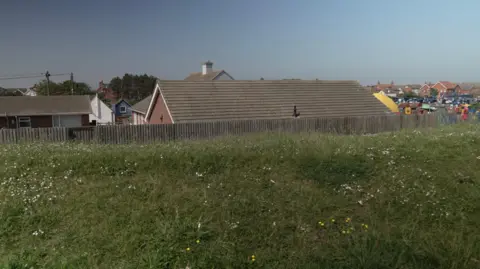
The existing flood defences for Lincolnshire were built following the devastating floods of 1953 in which 43 people lost their lives.
Chris Miller, the county council's head of environment, said 85% of these structures would be unreliable after 2040.
Leyland said he was "joining forces" with county council colleagues to "make representations to government" about the importance of protecting the coastline.
"This is a hugely important economic community that needs protecting from the sea – it's not a crumbling coastline like that of East Yorkshire or Norfolk."
He said the current formula used by the EA for calculating the cost and benefit of flood defences needed "resetting".
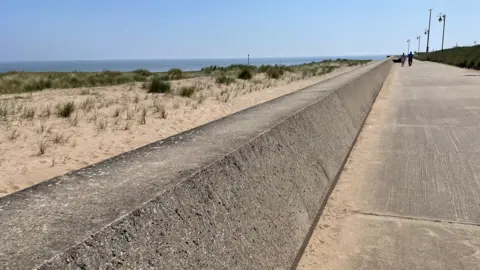
Every year the concrete defences are covered in huge quantities of sand, pumped from the seabed, to give communities added protection in a process known as "beach nourishment".
But the EA says it "will not be sustainable to continue with this method of flood risk management in the future due to the increased levels and frequency of sand that would be associated with the effect of climate change".
According to Brookes, this method of flood defence also builds up sand on many of the beaches along the Lincolnshire coast and is a "big draw for tourists".
"We will fight for our beaches and we will win. This coast is worth every penny, they [the government] needs to get its wallet out and spend," he said.
A spokesperson for Defra said the government was "working with local authorities and the Environment Agency to ensure coastal communities get the long-term protection they need".
In addition to the £600m investment, a further £30m had been announced for coastal communities facing eroding shores, while funding rules had been "overhauled" to "make it faster and simpler to get the right defences in the right places".

Paul Russell, who lives in the shadow of the sea defences in Mablethorpe, said he did not feel vulnerable.
"There are rumours that in 100 years' time Mablethorpe will be under the sea, but I don't believe that for one minute."
Russell, a town councillor and former mayor, added: "I've every confidence in the sea defences.
"We've had a few occasions where the tide has come over slightly, but I've not been worried at all."
Walton said she would consider moving to higher ground, but hoped it would not be necessary.
"I would consider moving out, but it's a shame because it's a lovely little town," she said.
"If it's something that can be sorted, then I think they should. It needs to be sorted and fixed, for the younger generation, if not for me."
Listen to highlights fromLincolnshire on BBC Sounds, watch thelatest episode of Look North.
Download the BBC News app from the App Storefor iPhone and iPad orGoogle Play for Android devices
