Funeral pyre find 'rare as hen's teeth'

 Oxford Cotswold Archaeology
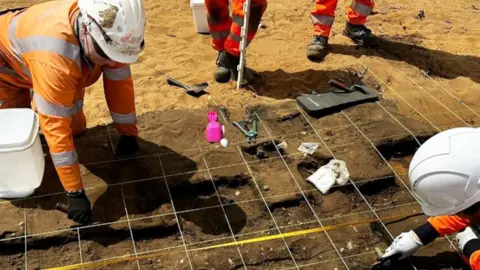
Archaeologists working on one of Britain's biggest digs have been amazed to find the remains of an ancient funeral pyre.
They made the discovery during excavations ahead of the building of the Sizewell C nuclear power plant, near Leiston, Suffolk.
"Funeral pyres are very rare archaeological features – they're the archaeological equivalent of hen's teeth," said Chris Fern, of Oxford Cotswold Archaeology.
He hopes that analysis of bone fragments recovered from the site at Goose Hill will reveal if they are human, as well as their sex or age.
 Oxford Cotswold Archaeology
"We know that lots of societies cremated their remains in prehistoric periods, as well as the Romans and early Anglo-Saxons," said Fern.
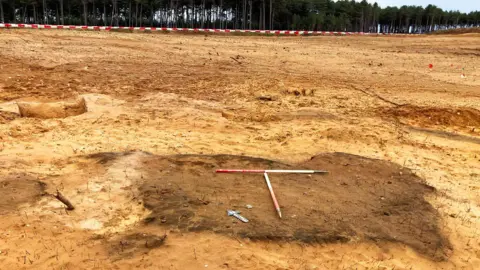
"But it's very rare to find the cremation pyres themselves because they tend to be built on the surface and would be lost over the years by ploughing."
A pyre is a structure, usually of wood, used to burn a body in a cremation rite.
The Goose Hill example was probably made of a stacked lattice of timbers over a core of kindling and heath scrub and supported by standing posts.
The remains of post-holes were also unearthed.
Fern suggested it probably survived because it was covered by a burial mound, which took hundreds, if not thousands, of years to be ploughed away.
Goose Hill was also used as a vital training ground during World War Two, which caused further disturbance.
 Oxford Cotswold Archaeology
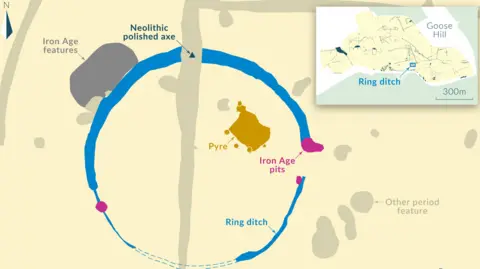
The pyre was inserted in the side of a ring ditch, which experts say must date to before the Iron Age (700BC to AD43)
It could therefore date from the Bronze Age (from 2500BC) or the Iron Age, or even centuries later, as suggested by its off-centre position in the ditch.
"In the Anglo-Saxon period in particular, they reused prehistoric barrows almost as a way of claiming the landscape, even though we know there can't have been an ancestral connection, as way of laying claim to territory," said Fern.
Very few bone fragments were recovered, suggesting most were removed after the fire died down and buried elsewhere.
But they could also be animal remains, because sometimes horses or dogs were cremated with their owners, or cuts of meat were added to the pyre.
Fern hopes it will be possible to radiocarbon-date the bone and charcoal, as well as studying the plant remains and any objects placed on the pyre.
 Oxford Cotswold Archaeology
Do you have a story suggestion for Suffolk? Contact us below.
Follow Norfolk news on BBC Sounds, Facebook, Instagram and X.
