A robot helped our 15-year-old daughter walk for the first time

 Gwenno Davies
Parents have been able to see their children walk for the first time through the help of a robot.
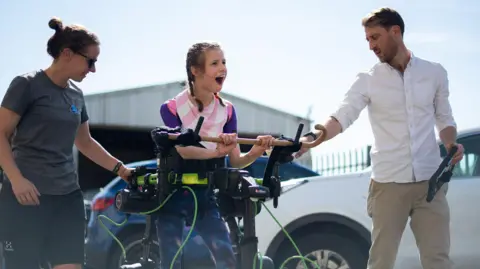
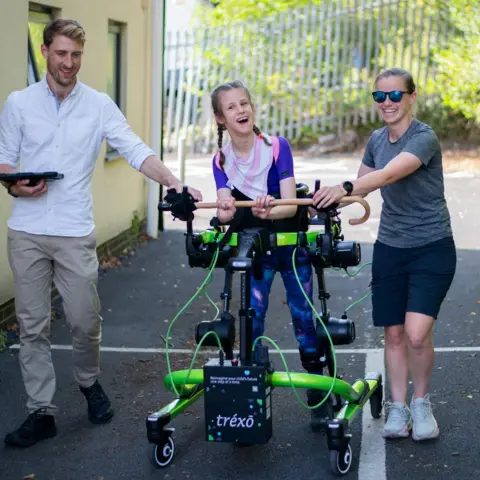
Brooke Hacker, 15, from Sketty in Swansea, has cerebral palsy and used the exoskeleton to walk 812 steps, with her four-year-old sister able to run alongside her.
Her father Andrew Hacker said "you can't put into words what it feels like to see your daughter do something you were told would never happen".
The trial in Carmarthenshire is the first time Canadian company Trexo Robotics has brought the £50,000 technology to the UK.
Brooke's family are calling for it to be made available "nationwide".
 Gwenno Davies
Cerebral palsy affects about one in 400 children in the UK, according to the NHS.
It is a developmental disability that affects movement and co-ordination.
Brooke has been attending physiotherapy sessions at Equinox Physiotherapy clinic in Cross Hands, Carmarthenshire, for over a year and was one of the first children to take part in the trial.
It was the first time Brooke's parents, Andrew and Rebecca Hacker, had ever seen her walk.
Brooke's mother, Rebecca Hacker said: "We've never seen Brooke walk like that before, to see her enjoy is incredible."
Andrew said they are "extremely proud" of Brooke's progress.
"She's an amazing young girl, she's intelligent, she knows what she wants. I always tell her the world's her oyster, if you work hard you'll go a long way, and she's doing very much just that."
Using the robot, Brooke's four-year-old sister Holly was able to run alongside her.
Rebecca said she never thought she would see the siblings running together, describing it as "incredible".
 Family photo
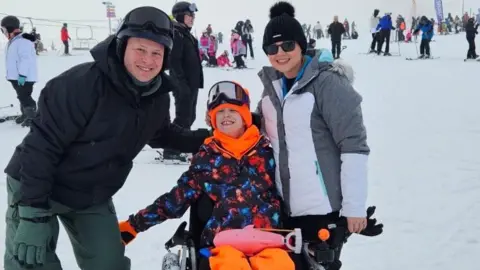
Rebecca and Andrew want to see the technology available "nationwide".
Rebecca said every child should have the opportunity to access equipment "that would change their life".
Andrew added: "The independence it gives them without having someone hold them, it gives them a sense of normality."
Mia Martin Evans, lead paediatric physiotherapist at Equinox, said Brooke walked 812 steps with the help of the robot while she would usually walk 30 in a normal session.
Mia said that developing technology will "ultimately benefit the children".
"It's hard to keep up with at times because innovation is just rapid," she said.
"Even with existing things you can add AI into the software to get better analytics that really give us insight. Through technology like Trexo and insights we can get, we can be really more specific in how we're delivering therapy programmes."
 BBC News
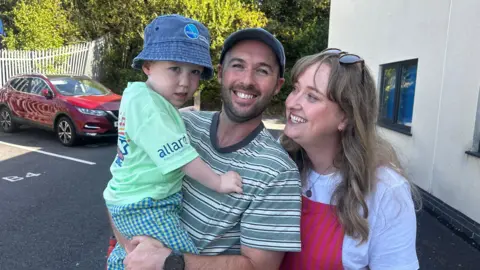
For Carys and Marc Bowen, seeing their three-year-old son Hopcyn walk for the first time was "overwhelming".
He was born with spastic quadriplegic cerebral palsy, and Carys said they were told "we don't know whether he'll be able to walk independently or sit up or speak".
"It was absolutely terrifying at the time," Carys said.
With the Trexo only being at Equinox clinic for five days, Carys added it was a bit like "dangling the carrot".
"He's tried it, but now it's being taken away because it's so expensive."
She added: "It's bittersweet because we can see that he loves it, but we're happy to just have this experience in the first place because he's going to progress from it."
What is an exoskeleton?
According to Trexo Robotics, the technology helps children to practise walking patterns that would be difficult to do through conventional therapy alone.
The motorised, wearable exoskeleton can be adjusted to a child's height, needs and abilities, and is designed to help children with conditions like cerebral palsy, spinal muscular atrophy and muscular dystrophy, or who have suffered from a stroke or brain injury.
It was created in 2011 when one of the co-creators, Manmeet Maggu, found out that his nephew who has cerebral palsy would never be able to walk.
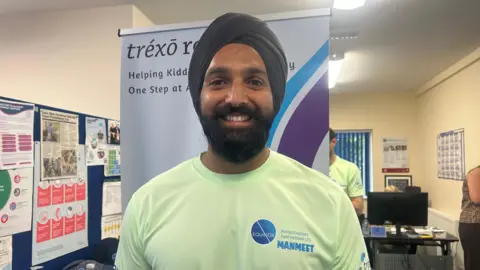
Manmeet told BBC Wales he hoped the technology would be rolled out across the NHS "in the future".
"We don't know how long that will take but what I know is that we're not going to stop or give up, any child who wishes to walk should be able to walk," he said.
He added it was "not a cheap device" costing between £40,000 and £50,000.
"The goal first of all is to have families and kiddos experience it, and then if they want to acquire the technology we can support them."
The robot is already in use in countries like the USA, Canada, Australia and Singapore.
Analysis by Owain Clarke, Wales health correspondent
From robotics to AI, from new medicines to DNA analysis, cutting edge technology has the potential to transform patients' lives.
But the latest equipment and drugs can be expensive, and because it has a limited budget, the NHS will never be able to pay for everything.
Independent experts, such as those who are members of Nice, the National Institute for Health and Care Excellence, assess emerging technologies and come to a conclusion about whether a new treatment should be offered, taking into account patient benefit, price and value for money.
So, they'll potentially have a say about whether this or similar technologies should be ultimately offered by the NHS and to what extent.
But, whatever, the outcome, the sheer speed of research and innovation in this and other fields, will give hope to many.
