Canada's Carney under pressure to fight back against Trump tariffs
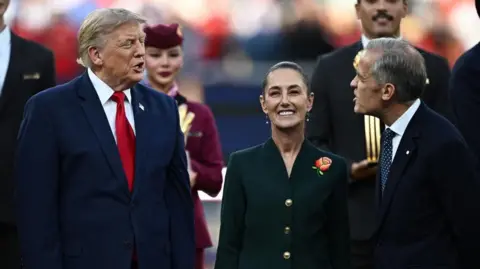
Just this weekend, Canadian Prime Minister Mark Carney and US President Donald Trump sat together in New Jersey for the World Cup final - a send off to a joint North American tournament that has, despite criticism over ticket prices and travel costs, been widely viewed as a success.
The following day, hours after the two leaders were pictured smiling and chatting inside the stadium, the US announced a fresh round of tariffs against one of its closest trading partners.
The surprise move slapped a 50% levy on a range of goods, from hockey sticks to candles and synthetic wigs.
Canadians, however, are now used to riding out the storm, says pollster David Coletto, CEO of Abacus Data.
"Most Canadians are largely of the view that they cannot trust the Trump administration," he said.
There remains "deep anger" among many over what they view as unfair treatment from the US, he said, adding that "most people do not want Mark Carney to cave".
The latest round of tariffs announced on Monday, which the US said was a response to "unequal treatment" of US cars, dairy and alcohol by Canada, is only likely to firm that resolve.
Still, Canadians could be forgiven for wondering - why now?

 Reuters
The levies, which will come into force on 19 August, come as on-again and off-again talks between the US and Canada to renew the North American free trade agreement with Mexico - known as the USMCA - finally seem to be on again.
The new Gordie Howe International Bridge, which is expected to bolster trade between the car capitals of Windsor, Ontario, and Detroit, Michigan, is set to open on Monday following weeks of delays, after Canada agreed to new revenue sharing terms with the US.
And previous recent threats to tariff Canadian planes, or seek restitution over wildfire smoke that drifted south into the US, were widely dismissed as bluster from the American president.
Mahmood Nanji, a fellow at Western University's Ivey Business School told the BBC he believes this latest move is a strong-arm tactic by the Trump administration to pressure Canada into a trade deal.
"He's using all tricks in the bag to try to get as much leverage as he can," he said.
Stakeholders who have been closely watching the trade file also say they aren't completely surprised by the move.
US officials have spoken publicly about their frustration with the retaliatory tariffs Canada has imposed, noting it's the only country besides China which has taken such countermeasures.
Candace Laing, President and CEO of the Canadian Chamber of Commerce, said in a statement that her organisation knew "this would get bumpier before landing".
The new tariffs are a significant ramp up in the trade dispute, and add to trade barriers already in place between the two countries.
The US has been maintaining active tariffs ranging from 15% to 50% on Canadian steel, aluminium and copper. It also charges a 35% tariff on Canadian softwood lumber, alongside a 25% tax on non-US parts in cars.
Those so-called sectoral tariffs are taking a bite out of those industries, and Canada is seeking some relief in ongoing talks with their US counterparts.
Meanwhile Canada has its own 25% counter-tariff on selected imports of American steel, aluminium and vehicles, and most provinces removed US alcohol from the shelves last year in response to the US levies.
The latest tariff threat, announced in the form of a presidential proclamation, also comes as parallel talks with Mexico appear to be progressing more quickly, adding more squeeze on Carney to reach an agreement.
US Trade Representative Jamieson Greer is in Mexico this week for the latest round of formal trade talks. Last week, Greer told the Aspen Security Forum that while he and his Canadian counterparts speak weekly, "we just haven't seen a lot of movement" on negotiations.
The US was the only party to refuse to renew the USMCA, the trilateral agreement, this month.
The agreement, which underpins around $2tn (£1.5tn) in trade each year, is facing pressure over unresolved disputes and US officials are pushing for changes. Without a long-term extension, the deal will undergo annual reviews until it expires in a decade.
The new US pressure could also signal a renewed broader focus by Trump on tariffs.
Canada has often been one of the first countries targeted by the US before it imposes them more widely - becoming a leading indicator of where American trade policies are headed.
On Tuesday, Greer hinted more global US tariffs were on their way.
"We expect to see some action soon," he told CNBC in an interview. "I can't really specify a timeline right now. I have responsibility to brief Congress and other stakeholders before I really reveal that kind of thing."
Carney, meanwhile, told reporters on Tuesday that he had spoken with Trump and the pair had agreed to intensify trade talks.
He also said Canada would "look at all options in terms of how we would respond" if the new tariffs come into effect next month.
Carney, who has repeatedly said that no deal is better than a bad deal with Trump, stressed that Canada's objective remains getting a comprehensive agreement signed with the US.
He met with Canada's provincial premiers on Tuesday afternoon to discuss the response to the latest US pressure, but may feel pushed himself by some provincial leaders to fight back.
"We can't keep rolling over, we can't keep backing down, we have to go full tilt," Ontario Premier Doug Ford, one of the most high-profile Canadian critics of Trump's trade policies, said on Tuesday.
Lawrence Herman, a trade expert with the CD Howe Institute think tank, also urged a tough response.
"Giving in and trying to get along with the United States by making concessions now is not the right strategy, and it would be, I think, harmful to Canada's national pride and our international standing in the eyes of the world," he told the BBC.
Pollster Coletto said the prime minister still has political runway with Canadians.
He said the public at this point is largely resistant "to more salvos coming from Washington in a way they weren't a year ago".
Nanji said Canada would have to make difficult decisions on how it chooses to move forward as the clock ticks towards 19 August, including possibly conceding on some outstanding issues if it means securing long-term trade certainty.
It will also need to figure out where to draw the line, he said.
Canada, he said, would likely "retaliate as well too, but they're trying to say 'let's not panic, let's stay calm'".
"But there will come potentially a breaking point at which we'll have to say, 'Here's the red line. You can't cross that.'"
