Scientists sail to Greenland to study melting ice sheets

 Richard Knights/BBC
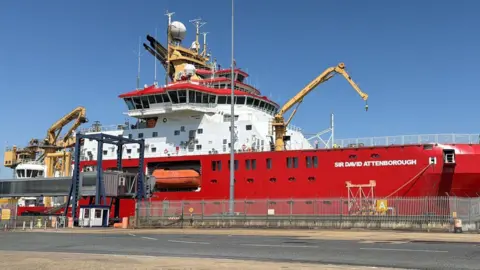
A group of international scientists are heading to Greenland on the UK's polar research ship RRS Sir David Attenborough to study how quickly melting ice sheets are pushing vital ocean currents towards collapse.
The team will depart from Harwich International Port in Essex on Thursday.
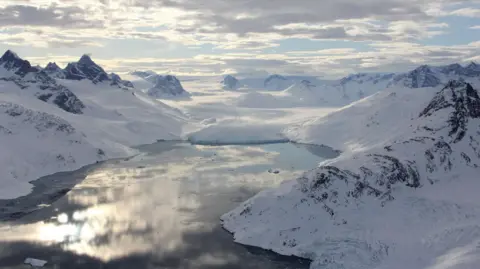
It is hoped the data gathered on tidewater glaciers can be used to improve predictions for the future of Greenland's glaciers and their impact on the surrounding ocean as they melt.
The scientists said collecting a pioneering array of data was vital because current climate models did not accurately represent the complex ways in which Greenland's glaciers interact with the warming ocean.
There are fears Greenland's rapidly melting ice will add vast quantities of freshwater into the ocean, with scientists warning that this could change a major Atlantic Ocean current system, called the North Atlantic Subpolar Gyre.
This in turn affects a network of deep and surface currents that stabilise the global climate and help to keep temperatures milder in Western Europe, compared with other regions at similar latitudes, such as parts of eastern Canada and Siberia.
A breakdown of this system could potentially plunge the UK and large parts of the Northern Hemisphere into a new ice age, scientists said.
 Richard Knights/BBC
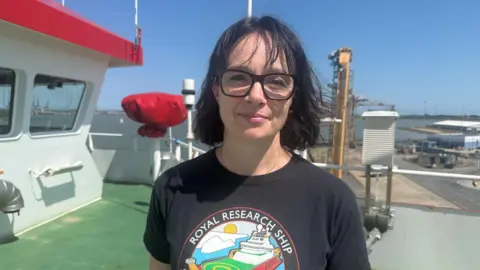
Dr Kelly Hogan, a marine geophysicist with the British Antarctic Survey, based in Cambridge, is leading the Greenland Ice sheet to Atlantic Tipping points project, also known as GIANT.
She said: "We're in a moment where our tools have finally caught up with our questions.
"With autonomous vehicles, advanced sensors and powerful modelling – boosted by AI – we can explore glacier-ocean interactions in ways that were unimaginable just a few years ago."
 Reuters
The scientist told the BBC the six-week project should lead to crucial and better climate analysis.
"What happens in Greenland really affects what happens in the UK," said Hogan.
"So if you melt more ice in Greenland, you get more freshwater into the North Atlantic, that can slow down the transfer of heat to Europe.
"And in the short term, like in 10 years, what could happen is that would change where it rains in the UK and it would be more stormy in our winters.
"That's a real problem if you're a farmer. That's a real problem if you're looking at where our reservoirs located. It's a real problem if you count on fish stocks in the North Atlantic for your job."
A small team of researchers will also be camping near the glacier itself to collect more data about how the ice is behaving.
Do you have a story suggestion for Essex? Contact us below.
Follow Essex news on BBC Sounds, Facebook, Instagram and X.
