Were 'forever chemicals' used at former RAF base?

 National Archives
Residents living around a former RAF base have met with scientific experts over concerns about potential chemical pollution at the site.
Former RAF Upper Heyford in Oxfordshire, which was used by British and US forces during World War Two, has already been developed, with another 9,000 new homes proposed on the site.
Residents fear the land may be contaminated with PFAS, a group of substances often referred to as "forever chemicals" because they can take thousands of years to break down.
Concerns were raised in April after a residents' petition claimed Environment Agency (EA) water quality data from a brook more than 2.5 miles (4km) downstream of the site showed PFAS levels higher than precautionary guidelines.
We've been looking into what we know so far.
Two "forever chemical" compounds - PFOA and PFOS, often used in firefighting foams - have been banned in the UK due to potential carcinogenic risks.
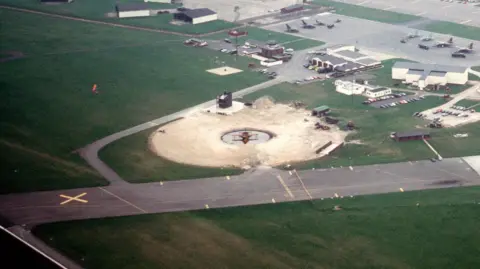
Both compounds have been detected in the stream near the former base, where firefighters would practice extinguishing blazes in a training pit.
The source of the stream, known as Gallos Brook, is an aquifer from within the old airbase, however, the source of the contamination is not known.
An environmental statement for the most recent development proposal at the site lists PFAS as an identified potential contaminant, linked with firefighting activities.
Residents from a number of nearby villages met with scientists and academics from Oxford Brookes and Manchester Metropolitan University in Upper Heyford on Thursday.
Several residents voiced concern about whether they had already been exposed, having lived near the base for decades.
One who attended the meeting told the BBC she was "terrified" and wanted answers.
"I am particularly concerned with my small allotment and fruit trees, which are right next to the stream. I have rinsed myself off and actually drank some of the water myself.
"I will be contacting the relevant authorities to ask for testing."
Thames Water has said drinking water in the area is safe.
Another resident Rob Cooze, who lives near the stream, said he came away from the meeting feeling "hopeful" that action would be taken on "stringent testing of the area and surroundings".
 National Archives
Site owners Dorchester Living previously said Heyford Park was a long‑established brownfield site that has been redeveloped for more than a decade, delivering homes and facilities under approved planning permissions.
CEO Paul Silver, has said extensive environmental investigations and remediation had already been carried out in consultation with the EA.
"The identification of PFAS as a potential risk does not mean that unacceptable harm is occurring and the PFAS measured in this location is some 5km from our site and could have come in part or wholly from other sources," he said.
He added that the "possibility of PFAS had already been identified" in various site assessments, confirming "further targeted investigation is appropriate in specific areas".
The study of PFAS is an emerging field but a small number of the chemicals have been identified as carrying significant risks to human health.
In 2025, the World Health Organization classified PFOA as carcinogenic and PFOS as possibly carcinogenic - increasing the risk of thyroid, testicular and kidney cancers. Both substances are now banned in the UK.
Dr David Megson, from Manchester Metropolitan University, specialises in environmental forensics and said he welcomed recommendations made by the House of Commons environmental audit committee last week, calling for a ban on the chemicals.
"We're at a really key time now," he told the BBC.
"Developers and consultants need more support, people developing technologies need more support and residents now need answers because we've kind of lifted the lid on this and realised what a massive problem it is."
The government has said it will consider the committee's recommendations. In February, it launched a PFAS plan, which includes increasing testing for them in the environment to tackle the substances.
