Water company defends CEO's £80,000 pay rise

 PA Media
Wessex Water has defended a £80,000 pay rise awarded to its chief executive, saying it brings her salary "closer to market benchmarks".
Ruth Jefferson's pay increased by almost 14% to £670,000, after the company said it was "deliberately set below comparable organisations" when she took on the role in 2024.
Environment Agency (EA) data shows last year the company released 190,666 hours of raw sewage into waterways - equivalent to about 21 years of continuous spillage.
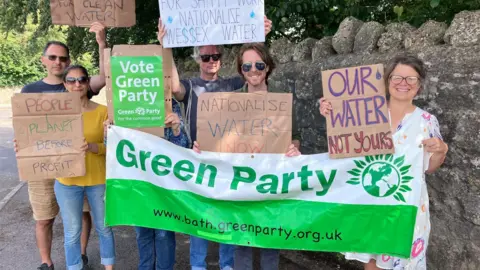
"I feel absolutely enraged, this should not be allowed to happen", said local resident Asha Amirali during a protest outside the company's headquarters last week.
Wessex Water said it was spending more than £8m per month on schemes to reduce raw sewage discharges.
Last year, the company made an annual profit of £96m, which it said was being entirely reinvested into infrastructure improvements.
Shareholders will not be paid a dividend for five years, until 2030.
Water companies are allowed to discharge raw sewage into rivers after periods of excessive rain, called a storm overflow.
This happens when high volumes of rainwater flowing into the same pipes that remove waste threaten to quickly overwhelm the system.
But companies can be fined if they let out raw sewage or other pollutants outside of these conditions.
Wessex Water's annual report shows there were four serious pollution incidents in the 2025-26 financial year, and the company was fined £11.3m.
The EA continues to carry out investigations in relation to nine separate incidents involving the company between 2022 and 2026.
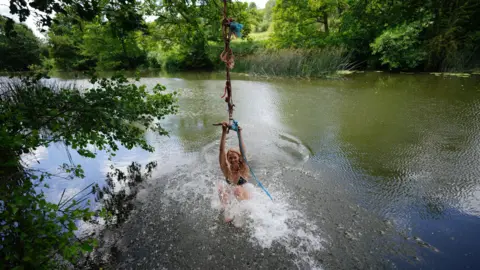
Faecal contamination from sewage is not routinely measured unless an area has been officially designated as a "bathing site".
Three locations in and around Weston-super-Mare - Uphill Slipway, Sand Bay and the town's main beach - and the River Frome at Farleigh Hungerford, are currently classed as "poor", with people being advised not to swim there.
"The water quality is degrading to the point where I'm scared for my children to swim in the rivers," said Amirali, as a small group of protesters gathered outside Wessex Water's headquarters.
"Over the years, I have been sick on occasions, and I know my children have been very ill from being in the river," Green Party councillor Joanna Wright said. "This is an issue that people locally face every day."
Rivers 'cleaner than ever'
But Matt Wheeldon, Wessex Water's director of infrastructure, said: "The environmental impact from storm overflows is tiny."
He pointed to EA data, which suggests Wessex Water was responsible for rivers not reaching "good" ecological status in about 25% of cases, with agriculture and rural land management having a much bigger impact.
"Less than 1% of the reasons are down to storm overflows," added Wheeldon.
The statistics suggest the release of treated sewage is a much bigger environmental problem because of the excess nutrients and chemicals it contains.
The EA classifies the rivers Avon, Frome and Severn as in "moderate" ecological status, based on assessments from 2022.
Wheeldon denied that river water quality had got worse.
"For the past 30, rivers have got better," he said. "There's plenty of scientific papers written about how ecology has recovered.
"Enjoy your river, it's cleaner than it's ever been, it's going to get cleaner, but it's never safe to ingest," he added.
