Warning over grades for white working-class girls

 Getty Images
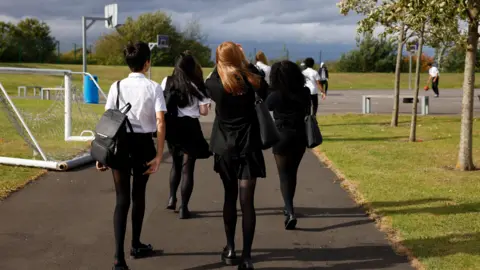
White working-class girls are being overlooked in efforts to tackle underachievement in schools across England, education leaders have said.
Since 2019, the number of low-income, white British girls passing GCSE English and maths fell by 6.4 percentage points, with 38% achieving a grade 4 or above in 2025.
Tom Campbell, the chief executive of E-ACT, a trust running 38 academies, described the drop in grades as "stark" and said he feared "a decline that we're never going to be able to arrest".
The Department for Education said it was working to "improve outcomes for white working-class children" and "radically reforming" school funding.
"It's this government's mission to cut the link between background and success, halving the disadvantage gap for this generation, so that every child has the opportunity to achieve and thrive," a spokesperson added.
Studies have previously suggested girls outperform boys from primary school through to university, but BBC analysis has found the gender gap has narrowed at GCSE level.
File on 4 Investigates and the BBC's England Data Unit compared GCSE results between 2019 and 2025 and found that in English and maths, a key benchmark, pass rates among girls have fallen.
Overall pass rates dropped by 1.6 percentage points during the period, with disadvantaged girls – those accessing free school meals in the past six years or who are in care – seeing a drop of 3.5 percentage points.
White British girls who are classed as disadvantaged saw an even bigger fall of 6.4 percentage points, with 38% achieving the expected standard at GCSE.
In comparison, 35% of white low-income British boys reached the expected GCSE standard in 2025 – an increase of 0.2 percentage points from 2019.
The BBC analysis also showed disadvantaged girls from some other ethnic backgrounds performed significantly better, with 64% of girls from low-income Asian homes achieving a pass in English and maths in 2025.
To reverse the trend, some schools have started to put measures in place to raise attainment.
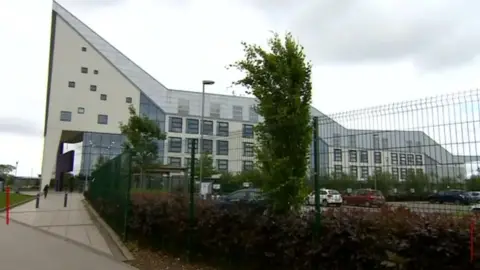
The Liberty Academy, in Hull, has trialled a female empowerment programme with a group of girls who have been identified as benefitting from extra support.
"In a working-class city I wouldn't say there's as many opportunities. People just say what's the point," said 15-year-old Holly, whose name has been changed.
Her classmate Charlotte, also not her real name, added: "I think because everyone is surrounded by people who maybe didn't go to university, it just puts it in their heads that that's just going to be me, so why should I try?"
Sarah Hossack, a teacher at the school, said: "There does seem to be a cohort that is being overlooked quite considerably.
"The conversation has very much been what can we put in place to support white working-class boys and the girls are getting left behind."
 Sarah Hossack
In March, the Conservative MP Charlie Dewhirst, who represents Bridlington and the Wolds, called on the government to publish a strategy to improve social mobility for young white men living in poorer communities.
Lisa McKenzie, a senior lecturer in sociology at the University of Bedfordshire, said singling out one group for intervention risked deepening divisions.
"They could target white working-class people at the expense of other groups. But then in five, 10 years' time, we're in that position with another group [of people]," she said.
"That tells me no government is actually serious about this because if they were serious, they'd talk about class."
'Flashing red'
Campbell runs academies in cities across England including in Sheffield, Manchester and Birmingham.
He said: "The data is flashing red.
"The challenge is that the boys are still doing a little bit worse. It's a sad state if it feels like a race to the bottom and that appears to be what is happening with white British girls.
"Over time the decline is stark and unless we talk more about this issue, then it may be a decline that we're never going to be able to arrest."
But Michael Cater, the executive headteacher at the Character Education Trust, which runs two academies in Kent, suggested school attendance might also be a "key issue".
Cater added: "The larger percentage of students that don't attend school, the worse outcomes become. At the moment there is a key identified group that white working-class girls are more likely to miss school."
The BBC asked 1,882 secondary teachers if the decline in girls' attainment could be linked to balancing education alongside caring duties at home.
Overall, 41% of respondents to the Teacher Tapp survey reported seeing an increase in girls from more deprived backgrounds taking on responsibilities at home, with 8% seeing a significant increase.
"Children are not immune to what's going on in society, worrying about whether parents are in a steady job or not, precarious housing, family responsibility, taking younger siblings to school," said Campbell.
A Department for Education spokesperson said: "It's this government's mission to cut the link between background and success, halving the disadvantage gap for this generation, so that every child has the opportunity to achieve and thrive – the reforms laid out in the Schools White Paper will do just this.
"More widely, this government is easing the pressure on families by lifting the two-child benefit cap, putting a family hub in every local council and providing 30 hours of early years education are all critical to giving every child the best start in life."
Listen to highlights fromHull and East Yorkshire on BBC Sounds, watch the latest episode of Look North.
Download the BBC News app from the App Storefor iPhone and iPad orGoogle Play for Android devices
