Sinn Féin Irish unity bill voted down in Irish parliament

 Getty Images
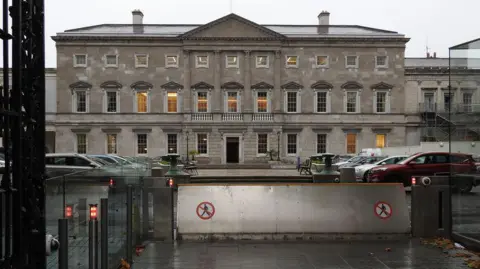
A Sinn Féin Irish unity law has failed to pass in the Dáil (lower house of Irish parliament) after Fianna Fáil and Fine Gael TDs voted against it.
On Tuesday Sinn Féin brought forward the bill in the Dáil, which it said would help with "planning and preparation" for a united Ireland.
The main crux of the law was a citizens' assembly on a united Ireland, which would have seen 99 citizens get together and debate the pros and cons of Irish unity, with a moderator.
The other part of the law would have put the onus on the taoiseach (Irish prime minister) to come up with a green paper on preparation for Irish unity which would cover topics from the economy to health and housing.
The bill was voted down by 79 votes to 69.
The taoiseach would have to consult with unionist and Protestant representatives, as well as civil society groups, all "political traditions, experts and underrepresented groups".
The Sinn Féin bill gave an 18 month timeline for the green paper to be published and after that, 12 months for a citizens' assembly to be set up.
But the Irish government, which is made up of Fianna Fáil and Fine Gael as well as independents, took issue with these timelines and decided to oppose the bill.
 EPA
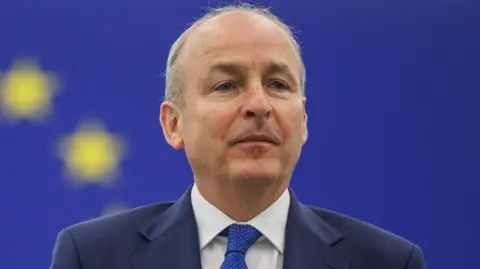
EPAIn a debate in the Dáil on Tuesday night, Taoiseach Micheál Martin said the bill would "do little to achieve its objective".
"The idea that we can finish building rigorous and independent data in 18 months and then answer questions on people's incomes and the structure of the economy is obviously not serious," he said.
He said a citizens' assembly was not the "appropriate mechanism" as securing the unity of the island requires "much broader participation of the public, of political parties and of all communities on the island".
'Happy to engage'
Tanaiste (Irish deputy prime minister) Simon Harris said he wanted to see a united Ireland.
He said he did not support the proposed law.
"I do not believe that we need it to prepare," he said.
"I do not believe that constitutional change should be tied to arbitrary timelines or that a citizens' assembly is the best way.
"These are not reasons to avoid engagement. There are reasons to deepen it.
"My commitment this evening is to continue working across this house with party leaders from all parties in government and in opposition to advance the conversation that is under way and will continue on the preparation that is required."
Timelines and deadlines
Fine Gael TD Emer Currie said she wanted to work towards a green paper but said preparation would not be helped by "placing deadlines on it".
"Nor do I believe that a citizens' assembly - valuable though that model has been on other issues - can by itself shape the future constitutional settlement of an entire island," she said.
"The conversation must be broader. It must invite new ideas and voices and every tradition to help shape what a new and agreed Ireland could become, not through deadlines but dialogue because that is what has worked before."
Fianna Fáil TD Malcolm Byrne said he also had concerns about "very strict timelines".
"There will be some people who will be able to move much more quickly than others," he said.
The Social Democrats, Labour and the Green Party told the Dáil they would support the Sinn Féin bill.
In response, Sinn Féin leader Mary Lou McDonald said for Fianna Fáil to push back on it was a "matter of wonder to me".
"It seems the party cannot see the wood for the trees. It is the party that refuses to lay that preparatory ground for that peaceful, orderly, democratic transition to a united Ireland."
Correction 12 July 2026: This story was updated to accurately reflect Emer Currie's quotes. An earlier version of this story misquoted Currie as saying a citizens' assembly "can shape the future constitutional settlement of an entire island".
