I'll give Burnham benefit of doubt on new powers for Wales, says first minister

 Reuters
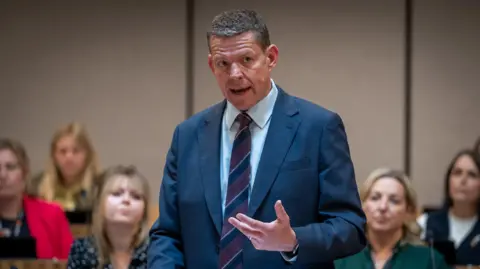
First Minister Rhun ap Iorwerth said he is willing to give the man expected to become prime minister the "benefit of the doubt" over more powers for Wales.
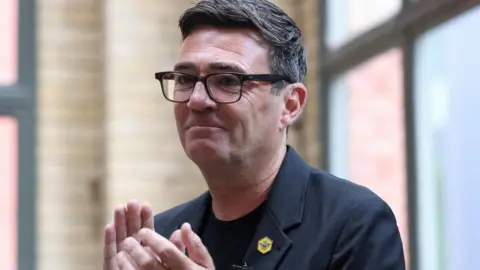
Andy Burnham told an audience in Manchester on Monday that he was willing to devolve more power to the UK's nations and England's regions.
Plaid Cymru's Rhun ap Iorwerth said he was "yet to hear" what the MP for Makerfield would do to help empower Wales' devolved institutions, and said there were "signs" he might want to bypass the Senedd and Welsh government.
Burnham said he wanted powers to go "deeper down" in Wales. The meaning was not confirmed on Monday, although a Labour source said this referred to giving powers to councils.
He said he would set up a "No 10 North" responsible for devolution, moving some Downing Street functions to Manchester. Ap Iorwerth said that would mean "very little" to people in Wales, and said the Senedd had to be empowered to "take Wales forward".
Plaid said Wales should have the same powers as Scotland, with Welsh Liberal Democrat David Chadwick accusing him of leaving the country at the "back of the queue".
At a museum in the city Burnham was previously mayor of, the new MP for Makerfield set out a vision for a "rewired Britain", taking power "out of the centre".
He promised to "bring about the biggest rebalancing of power our country has seen", saying: "It is time for Whitehall to accept that growth cannot be ordered from the top down."
The speech mostly focused on the regions of England, and did not make specific pledges to hand new powers to the Cardiff-based Welsh government.
But he vowed the days of "Whitehall fighting" the devolution of power into the regions of England and the UK nations "are over for good".
"The job of No 10 North will be to make power flow into the Midlands, into the south-west, into the east of England and yes into London," he said, giving examples of English regions he would hand powers to.
"It will be about offering new opportunities to extend devolution in Scotland, Wales and Northern Ireland by taking power deeper down," he said.
"The people of Dundee and Bangor feel just as distant from Holyrood and the Senedd as they do from Westminster."
Burnham promised "good growth in every postcode", with "powers for areas undergoing industrial transition like Port Talbot, Scunthorpe and Aberdeen".
The pro-independence Plaid Cymru party beat Burnham's Labour in the May 2026 Senedd election, forming a minority government in the vote's wake.
During the campaign Rhun ap Iorwerth called the more powers and funding, including devolution of the railways, the Crown Estate, policing and justice.
Most of his demands had been shared by the previous Welsh Labour government, but not the UK government under Sir Keir Starmer.
Burnham's team has previously ruled out reforming the system that governs how the Welsh government is funded, known as the Barnett Formula - something the first minister said was "rather a bad start".
Speaking to BBC Wales, ap Iorwerth said he "wants to have a very constructive relationship" with Andy Burnham.
He said the Senedd and Welsh government should be "respected" and that "currently we are yet to hear how far Andy Burnham is willing to go on that road towards empowering us on behalf of the people of Wales".
"When he's talking about a No 10 of the North that was to an audience in Manchester.
"I hope that he will be willing to engage in a way that we need a UK prime minister to engage, on a real understanding that the institutions that we have - the Senedd, the Welsh government, have to be empowered if we are to take Wales forward.
"So far, we haven't heard that from him. I'll do what I can to help."
He said there were "signs" that he might want to bypass the Senedd and the Welsh government.
"But at this point he's not prime minister yet. I want to give him the benefit of the doubt there."
In a statement on Monday, ap Iorwerth said: "A Number 10 of the North will mean very little to the people of Wales."
 Senedd Cymru
Ahead of the speech Ken Skates, the interim leader of Welsh Labour, said: "We need devolution within Wales, not just to Wales, ensuring power is closer to communities."
Skates was in the front row of Burnham's audience on Monday.
He told BBC Wales that Burnham's vow to devolve power "deeper down" means "making sure that power is devolved to the most appropriate level".
"That we shouldn't have a centralised state in Wales, just as we shouldn't have a centralised state at a UK level at Westminster," Skates said.
Under Wales' existing devolution settlement, local government is the responsibility of Cardiff Bay.
The leader of the Welsh Local Government Association, Anthony Hunt, said he hoped Monday's speech would mean more money for Welsh councils to spend - but warned against leaving Welsh government out of the conversation.
Hunt, a Labour politician, said that the UK government should not just "see Welsh government" when it comes to Wales because there was "another level of government too".
But he added: "We all need to get together and have a conversation about how this will work. I understand how the Welsh government has been left out before and that is not healthy."
Former counsel general and ex-Labour minister Mick Antoniw said it was a "good speech" but a "lot more substance" was required.
"Devolving deeper is only one part of a workable and cohesive reform, unless the outstanding constitutional dysfunction is addressed reforms will fail."
Welsh Liberal Democrat MP David Chadwick said: "Andy Burnham says he wants to take power out of Westminster, yet today's plans appear to leave Wales once again at the back of the queue compared to English regions."
Reform Wales Leader Dan Thomas said: "The people of Wales and the wider United Kingdom did not vote for more constitutional change or another round of devolution debates.
"The British people were not given the opportunity to choose Andy Burnham as prime minister. If he intends to pursue a fundamentally different agenda, including further devolution, he should return to the people and seek a fresh mandate."
