What is the King's Speech and what happens during the State Opening of Parliament?
King Charles has delivered the King's Speech in the House of Lords, setting out the government's planned new laws as part of the State Opening of Parliament.
The speech marks the start of the new parliamentary year, and included 37 bills minsters want to pass in the next session.
However, the event was overshadowed by the leadership speculation which has surrounded Prime Minister Sir Keir Starmer since Labour's heavy losses in the 7 May elections.
Who writes the King's Speech and why is it important?
The King's Speech is given by the monarch in his constitutional role as the UK head of state.
However, the speech is actually written by the government to outline its policies and proposed legislation for the new parliamentary session.
It is formally called the "Speech from the Throne" because it is delivered from the throne of the House of Lords.
The King reads it out in a neutral tone, to avoid any appearance of support for its contents.
The MPs, peers and other dignitaries in the chamber generally listen in silence.
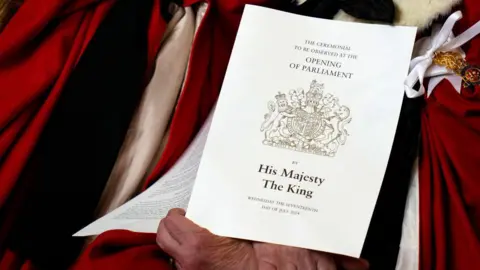
The last King's Speech took place in July 2024. It outlined the draft laws the incoming Labour government planned to introduce during its first parliamentary session, which finished on 29 April 2026.

 Getty Images
Charles delivered his first King's Speech in November 2023, after succeeding his mother, the late Queen Elizabeth.
He also gave the speech on her behalf in May 2022, while he was still the Prince of Wales.
What happens during the State Opening of Parliament?
The King's Speech is the centrepiece of the State Opening of Parliament, the main ceremonial event of the parliamentary calendar. Its origins can be traced back to the 16th Century.
The current ceremony dates from the opening of the rebuilt Palace of Westminster in 1852.
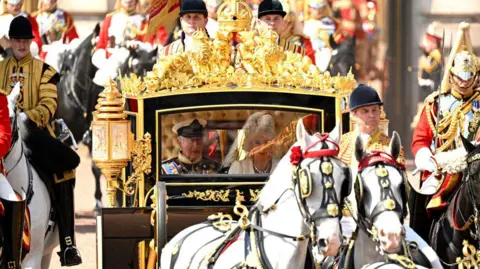
The event begins mid-morning with the monarch's procession from Buckingham Palace to Westminster in an ornate horse-drawn carriage. He is escorted by members of the Household Cavalry.
A separate coach carries the royal regalia - the Imperial State Crown, the Cap of Maintenance and Sword of State - to Westminster.
 Getty Images
Charles arrives at the Palace of Westminster Sovereign's Entrance and goes to the robing room.
Wearing the Imperial State Crown and his official robes of state, he then leads the Royal Procession to the House of Lords.
The senior House of Lords official known as Black Rod is sent to summon MPs from the House of Commons.
When Black Rod arrives, the door to the Commons is slammed in their face.
They then have to knock three times with their rod before the door is opened, after which MPs follow Black Rod and the Speaker of the House of Commons back to the upper chamber.
The refusal to let Black Rod enter at the first knock is widely believed to symbolise the Commons' independence from the Crown. However, Erskine May, the "bible" of parliamentary procedure, says the custom is to allow the Commons to establish Black Rod's identity.
Once in the House of Lords, MPs listen to the speech from the opposite end of the chamber to the throne.
The speech typically starts at about 11:30 BST.
Its length depends on the number of proposed laws and other announcements - such as foreign policy objectives - but it normally lasts about 10 minutes.
Before the King arrives, the Yeomen of the Guard carry out a ceremonial search of the cellars of the Palace of Westminster for explosives to commemorate Guy Fawkes' 1605 gunpowder plot.
A member of the Commons is "held hostage" in Buckingham Palace while the King is in Parliament, to ensure the monarch's safe return.
The State Opening of Parliament is broadcast via BBC iPlayer, BBC Sounds and the BBC news website.
Who is the current Black Rod?
 Getty Images
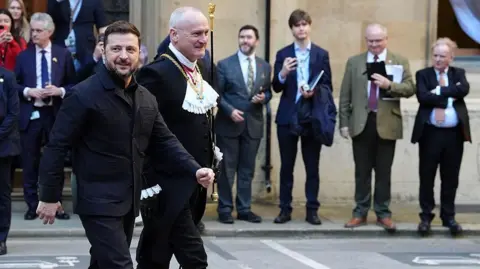
Black Rod is one of the most senior officers in the House of Lords, and participates in all major ceremonial events in the Palace of Westminster.
Their full title is Lady or Gentleman Usher of the Black Rod.
The current Black Rod, Ed Davis is a former senior Royal Marines officer.
He started in the role in July 2025, when he took over from Sarah Clarke, the first woman to hold the position in its 650-year history.
What happens after the King's Speech and do MPs get to vote on it?
The new parliamentary session begins when the King leaves the Lords chamber.
About two hours after the speech is delivered, MPs reassemble in the Commons to begin debating its contents.
After introductory speeches by two backbench MPs, the leader of the opposition makes a speech, followed by a response from the prime minister which sets out more details about the government's plans.
The debate normally lasts about six days. At the end of the debate, MPs vote on the speech but governments very rarely lose.
The last time this happened was in January 1924, under Conservative Prime Minister Stanley Baldwin.
He went ahead with a King's Speech - delivered by George V - despite having lost his majority in the previous month's general election.
Baldwin was forced to resign, and Labour formed a short-lived government.
Peers also spend several days debating the King's Speech in the House of Lords but do not normally hold a vote.
