Warning traditional crafts in danger of dying out

 BBC
BBCSome of the South West's traditional crafts are in danger of dying out within a generation, according to arts organisations trying to save them.
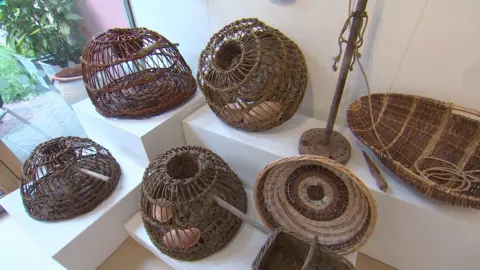
The Heritage Crafts' endangered Red List notes some skills like traditional Withy Pot making - using willow to weave crab pots - now only have one professional left who makes it their main income.
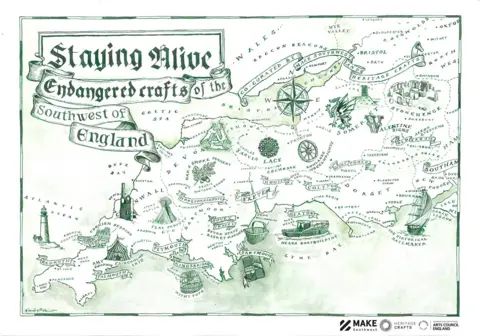
Make Southwest in Bovey Tracey, Devon, is holding an exhibition called Staying Alive: Endangered crafts of the south-west of England, that is co-curated by Heritage Crafts, an association set up to preserve traditional techniques.
Laura Wasley, from Make Southwest, said cultural heritage was important: "It's who we are and what we are famous for."
 Commissioned by Heritage Crafts, illustrated by Verity Robinson
The exhibition features 14 master makers and illustrates how geography has influenced the region's traditional industries.
From boatbuilding and rope making, to sail making, basket weaving and tanning, many of the skills originally grew out of the demands created by farming and fishing.
Wasley said the region's relative isolation and rich natural resources probably helped preserve its regional identity, with longstanding craft traditions, including thatching, dry stone walling and hedge laying all still being used today.
She said: "It's so important we shout about craft makers in our region. It's vital for tourism and our economy."
Earlier this year, Wasley invited MPs from a variety of parties to an event in parliament showcasing craft creatives to highlight the importance of small individual makers to the area's regional economy and the need to preserve them.
Some crafts have already disappeared.
Hilary Burns, from Yalberton, Devon, is trying to revive the art of making scuttle baskets.
No-one has made them in Britain from about the 1950s, so there is no-one for Burns to learn from.
Once widely used in Devon, the willow was tightly woven with strips of wood in between, making them useful for transporting grain for beer making or animal feed.
Burns said she thought plastics quickly replaced them, but added: "I think there's a real interest in old techniques and materials.
"People are really interested in using what's grown where they are."
She has learnt the method and intends to teach others so the skill is not lost.
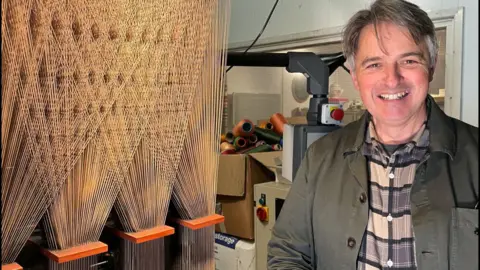
In an industrial unit in Dartmouth, Devon, Robert Ely runs Papilionaceous.
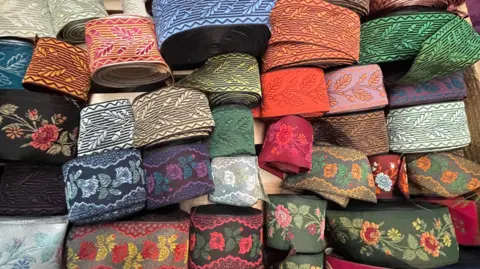
He is one of four makers in the country who produces silk ribbons and the only one to weave bespoke jacquard and plain ribbons on a narrow fabric loom using the techniques that he does.
He has created ribbons and braces for period BBC dramas such as Poldark and The Other Bennett Sister, as well as films including Little Women.
But his business has evolved and he has found surprising modern applications for the woven silk he creates.
Capitalising on its insulating and fire-resistant properties, he now designs audio cables for headphones, and is being approached by companies in Germany and Spain who cannot find the skills they need to make them.
He says: "I'm not a museum piece.
"As a weaver, I'm part of an inherited lineage of weaving but it doesn't mean weaving now is the same as 100 years ago."
The organisations fighting to preserve traditional occupations say, in an increasingly digital and AI world, championing handmade artistry will become even more important to the region's economy, tourism and cultural identity.
Daniel Carpenter, executive director of Heritage Crafts, said: "To lose this generational knowledge at this stage would be madness."
