'Not a good year for the M5,' highways boss says

 Caroline Thorne
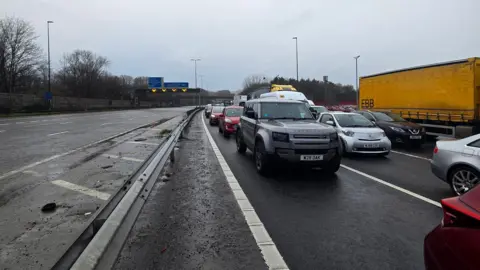
National Highways says it has "not been a good year" for the M5 amid a number of closures of the key route through the South West.
Repeated closures have led Sir Ashley Fox, MP for Bridgwater, to write to the government calling for an urgent review into the way closures on the M5 are managed.
The road has closed on a number of occasions during 2026 for crashes and welfare-led incidents. Police said any effort to speed up the process to open the road after incidents could undermine any criminal prosecutions.
Ian Thompson, National Highways' lead officer for stakeholder relations in the region, said: "We fully appreciate the impact that these incidents and closures have on the local communities."
"The solution to that is to build a new road along the M5 – that's not happening. So the only way to deal with the impact of congestion is to reduce the number of incidents," he added.
The closures have led Sir Ashley Fox, MP for Bridgwater, to write to the government calling for an urgent review into the way closures on the M5 are managed.
"The M5 is a vital artery for Somerset but it feels like residents are being brought to a halt almost every week," said Fox.
"When the motorway closes for hours, traffic floods onto local roads that were never designed to cope. Residents are stuck in gridlock, businesses suffer, and people's daily lives are disrupted."
According to figures from National Highways, Somerset has 12.9% of the South West's motorway network and 15.7% of incidents leading to a closure happen in the county - but 29.1% of incidents involving "persons in crisis" occur along this stretch.
In a letter to the Roads Minister, Fox has called for greater use of managed traffic flows and contraflow systems, improved diversion routes and traffic management measures, and a review of procedures involving people in crisis.
'M5 is a nightmare'
Caroline Thorne, who has fibromyalgia, travels about 50 miles (80km) from her home in Glastonbury, Somerset, for treatment at the Brightwell Clinic in Bradley Stoke near Bristol once a week.
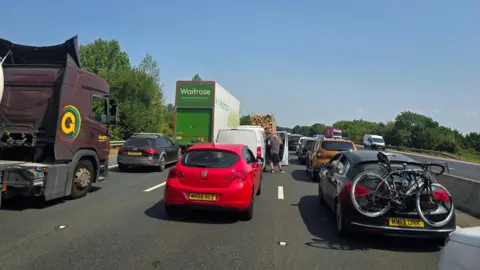
She described the journeys as a nightmare as what should take 45 minutes each way can sometimes take six hours due to closures.
She said the road has become a "nightmare". The closures are more regular now," she added.
 Caroline Thorne
Thorne lives with endometriosis and fibromyalgia, conditions that cause widespread pain and fatigue.
Thorne said her health issues cause "agonising pain", but she is able to find some relief through weekly hyperbaric oxygen therapy treatments, which work by delivering a higher concentration of oxygen to the body.
But she said the stress of getting stuck in traffic on the way home "almost undoes the work the treatment has done".
"It's a nightmare, the closures are more regular now. The state of the M5 and the delays to journeys and road closures is making it more stressful to get there," she said.
 Caroline Thorne
In January, Thorne said she found herself stuck on the M5 for eight hours, unable to leave her car to use the bathroom.
Being trapped in her vehicle for several hours also causes flare ups of her conditions, which is "extremely painful".
"To be stuck in a car for eight hours, not allowed to get out of your car, when you've got issues like I've got with bowel and bladder... I could become quite easily an emergency," she said.

Avon and Somerset Police is responsible for deciding how much of the motorway should be closed, and for how long.
At a Somerset Council meeting earlier in July, Andy Roebuck, the force's forensic collision investigation lead officer, detailed why police investigations can take so long - warning that any effort to speed up the process could undermine any criminal prosecutions.
"Our average time at a scene this year has been just under five hours. I accept that the road would have been closed longer, because as soon as the first emergency units attend, they put a road closure on, which is quite right for their safety and the preservation of evidence at the scene.
"We have very stringent rules of how we should be operating. For us to operate differently and do less would need a change in legislation, and a change in the coroner's judicial system as it currently stands."
In response to Fox's comments around how the police deal with people in crisis, a spokesperson from Avon and Somerset Police said their priority is to protect life while ensuring the safety of everyone involved.
"There is no-one-size-fits-all approach to incidents of this nature. They are often complex, dynamic and unpredictable," a police spokesperson said.
"Any decisions about physical measures such as barriers or other infrastructure on bridges would be matters for the relevant highway authority rather than the police."
Follow BBC Somerset on Facebook and X. Send your story ideas to us on email or via WhatsApp on 0800 313 4630.
