The man who camped in a tropical forest for his job

 Tom Lovett
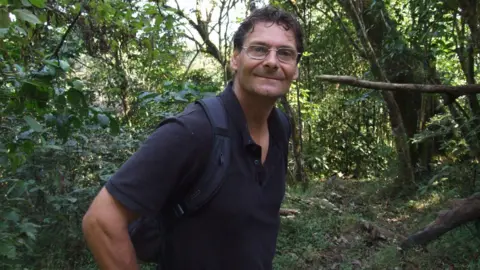
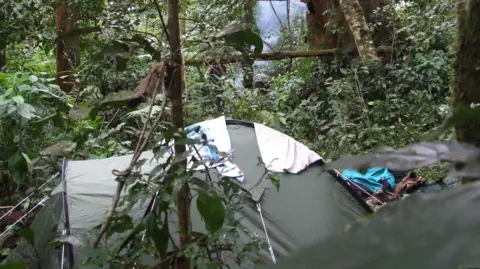
"It was pouring down with rain most days. Everything was wet, there was mould in my boots and I was feeling a little bit miserable," recalls Prof Jon Lovett.
"Then this shaft of sunlight came through the forest canopy and there was a patch of sun where one of these mycotrophs was growing. I thought, 'this is a new species'."
In 1997, Lovett was living out of a tent in the forests of Tanzania during the rainy season to conduct an environmental survey of the area when he spotted the plant.
The mycotroph, a type of plant that feeds on fungi, was officially confirmed as a new and critically endangered species in June, almost 30 years after its discovery.
Dubbed 'Afrothismia lovettii' after Lovett, this is now the eighth plant species to be named after him, due to his botanical research in eastern Tanzania since 1979.
Now based in Swaledale and a faculty member at the University of Leeds, Lovett lived in the tropical forest for work, including a two-year stint in the 1980s.
Although he had a guide and there was a village to pick up supplies from, Morogoro, the nearest city was "several hundred kilometres away", by his estimation.
His closest neighbours would often be the wildlife that called the forest home, including elephants and buffalo.
"You were always surrounded by large animals," he explains.
"You couldn't see them because the forest vegetation is quite thick but you could hear them moving around."
 Tom Lovett
There were also snakes, driver ants which move in large colonies "eating everything in their way", and scorpions that would wait up in the trees for prey.
Despite this, Lovett said the rainforest is "no more hazardous than trying to cross the road in busy traffic" once acclimatised to the surroundings.
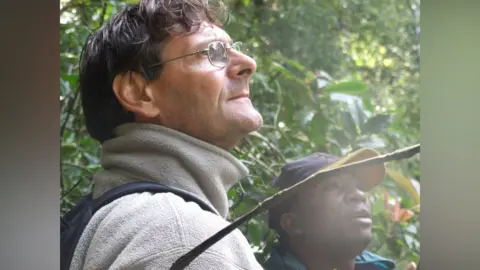
He describes the job as "tough" at times, but adds he "really enjoyed it and the real sense of becoming one with this incredibly biodiverse, rich environment."
After Lovett discovered 'Afrothismia lovettii', he sent it to Dr Martin Cheek, an expert on tropical African plants at the Royal Botanic Gardens in Kew for further study.
The mycotroph is only about the size of a penny, and has a translucent, golden yellow base with white antennae.
After nearly three decades of researching other species of Afrothismia across Africa, Dr Cheek was then able to confirm the plant was new to science.
The seven other plants also accredited to Lovett's discoveries are two trees, a liana, a shrub, an orchid, and two additional mycotrophs.
His work over the years has even contributed to the area being recognised as one of the world's top biodiversity hotspots, which is important for conservation.
 Tom Lovett
While "tensions between conservation and development" exist, according to him, collaboration between campaigners, researchers and policymakers "is needed now to end biodiversity loss and repair our world."
"It's a matter of working hand-in-hand to ensure these incredible natural resources survive, and the benefits are coming down to the local communities," he says.
Although Lovett's focus has moved from botany to renewable energy research, his work has still taken him back to Tanzania over the years.
His next trip is to an area of the Ngezi Forest threatened by expansion, to promote "the unique nature" of the landscape in the hopes it will help protect it as an asset.
He still misses aspects of his life in the forest "every day" he adds.
Near his Yorkshire Dales home is Muker Meadows. The upland hay meadows are protected in places as a Site of Special Scientific Interest (SSSI) and the Northern Pennine Dales Meadows Special Area of Conservation (SAC).
As an early riser, Lovett often takes morning walks in the area, which is rich with species of flora and fauna.
"It just reminds me of a time when I would be in the forest in the early morning when everything was quiet and the birds and the wildlife were beginning to stir," he says.
"It becomes very much part of you when you live in the forest for that long."
Listen to highlights from West Yorkshire on BBC Sounds, catch up with the latest episode of Look North.
