Youth volunteers help rebuild flood-hit village

 Bahu Trust/Islamic Help
Umair Suleman thought he understood climate change.
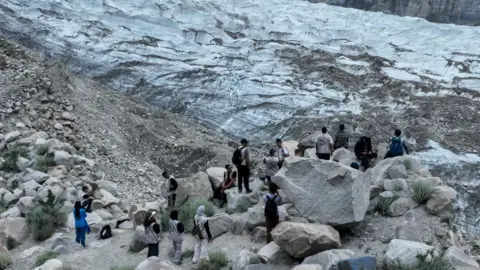
Like many young people, the 18-year-old had read about melting glaciers and rising temperatures. But standing on the Passu Glacier in northern Pakistan, surrounded by ice that has sustained communities for generations, changed his way of thinking.
"Climate change used to be a distant idea. But when you go to a village like that, you start to appreciate how dangerous of an issue it is," he said.
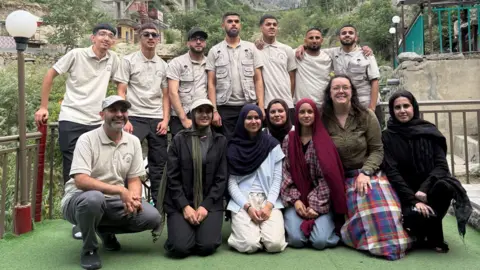
Umair was one of a group of young volunteers from Birmingham who travelled thousands of miles to one of the world's most climate-vulnerable regions in Pakistan, after raising almost £50,000 through community fundraising.
The group, aged between 18 and 25, travelled to the remote district of Ghizer in Gilgit-Baltistan with Birmingham charities Bahu Trust and Islamic Help.
For several days they lived alongside families in the mountain village of Tali Das, sharing meals and hearing first-hand accounts of lives reshaped by climate change.
"You wouldn't think that this village has just been destroyed and they're trying to rebuild. It was just a community of people smiling and all together," Suleman said.
Residents there rebuilt their community after a glacial lake outburst flood forced them from their original homes.
The youth volunteers, from areas including Balsall Heath, Sparkbrook and Sparkhill, helped establish a climate disaster rescue centre.
The centre was designed to equip local people with emergency equipment and training so they can respond quickly to floods, landslides and other climate-related disasters while waiting for emergency services to reach the remote area.
Volunteers also assisted the community by planting trees and helping to renovate a school.
 Bahu Trust/Islamic Help
But many of the lasting memories came away from the construction work, volunteer Haaris Zahir said.
"[Seeing how the community was living] put me to shame, to be honest, because thinking about everything that we've come from, we have water, homes and easy access to food.
"They had to start from zero, literally from scratch," he said.
Northern Pakistan is home to more than 7,000 glaciers, making it the largest concentration outside the polar regions.
As temperatures rise, many are retreating, creating unstable glacial lakes that increase the risk of devastating floods.
For the Birmingham volunteers, seeing those changes close up made an issue often discussed in classrooms and online feel deeply personal.
Mission Possible coordinator, Kiren Shafiq, said the trip was about far more than delivering aid.
"Our vision has always been to empower young people to become compassionate leaders and active citizens," she said.
"Watching these volunteers grow in confidence while building genuine friendships with local communities has been incredibly rewarding.
"They have shown that young people have the passion, creativity and commitment to build a more hopeful future for everyone."
Back in Birmingham, the volunteers say they have returned with a different perspective, not only on climate change, but on the resilience of the communities living on its frontline.
Follow BBC Birmingham on BBC Sounds, Facebook, X and Instagram.
