Why did the National Glass Centre fail?

 BBC
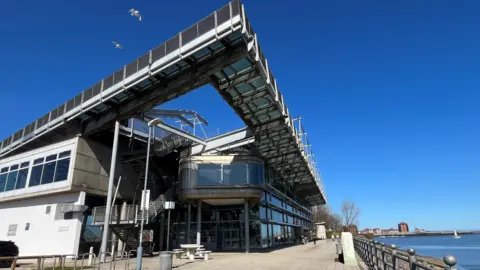
BBCThe National Glass Centre (NGC) in Sunderland was opened to much fanfare in 1998 with the aim of shining a light on the city's centuries-old trade. After being saved from closure once, it is due to shut forever on Friday. Experts and campaigners give their thoughts on why it has come down to this.
On a recent visit to Sunderland, Alexander Goodger, director of Stourbridge Glass Museum, said he was struck by the lack of signage pointing him to one of its main tourist sites.
"There was nothing to signpost me to go there," he said. "When you get off at the underground [the Metro], it needs very clear posters and signifiers to say visit the National Glass Centre… you wouldn't know being in the city centre."
Glass has a long history in Sunderland. The area is home to the earliest known references to stained glass in the UK, and in the 18th Century several major glass factories could be found along the River Wear.
The NGC was meant to celebrate the heritage and ensure the city would remain at the heart of the UK's glass industry.
Almost 30 years on, the glass hub, now run by the University of Sunderland, is due to shut for good. Its closure, which the university claimed was due to prohibitive running and maintenance costs, has been mired in controversy including debates over true repair costs, running into their millions.
Goodger said it was clear the NGC's business model had not worked, but he said there could be hope.
"They can turn that around and make it a profitable visitor attraction," he said.
The university said it had to focus its cash on teaching and research.
 Dr Laura Johnston
In 2013, the university took over the site from a charitable trust after a period of low ticket sales and a closure risk.
The venue reopened to much noise, with the university's then-head saying they had a plan to make it a venue with "national significance".
But financial data provided by the university, not including capital costs, suggests the NGC has been losing money each year since its reopening.
Its biggest loss was £1.1m in the 2014-15 financial year, while its smallest was £573,000 in 2020-21. However, this does not include income from car parking.
The university said these figures included Arts Council funding, including a portion of a £5.1m grant shared between a few local attractions such as Sunderland Museum and Winter Gardens from 2018 to 2026and a separate direct grant of £2.1m.
The Arts Council also gave the university £750,000 which it used to help fund the centre's 2013 refurbishment.
The university also received money from the National Lottery Heritage Fund and other foundations to help pay for the revamp.
In 2024, the university's board of governors' chair Farooq Hakim said the organisation had taken over the NGC as it believed it had a "civic duty" to do so.
He said the university had believed at the time it was in a financial position to "absorb the operational and business maintenance costs" of the hub.
'Premium destination'
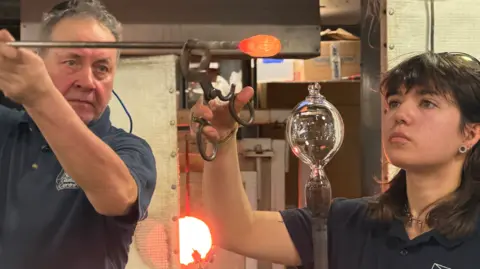
Running a glass centre involves high energy bills, especially as the site has been home to the university's degree-level glass programme since 2001.
For example, in 2023 it spent £496,611 on electricity, gas and water.
Goodger questioned whether enough had been done to bring these costs down. He said his museum in the West Midlands had decarbonised much of its energy usage, which had dramatically cut its bills.
He also said his museum had made money by charging entrance fees and renting out space to local companies.
"If you just look at the spreadsheets, you think it's a waste of money - let's close it," he said.
But Goodger said he believed the NGC could be made to work financially.
"It's in a premium destination, it's on the water side," he said. "There needs to be a will there."

Save the Glass Centre campaigner Carolyn Basing believed other decisions had affected its financial viability.
She said the decision to close the roof to visitors in 2018, as well as the site no longer being rented out as a wedding venue, had impacted income.
"The roof was a massive tourist attraction," she said. "People loved coming here, walking on the glass – it's a fabulous view out on the river."
The roof closure had initially only meant to be temporary, but the university never reopened it.
Museum expert Dr Mark Liebenrood, at Birkbeck University, said regional museums faced distinct challenges.
Museums, unlike those in capitals such as London, simply struggle to attract tourists, he said, and this was particularly true of cities which had few attractions.
"It's going to be more of a challenge for you to persuade someone to go there," he said.
Museums also suffered during economic downturns, he said.
"Very often museums get caught up in other sorts of contextual issues like cost of living or a recession," Liebenrood said.
 BBC/Jim Scott
The University of Sunderland said financial pressures facing universities was "substantially and materially different" compared to 2010.
It said no group or individual had put forward a feasible plan for the NGC, including those campaigning against its closure.
"Any such plan, had it emerged, would have needed to meet the significant financial requirement for capital works, and the aforementioned annual subsidy," it added.
While the university plans to demolish the site, campaigners are trying to get it listed, and Sunderland City Council - now led by Reform UK - is trying to slow down the demolition.
The university's 44-year-old glass degree programme has also ended, with the nearest equivalent located in York.
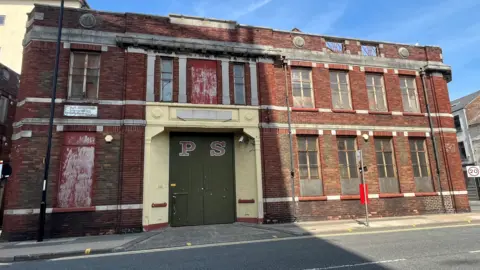
Charity Sunderland Culture is looking to convert a former warehouse into a glassmaking hub in the Sunniside area of the city to replace the NGC.
Glassworks, which would not have a museum but instead contain space for glassmakers and classes, is backed by £5m in government funding but still needs another £5m before it can be built.
If the charity can find the money, it hopes to open the new hub in 2028.
