Hundreds of twitchers flock to see African bird in UK for first time

 Steve Culley
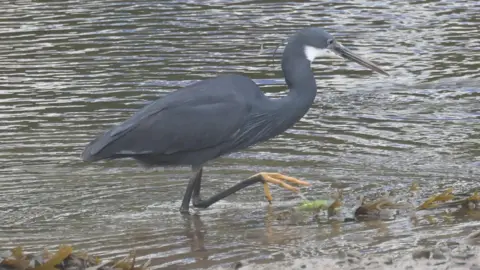
Hundreds of twitchers from across the UK are flocking to a seaside town in north Wales to see a "rare" heron.
Ornithologist Simon Hugheston-Roberts spotted the western reef heron - more commonly found in southern Europe, Africa and parts of Asia - at Y Foryd in Caernarfon at 10:00 BST on Saturday.
After confirming the grey-blue bird, he alerted a birdwatching WhatsApp group and by the afternoon, about 300 ornithologists arrived in the town hoping to catch sight of the egretta gularis.
Naturalist and broadcaster Iolo Williams said it was a UK first, adding that warm, fairly strong southern winds may have blown the heron out to sea, where it "got lost and was carried here".
 Marc Hughes
Hugheston-Roberts, who has decades of birdwatching experience and conducts monthly bird counts at Y Foryd, said he was on his usual walk when he "was lucky to see a small dark heron flying over me on the shore".
"After getting a better look I thought this is a rare thing," he told BBC Cymru Fyw.
Explaining how he identified it as a western reef heron, Hugheston-Roberts said: "I've spent time birdwatching in Africa and the Middle East, so I'm familiar with a variety of different types of herons and as well as this species.
"So, I applied my knowledge and years of experience of observing birds to inform a process of identification.
"Dark variants of little egrets are very rare but there are species of herons from North America that look similar, such as the little blue heron, but they have subtly different identification features if you look closely."
Hugheston-Roberts explained how he went through a process of ruling out other potential species to be sure, saying "a little egret joined the western reef heron so I was able to compare and contrast the size and structure of the two herons side by side to confirm".
He said he had a "gut feeling" that is was a western reef heron.
"They are very impressive," he said.
 Steve Culley
After Hugheston-Roberts shared news of the heron's arrival in Caernarfon, word spread.
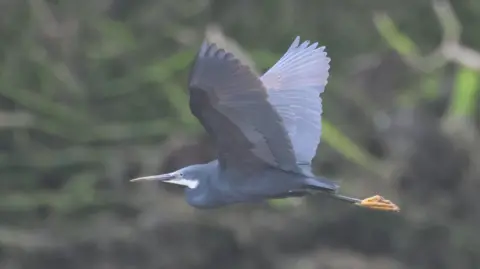
From feeding in the harbour near Cei Llechi and roosting in trees by Aber Bridge, to flying over the fields of Morfa Dinlle, returning to the Foryd and even passing above Caernarfon Castle, the western reef heron has attracted birdwatchers, photographers and artists to the town.
 Richard Partis
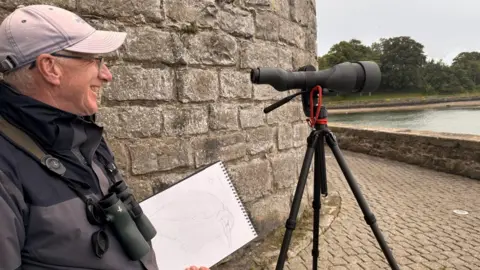
Among those hoping to catch a glimpse of the bird near the Anglesey Wall on Sunday was ornithologist and artist Richard Partis.
Partis, who had been tracking the bird for almost 12 hours, said it was his first time seeing a western reef heron.
"I knew people had seen him feeding in the harbour early in the morning, then he went into the woods when the tide came in," he said.
"It's been moving around all day. I've probably seen about 50 birdwatchers here today, including a lot of twitchers from Essex.
"For some people, birdwatching is almost a full-time job. I heard some visitors travelled on to Orkney after hearing about another rare bird there, while others were planning to stay here overnight."
Partis was also sketching the heron as he watched.
"It has a long neck, but that's difficult to capture when it's tucked into its feathers," he said.
"I'll paint it grey-blue when I get home.
"Everyone has been very respectful and kept their distance so as not to disturb the bird."
 S4C
S4CNature observer and broadcaster Iolo Williams was on a wildlife cruise filming Springwatch when he heard about the sighting.
He said: "I've seen the bird where it belongs.
"It's a smart bird, all over its body is a lovely grey-blue."
The Welsh ornithologist said the popularity was unsurprising "because this is the first ever recording in Britain for this bird".
Although the sighting came shortly after Wales recorded its hottest May day on record, with temperatures above 32C, Williams does not link it to climate change.
He said: "You will always have a bird that gets blown out on its way or gets lost for whatever reason.
"It's happened since records began... this happens from time to time but very rarely is the first record seen in Wales.
"We have had warm, fairly strong winds from the south so I think the heron went out to sea, got lost and was carried here.
"They can fly over quite a distance so I'm sure if someone has recorded it in Spain, France and Portugal, but this is certainly the first time it has been recorded in Britain."
According to Williams, Y Foryd area and the Afon Seiont estuary were "great places for him", as he feeds in a similar way to a Little egret, searching for and eating small fish.
 Steve Culley
Hugheston-Roberts said his next step was to write a report to the British Birds Rarities Committee (BBRC) so that they can confirm his finding.
If confirmed, it will then be added to The British List.
