'We're young - we don't think much about the EU'

 Ben Schofield/BBC
How do younger voters feel about the European Union and the UK's relationship with its neighbours?
A decade on from the EU Referendum, polls suggest a majority of UK voters would support a hypothetical bid to rejoin the EU.
Pollsters say that is partly because young people who are reaching voting age are more likely to be Euro-friendly.
But for some who reached adulthood after the UK left the EU, the bloc and its free movement, customs union and single market are foreign ideas, distant from their day-to-day lives.
 Ben Schofield/BBC
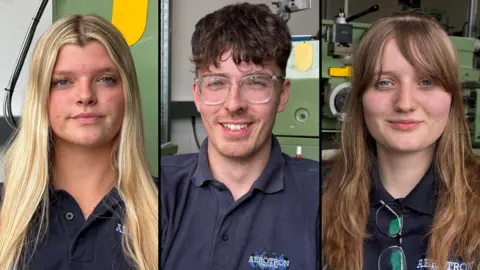
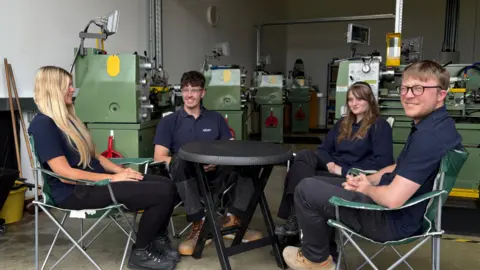
Will, Hope, Tegan and Myles were aged nine and 10 when UK voters were asked to choose between remaining and leaving the EU.
No-one blames them for not being politically engaged a decade ago.
When asked how they think they would have voted, there is no 52:48 split – all four say the same thing.
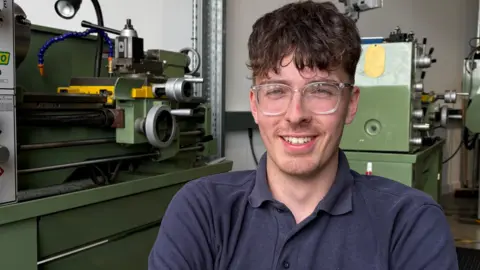
"I think I would have voted to leave," says Myles Dillon, who is in the final few weeks of a three-year engineering apprenticeship with Aerotron in Chatteris, Cambridgeshire.
"I think it's good to be focused on the UK and focused on our people, our country," he adds.
 Ben Schofield/BBC
Myles, 20, commutes each day to Chatteris from his home in Huntingdon, Cambridgeshire.
We meet him and the others at the North Cambridgeshire Training Centre in Chatteris, where they receive hands-on and classroom-based learning.
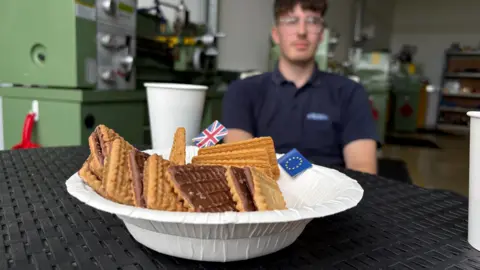
Myles says "even at work no-one speaks about" the EU.
"We speak about some political things at work, but Brexit's never come up," he says.
 Ben Schofield/BBC
Would Myles vote to rejoin the EU, if given the chance?
"I've seen no benefit in the EU and I've seen no benefit out of the EU," he says.
So, he adds, "we might as well stay where we are".
"I think it's a good thing to run our own country and worry about ourselves, rather than being in the EU and having to worry about other countries, whereas we should just be focused on England," Myles adds.
 Ben Schofield/BBC
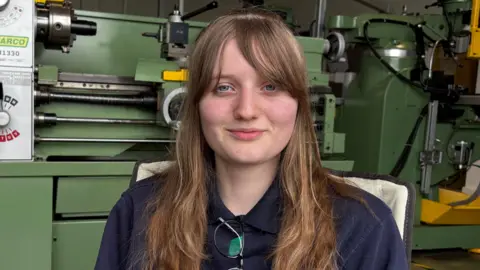
"Being so young when we did leave, I've personally not seen any change," says 19-year-old Tegan Smith.
For her, the EU is a distant concept.
"My life is normal – this is how it would always have been.
"You don't really think about what's going on worldwide... so I've not really had any thought into it," Tegan says.
Being young "you're probably more work-focused, more thinking about the way you are in your life", she adds.
On whether to rejoin or stay out, she would weigh up the pros and cons.
"If there is so many positives in rejoining, then yes, definitely that would be the better option.
"But if there won't be too much of a difference with staying out of it, then it would be better to just stay where we are," she says.
 Ben Schofield/BBC
Chatteris, which is 24 miles (38.6km) north of Cambridge, lies within Fenland, where 71.4% of voters backed leave in 2016.
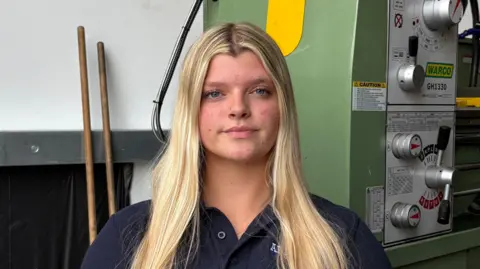
Hope Hayden-Ferguson, 20, does not feel like she has missed out on opportunities living and working outside the EU.
"I think I've had quite a few really good opportunities working with the Aerotron, so I don't feel like I've personally missed out on anything, but I could understand why other people might feel like they've missed out," she says.
Hope adds she does not think about the UK's relationship with the EU.
How would she feel about a referendum on rejoining?
"It would not affect me in any way, so I'm not bothered," she says.
Similar to her colleagues, Hope thinks she too would have backed the Leave campaign in 2016.
"Like the rest have said – it's better to focus on just our country," she says.
 Ben Schofield/BBC
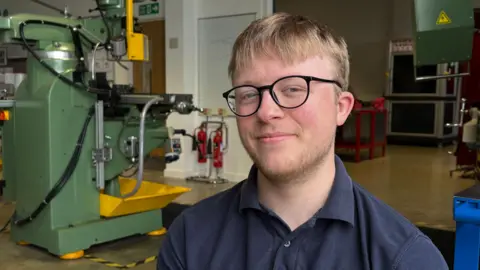
Will Harris-Aebvtivs says while he remembers 2016, he does not recall "much of the referendum".
"It was only a few years afterwards that I realised what it was and some of the implications of it," he adds.
He says that growing up outside the EU had "not made any big impacts to me personally", but he could back rejoining.
"I know that when we left, it had a lot of implications for travel between European countries from the UK and import and export tariffs and things like that.
"I think it would be a good thing, personally, to rejoin. It would be easier for us holidaying and going to countries and things like that," he says.
What do the polls say?
 Andy Meeson/BBC
Chris Hopkins, the director of political research at polling firm Savanta, says polling has consistently suggested a majority of voters would support rejoining the EU.
That, he adds, is driven by two things: demographic change and "Brexit regret".
In 2016, "older voters were far more likely to be leavers and younger voters were far more likely to be remainers".
"Some of those older voters will simply have died off and they're being replaced by younger voters," Hopkins says.
Voters who were too young to vote a decade ago but have since turned 18 are "overwhelmingly more likely to vote to rejoin".
While many views on both sides are "entrenched", Hopkins estimates between "one in five and one in seven" leavers might have changed their minds.
What was causing "Brexit regret"?
"I think there is just a perception not so much that anything was gotten wrong in 2016," he says.
But he adds that "Brits" don't "necessarily feel as though they've really felt the benefit of Brexit".
"Their life hasn't necessarily improved in the way that maybe some in the Leave campaign said it might."
'Entirely hypothetical'
Yet polling on "rejoin or stay out" has been volatile, with margins that "differ quite significantly".
These surveys are "entirely hypothetical" and "hypothetical polling doesn't always have the best track record".
The public "just really isn't engaged that much in the EU" at the moment.
"So when you ask the public a question that is to some extent unexpected or doesn't really resonate with them on a day-to-day basis, you can get some fairly large swings in public opinion."
Back with the apprentices, Will says in 2016 he was "only 10", "in primary school" and "more focused on... what I had for lunch".
But as the government – and potential new Labour leaders – look for a closer relationship with the EU, arguments about staying out, rejoining and everything in-between, may come more into focus.
Do you have a story suggestion for Cambridgeshire? Contact us below.
Follow Cambridgeshire news on BBC Sounds, Facebook, Instagram and X.
