Charity says invasive weed in river is 'big problem'

 The Canal and River Trust
A charity which helps look after canals and rivers said the growth of a type of weed in the River Soar was a "big problem".
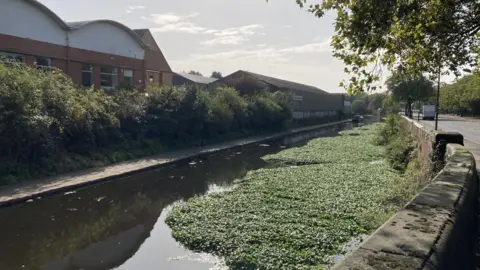
The Canal and River Trust has launched an appeal to help raise funds to tackle floating pennywort in the River Soar in Leicestershire.
The trust said floating pennywort - which was introduced into the UK in the 1980s as a plant for garden ponds - can grow up to 20cm (8in) a day and was able to double its weight in as little as three days.
Hannah Booth, environment manager for the south at the Canal and River Trust, said the invasive weed species was "one of the biggest issues" for waterways across the country.
'Massive impact'
"You can practically sit there on the riverbank, and see it grow and because of the way it grows it forms dense mats.
"It can become a thick dense carpet right the way across the waterway and that causes a problem for all sorts of people," Booth said.
Booth, who covers the East Midlands as part of her patch, said the River Soar was the most affected waterway which the Canal and River Trust manages in the region.
The trust said the area of the River Soar previously most affected by the weed was from the edge of Leicester to the River Trent.
She told the BBC the growth of floating pennywort impacted people fishing as they cannot access the water, people who want to be out on canoes, as well as wildlife.
"Many of our native plant species that should be thriving in our rivers really struggle.
"They're unable to photosynthesize to reduce the food they need, and they start to die off.
"Many fish will leave the water because it's not as well oxygenated as it could be.
"So they might move to other areas, but there's also lots of invertebrates, lots of bugs in the water, which aren't able to move in that way, and they just don't thrive and may even completely die off.
"It has a massive impact on our waterways."
 The Canal and River Trust
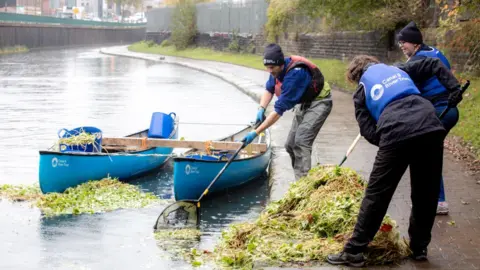
Booth told the BBC volunteers worked about 400 hours in the River Soar last year removing floating pennywort by hand.
She added as the growth rate of the weed increases throughout the season it becomes "too hard" to remove by hand and contractors get rid of it using specialist machinery, which she said came at a "massive cost".
"We're anticipating that we're going to spend in the region of £65,000 on the removal of pennywort by contractors this year and most of that will be spent on the River Soar," Booth said.
The Environment Agency (EA) said it was looking for additional funding to begin a programme of forensic removal from the most upstream point of the infestation.
It said it would involve hand picking every piece of floating pennywort out of the river and monitoring these locations as well as removing any new growth.
An EA spokesperson said: "We are constantly assessing for new risks and threats to natural biodiversity from invasive species.
"Floating pennywort deprives water life in the River Soar of the oxygen it needs to survive.
"We are working with the Canal and River Trust and volunteer groups to combat this issue so we can protect native species in the region."
Listen to BBC Radio Leicester on Sounds and follow BBC Leicester on Facebook, on X, or on Instagram. Send your story ideas to eastmidsnews@bbc.co.uk or via WhatsApp on 0808 100 2210.
