Boy's Tourette's swear words 'need no apology'

 BBC
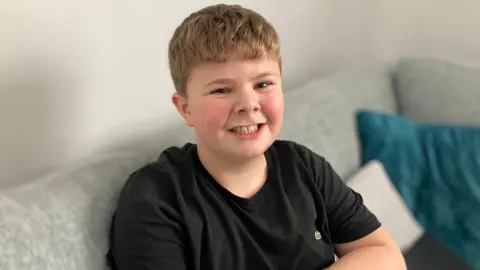
BBCThe parents of a boy with Tourette syndrome (TS) are campaigning to raise awareness of the condition, as people take offence over their son's involuntary swearing and vocal tics.
Nine-year-old Rocky, from Bristol, was diagnosed last year with coprolalia, a symptom of TS that causes uncontrollable swearing and socially inappropriate outbursts.
His parents, Sarah and Mike, said it leaves their son exhausted and anxious, and he now studies with a tutor at home as he is unable to manage his symptoms in school.
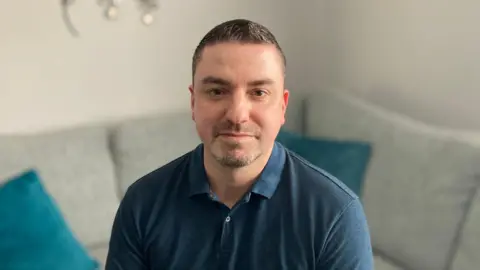
Mike said the family "get lots of stares" and "people make remarks" when they hear Rocky swearing, and they want to challenge the stigma that it is intentional.
Sarah stressed that these "offensive or taboo" outbursts are involuntary, and do not reflect the person's true beliefs, emotions or opinions.
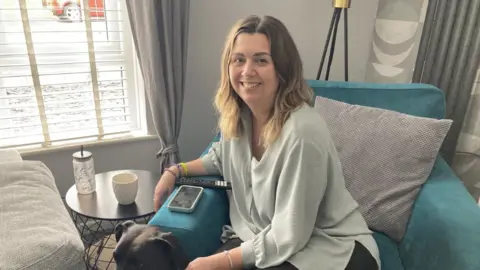
"When something is said or done on an uncontrollable impulse, this does not need to be apologised for," said the mother-of-three.
"I guarantee that the person who has said or done something that has caused offence is mortified.
"I want people to see what individuals like my son go through and to try and further educate."
Mike added: "I can understand their [people's] reaction because they just don't realise. It's very difficult."
Rocky first began developing symptoms such as facial twitching at the age of three, and by the time he was six, his symptoms became vocal.
"It just feels like an itch, but if you leave it, it builds up; that's normally what it feels like," Rocky described.
He said his swearing tics worsen when he feels tired or stressed, and can sometimes last for hours.
"People younger than you [at school] don't really understand, so they might just think you're being funny. So they laugh, and I've dealt with it multiple times," he said.
"But I'm stuck with it, and it will always be that way."
After being formally diagnosed by a paediatrician, Rocky was given an Education, Health and Care Plan (EHCP), which sets out tailored support for children with complex special educational needs (SEN).
He is currently out of mainstream education, but with the support of a local school, he takes regular lessons with a tutor at home.
A spokesperson for the Department for Education (DfE) said: "We are committed to supporting young people living with Tourette syndrome and other tic disorders, and recognise the importance of research to better understand and find new treatments for Tourette syndrome and other long-term conditions."
'Families trapped'
Amid a shortage of resources, the family are trying to set up a support group for those affected by the condition, supported by Tourettes Action.
Charity CEO Emma McNally said a decline in referrals from children's mental health services and paediatrics means "families find themselves trapped", struggling to fund the cost of private care.
"Children are frequently bounced around different services for months, often years, only to be told that no local provider is commissioned to help," she said.
"Until Tourette syndrome is given the same attention and clinical framework afforded to conditions like autism and ADHD, children will continue to face unacceptable delays."
According to the NHS, TS causes a person to make sudden and repetitive sounds or movements, known as tics.
It is typically diagnosed when symptoms have lasted for longer than a year. There is no cure, but treatment can help to manage the tics.
The charity Tourettes Action said more than 300,000 children and adults are living with the condition in the UK, and it is more common among boys.
Only about 10-30% of people with TS have coprolalia symptoms like Rocky.
Follow BBC Bristol on Facebook, X and Instagram. Send your story ideas to us on email or via WhatsApp on 0800 313 4630.
