Accused disposed of men's bodies but denies murder

 Devon and Cornwall Police
A man accusing of killing two men he met in a homeless shelter has told a court he found their bodies on his land on separate occasions and, while high on ketamine, agreed to dispose of one of them but had no memory of making a decision to dismember the other.
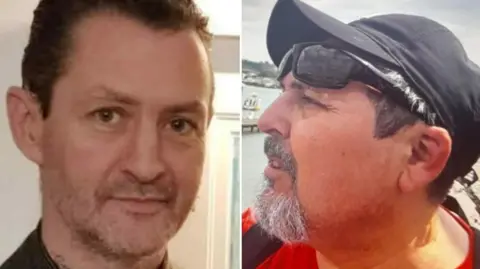
James Desborough, of Old Oak Woods, Lower Sticker, Cornwall, is accused of murdering Claudio Aquilino, 57, and Daniel Coleman, 43, between April and July last year.
Giving evidence at Winchester Crown Court, he told jurors he did not kill the men, who were both his friends, but had previously pleaded guilty to preventing the lawful burial of the men.
Desborough, 40, told jurors both men stayed on his land near St Austell while they were struggling mentally and died when he was not present, in what he described as "a series of unfortunate circumstances".
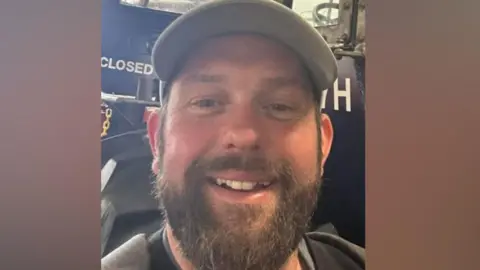
Desborough told jurors he got on with Aquilinio "very well" after they met while living at the Sandy Lodge shelter in Newquay and allowed him to stay on the land he owned at Paramoor Woods in Sticker after they were asked to leave.
"He was in bad shape," he said of Aquilino.
"He had burns on him [from an attack]. He was convinced that these people were trying to kill him... certainly paranoid. He did speak about suicide once or twice."
Desborough said he thought Aquilino had left his land but found his body one day.
"He was hanging from a tree from where the punch bag was," he said.
"I saw the wheelie bins first. They were behind him on the floor on their side."
The court previously heard there was a relationship "of some sort" between Desborough and Coleman's wife Hannah, which had caused the defendant's relationship with the other man to become fractious.
Desborough told jurors that, by mid-May, he was "absolutely not" sexually interested in Hannah Coleman, who he said was "bad news" and had assaulted Coleman.
Desborough said he allowed Coleman, who was in an "erratic and manic" state, to stay at the woods because of this.
He said Coleman was with him when he found Aquilino's body.
"I was high on ketamine at the time," Desborough said, adding he started to panic because he also had Class A drugs and cannabis saplings on the land.
He said it was Coleman who convinced him to use Aquilino's bank card and who said he would "get rid of him [Aquilino]".
Desborough told jurors his involvement in disposing of Aquilino's body included getting pallets and disposing of his ashes in a stream.
"I knew it was wrong," he said. "I started to get paranoid. I was upset."
Desborough said he found Coleman dead face down in the stream in mid-June.
"I can't actually remember making any decision about dismembering Dan," he said. "I accept that I did it but I did drink a lot of tequila.
"I was numb by that point."
Sean Brunton KC, defending, asked him if he killed Aquilino and Coleman.
Desborough said: "No, I did not."
Ahmed Hossain KC, prosecuting, asked if he knew it was wrong to dismember or burn bodies.
Desborough said: "Now that I'm sober and, looking back at it now, I know it is wrong."
He also asked about Desborough's conviction for murdering his prison cellmate.
Hossain said: "He irritated you by snoring, so you strangled him."
Desborough denied this, adding he did not get a thrill out of killing people.
"What happened in Exeter was out of character," he said.
Earlier, Home Office-registered pathologist Dr Amanda Jeffery told the court she carried out three post-mortem examination on Coleman's remains, which were found on different days.
She said: "In very simple terms, it has not been possible to determine Mr Coleman's cause of death and that is primarily due to the condition of his body at the time he was discovered.
"He has been dismembered in five areas: through the neck, through the shoulders and then through each leg."
'Foul play by another'
Brunton asked if part of Coleman's liver was present and showed damage consistent with his clinical diagnosis of cirrhosis and alcoholic liver disease.
Jeffery said it did and agreed sudden deaths could occur in a background of people with alcoholism.
Brunton suggested other scenarios which could have caused his death including: "foul play by another", medical causes "due to his very poor state of health", drowning, and strangulation, which Jeffrey said she could not rule out.
Brunton said: "It's not possible to exclude a natural collapse and death with subsequent dismemberment of the body."
Jeffery agreed.
The trial continues.
Follow BBC Cornwall on X, Facebook and Instagram. Send your story ideas to spotlight@bbc.co.uk.
