'You can't describe the loss' - the reality of bovine TB on farmers

 BBC
BBCThe effects bovine TB (bTB) has on farmers ranges from emotional to financial.
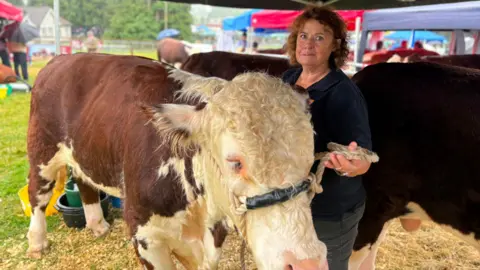
Breeder Rachel Leader said the loss of cattle "has a devastating effect on all of the family".
"The loss of that one animal, or animals, that you've grown up with, and suddenly there's nothing after these years of generation... it's just mind boggling, and you can't describe the loss when you do lose your cattle."
But what can be done to tackle bTB?
A 12-week consultation, launched in early July by Northern Ireland's agriculture, environment and rural affairs minister, is asking for views on wildlife interventions and explores options such as culling badgers or testing and vaccinating or removing them.
The cost of dealing with the disease is expected to exceed £70m this year, the bulk of it in compensation to farmers.
While the rate of bTB has fallen lately, it is still close to 10% of the national herd.
The consultation is part of the Blueprint for Bovine TB Eradication launched last year.
The Chief Veterinary Officer Brian Dooher said the disease was a "complex problem", requiring a "comprehensive and evidence-based approach".
Rachel Leader said she plans to respond to the consultation.
"They blame badgers, but there are other elements that I'm sure will cause and contribute. I don't think there's enough traceability."
Speaking at the Clogher Valley Show in County Tyrone, Leader said she had one heifer "that was taken away 18 months ago".
She said after going through tests for bTB her heifer "was actually clear".
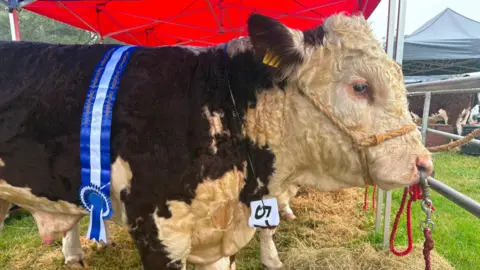
"It's the impact of losing pedigree Herefords, the family line, the genetic breeding that we've had to build up. She would have been one of our show animals for Balmoral, so we were devastated at that loss.
"We do have a replacement heifer of hers. But very often, when you've had generations of breeding cattle, breeding the family lines... to lose those and then try and start again. It just doesn't work."
'Significant' animal health challenge
Wildlife intervention involves actions to tackle the maintenance and spread of bTB in badgers, which are implicated in the spread of the disease.
A previous order by former minister Edwin Poots for a cull of badgers was quashed by the High Court.
The current agriculture, environment and rural affairs minister Andrew Muir ordered a review of the department's bTB strategy which was delivered in 2024.
A steering group was then formed and published a blueprint for eradication last year.
Muir said bTB continued to have "a devastating impact" on farmers, their families and rural communities.
"It also places unsustainable costs on both industry and government.
"The Blueprint to eradicate bTB sets out three key pillars on which action is required to tackle this problem; Cattle, People and Wildlife.
"I recognise that a wildlife intervention is a complex and sensitive issue, and one on which there are strongly held and differing views."
He added that there was "no preferred option" in the consultation.
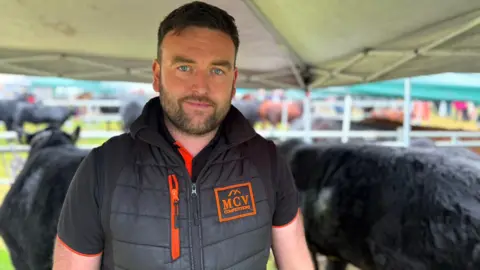
Farmer Conor McVeigh believes the skin test for bTB "is completely out of date".
"It needs updated, the skin test isn't enough. I know they have introduced a blood test. It's not mandatory at the moment. There's a few different mixed opinions on it as well. I think something needs to be done in regards to testing before they can try and eliminate TB.
"I've strong opinions about TB. I would like to see it completely eliminated."
He said the emotional impact of losing cattle to bTB is like losing "part of the family".
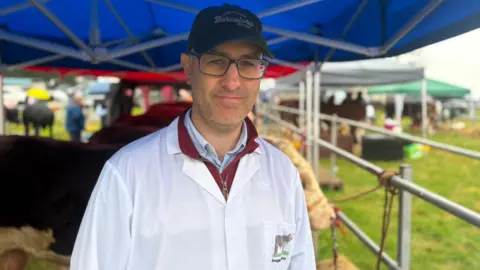
Pedigree breeder Mark Moore said testing for bTB is "a nervous time".
"It's the time of the year for a farmer because all of your outputs depends on the results of them, the TB tests."
He had an outbreak five years ago that left him closed for three months.
"You're losing bloodlines as well. So it's all got an impact. It has to be thought about."
Moore added that anything to help control bTB would "definitely be welcome".
"You can definitely see badger activity and we know that they are carriers, badger numbers should be monitored and see how that the effects of that in the spread."
What are the options?
The consultation outlines three options:
- Non-selective culling - controlled shooting of free-roaming badgers, controlled shooting of cage-trapped badgers and controlled shooting of stopped restraint (snare) captured badgers, by trained marksmen.
- A Test and Vaccinate or Remove (TVR) approach - a selective cull in which badgers are trapped and tested. Healthy badgers are vaccinated, micro-chipped and released. Those that test positive are humanely euthanised by lethal injection.
- Vaccination only - badgers in a defined area will be vaccinated without prior testing.
Culling has previously been used in England and the Republic of Ireland as a control mechanism.
It has effectively ended in England, as the government moves towards a vaccination strategy.
The Republic of Ireland is currently considering other measures to prevent the spread of the disease.
Need to reduce costs
A programme of compulsory testing of cattle in Northern Ireland for TB began in the 1950s.
But the cost of it has consistently increased, mostly due to the rising value of the animals that have to be removed if they test positive.
Compensation is paid to farmers on a full market value basis.
The consultation says the latest cost is expected to exceed £70m, with the compensation bill making up more than three-quarters (£54m) of that.
Daera has consulted on reducing that compensation.
Farmers said they were prepared to go to court over the proposal.
The emotional cost and the long-term impact on the farm business are much harder to measure.
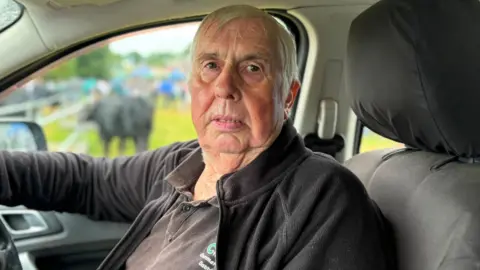
Robert Miller has been impacted within the last year by bTB.
It was the first time in his 35 years farming that it had affected him.
"I had cows and calves that I wanted to sell and trade was very good at that time," he told BBC News NI.
"I was grounded with them and had to keep them. Four months, got my second clear test and just got the same priced animals that I would have got four months earlier.
"I have some very expensive cows in my herd and if one of those went down, where would be at?" he added.
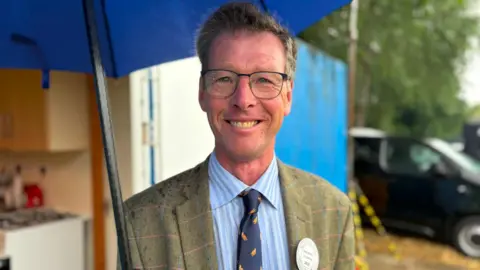
It is not just farms that are impacted by bTB, agricultural shows can also feel the effects of it.
Nicholas Lowry is president and chairman of the Clogher Valley Show, he said: "People could well qualify for championships and what have you all of a sudden, they can't get here, because they're shut down.
"If they can't get here because of TB, they're disappointed."
The consultation runs until 25 September.
