Why were turkeys taken on a 3-month walk to London for Christmas?

 Getty Images
When the gobbling sounds of turkeys filled the air on the Suffolk/Essex border, residents would have been forgiven for thinking there was a flock nearby.
However, it was actually a small group of people dressed up as turkeys to mark the long-lost practice of taking turkeys on a three-month walk to London for Christmas, and 500 years since the birds were introduced to the UK.
It is many years since 90,000 turkeys crossed the bridge at Dedham. But the group took a short walk across the border near the village on Wednesday to mark the anniversary after avian flu prevented real birds being used for the occasion.
But what exactly is turkey droving, what is the history behind it and why did it take three months?
 Luke Deal/BBC
How did they first arrive in the UK?
Turkeys are native to America, but are believed to have found their way to England 500 years ago, thanks to a man called William Strickland who lived in East Yorkshire.
In 1526, he acquired six turkeys during a visit to America, and brought them back to Bristol to sell.
According to Paul Kelly, the managing director and co-owner of Kellybronze Turkeys based in Danbury, Essex, Strickland made a success of the business but it was King Henry VIII who "put turkey on the map".
"He cooked a turkey at Hampton Court and it replaced the peacock in the royal courts," he explained.
Kelly said Charles Dickens' tale 'A Christmas Carol' had boosted the bird's popularity for festive meals. But even before this, East Anglian farmers had been transporting them to London for hundreds of years.
 Attleborough Heritage Group
Why did it take three months?
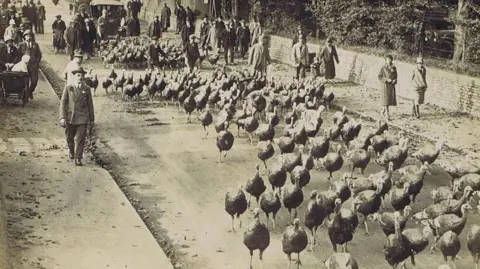
Known as turkey droving, farmers would rear their birds throughout the year before they undertook a three-month walk with them to ensure they arrived in time for the London markets at Christmas.
The flocks would travel through Norfolk, Suffolk and Essex and along a route that is now the A12.
Near Dedham, the turkeys would cross over the bridge on The Street.
"This was a huge traditional bridge for the turkey crossing from Suffolk to Essex on their journey to London to the Smithfield Market to be sold at Christmas," Kelly continued.
"There's records of over 90,000 turkeys crossing this bridge.
"They walked them slowly and there were feeding stations along the way down the A12 because if they walked them too fast, they'd lose weight and they wouldn't get paid as much at Christmas."
Why did it stop?
 Getty Images
Kelly said the people droving the birds were "incredibly skilled, talented people", but when trains came along in the late 1800s, the profession died out and many people emigrated to Australia to find similar work.
"Then of course refrigeration came along in the 1930s, and a lot of turkeys were plucked on the farm, refrigerated and moved in trucks into the London market," he added.
Kelly had planned to walk a small group of turkeys over the bridge near Dedham to mark the anniversary.
"I'd had a flock of turkeys in training on roadways for the past three months now," he said.
"Then of course avian influenza comes along and we had a housing order just last week.
"It was really frustrating, I was really looking forward to getting a flock out."
Instead a group of 10 people dressed as turkeys to mark the occasion.
Do you have a story suggestion for Suffolk? Contact us below.
Follow Suffolk news on BBC Sounds, Facebook, Instagram and X.
